
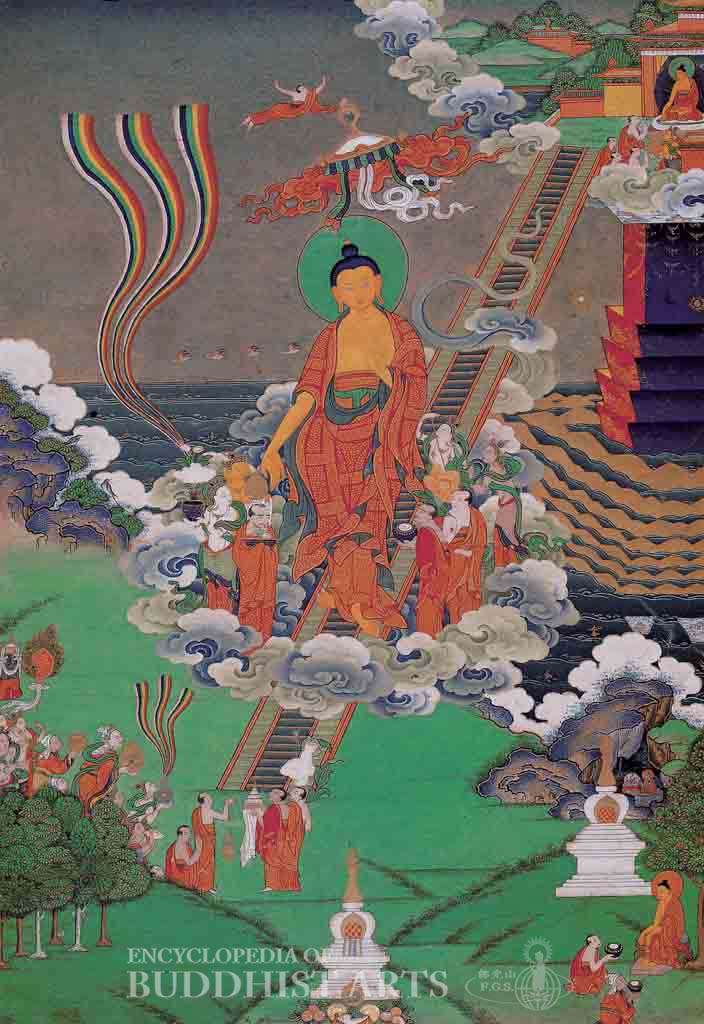
Life of the Buddha - Return from Trayastrimsa Heaven
Ink and color on cotton
Life of the Buddha - Return from Trayastrimsa Heaven
CHINA
This 19th century thangka showing Sakyamuni Buddha returning from Trayastrimsa Heaven was once kept in Katok Monastery. It is one in a series of 12 thangkas depicting scenes from the Life of the Buddha. The painting is mounted scroll-style on decorative Chinese brocade with wooden rollers at the top and bottom. The scroll measures 100.3 cm in height and 59.7 cm in width. The Buddha went to Trayastrimsa Heaven to teach the Dharma to his mother, Queen Maya. Three months later, escorted by heavenly beings, he descended back to earth on a triple staircase made of gold, silver, and crystal.
Towering above the other figures, the Buddha is shown in the center of the thangka walking down the stairway. He has a tall usnisa, an urna between his eyebrows, and long ears. His red monastic robe is decorated with golden patterns. A Four-Headed Brahma, Sakra, two heavenly beings, and three monks stand on clouds surrounding the Buddha. A tilted canopy is painted above the Buddha’s head, and a monk is shown flying through the air above it. To the left of the Buddha, a heavenly being holds a vase which emanates a curving rainbow of colorful light. In the background, four birds in a single line fly towards the light.
Mount Sumeru is shown on the right in the middle register, rising from a cosmic ocean or lake. Surrounded by clouds, Trayastrimsa Heaven sits atop Mount Sumeru. In the palace, the Buddha is seated in full lotus position, forming the bhumisparsa (earth-touching) mudra. The four monks below him join their palms in reverence. Beside them is the Buddha’s mother who is in the form of a heavenly being holding a Dharma wheel.
At the bottom of the stairs, a group of monks and disciples wait for the Buddha to descend. They hold offerings including a conch shell and a Dharma wheel. In the lower right corner, the Buddha is portrayed accepting offerings beside a white stupa; while in the background, a small figure sits beneath a blue cliff. Another stupa is shown in the center of the bottom register. Vivid colors and intricate details make this an exquisite artwork.
For more details, go to the Encyclopedia of Buddhist Arts: Painting I-O, page 484.
Cite this article:
author = Hsingyun and Youheng and Youlu and Wilson, Graham and Manho and Mankuang and Huntington, Susan,
booktitle = {Encyclopedia of Buddhist Arts: Painting I-O},
pages = 484,
title = {{Life of the Buddha - Return from Trayastrimsa Heaven}},
volume = 15,
year = {2016}}