
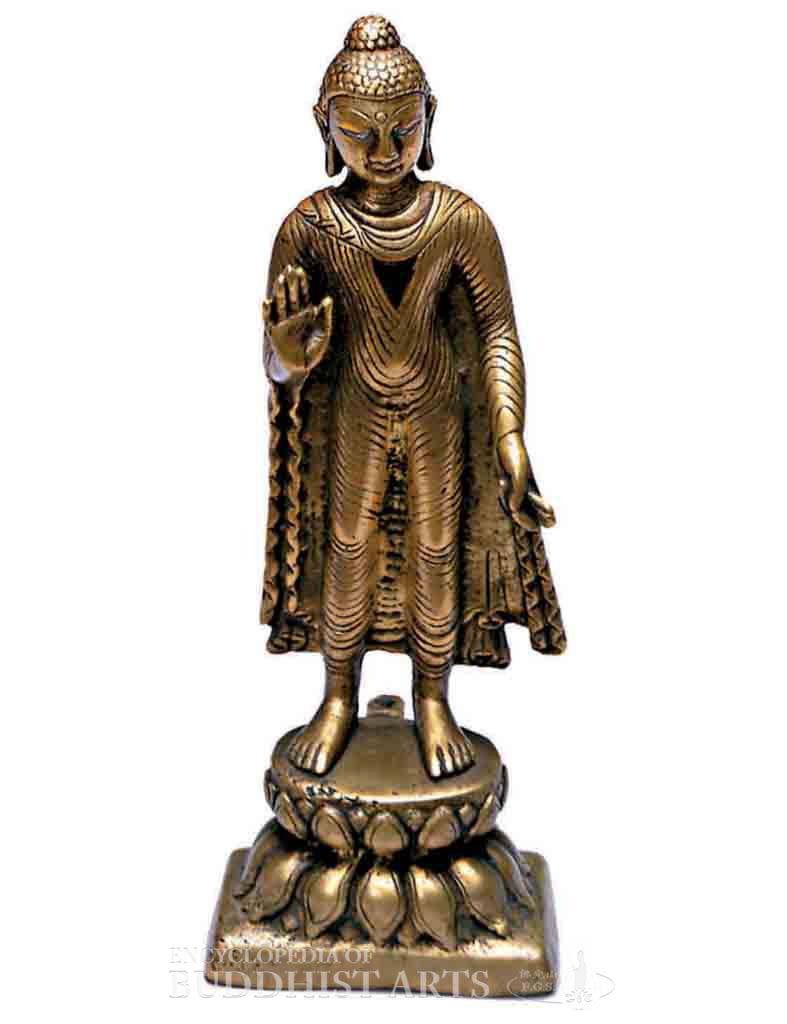
Standing Buddha
Brass inlaid with silver
Standing Buddha
INDIA
Kashmir succeeded Gandhara as a center of both Buddhism and metal casting during the 8th century. The influences on this Buddha come from both Gandhara and Gupta period (circa 320–550), although Kashmir contributed certain features.
The Buddha stands on a deep, double lotus pedestal that is on a square platform. He wears a tight fitting monastic robe that covers both shoulders. The robe folds fall in a pattern of regular waves that adapt to the shape of the limbs beneath. The Buddha’s right hand is in abhaya (fearlessness) mudra, while his left hand secures the fold of the material about that arm. The fall of the robe over the arms forms rippling folds that emphasize the way the material flares away from the body, as if in movement. This impression is strengthened by the way the head and body incline forwards.
For more details, go to the Encyclopedia of Buddhist Arts: Sculpture St-Z, page 1139.
Cite this article:
author = Hsingyun and Youheng and Lovelock, Yann and Chou, Yuan and Huntington, Susan and Edson, Gary and Neather, Robert,
booktitle = {Encyclopedia of Buddhist Arts: Sculpture St-Z},
pages = 1139,
title = {{Standing Buddha}},
volume = 13,
year = {2016}}