
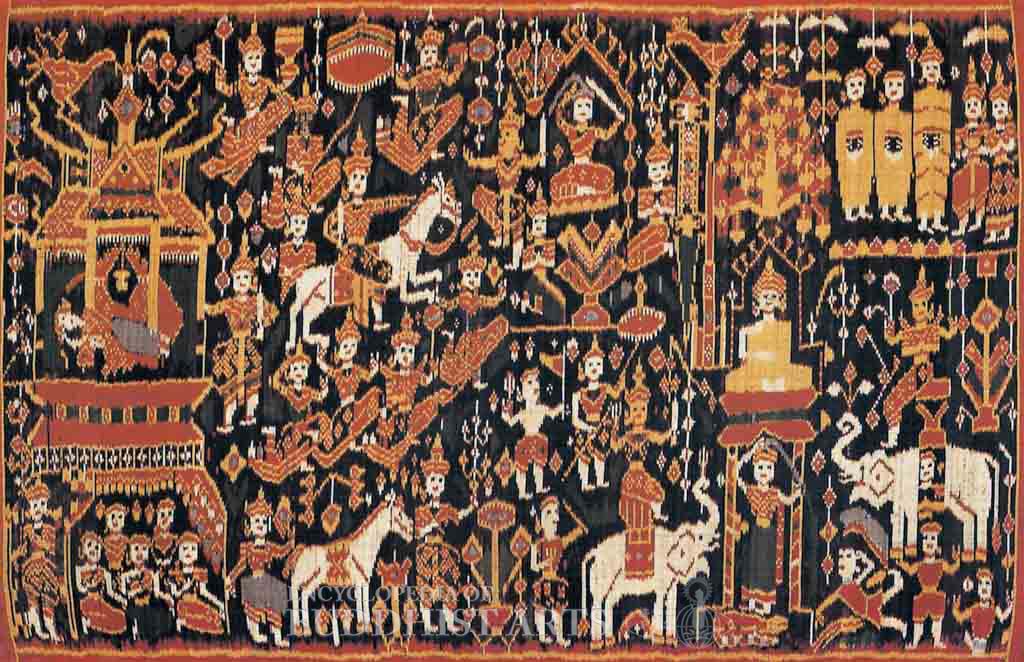
Ta Kream: Wall Hanging with the Life of the Buddha
Silk
Ta Kream: Wall Hanging with the Life of the Buddha
CAMBODIA, Battambang, Ta Kream
This ikat silk wall hanging depicts the Life of the Buddha. It is in the form of a complex, yet compact graphic narrative. The figures of humans and animals are primarily colored in red, yellow, black, and white. The fine patterns on the clothing, palace, and canopy indicate a high attention to detail and superlative weaving skills.
The events in Prince Siddhartha’s life include the great departure, the quest for enlightenment, the defeat of Mara, the attainment of enlightenment, and the teaching of the Dharma. The narrative is non-sequential and begins when Prince Siddhartha decides to renounce his life of luxury after experiencing the suffering and impermanence of life. He is shown leaving his sleeping wife and child, and mounting his horse. His departure is blessed by the Four Heavenly Kings.
In the center of the upper register, Prince Siddhartha cuts off his hair and begins his life as an ascetic. In the lower register on the right, the prince is depicted clad in yellow beneath the Bodhi tree. He is assailed by Mara’s army on white elephants. At the moment of enlightenment, he forms the bhumisparsa (earth-touching) mudra, and Prthivi, the Earth Goddess rises up. The prince has now become the Buddha. In the upper register on the right, Shakayamuni Buddha is accompanied by his two disciples as he teaches his father and aunt.
For more details, go to the Encyclopedia of Buddhist Arts: Artifacts, page 327.
Cite this article:
author = Hsingyun and Youheng and Youji and Pokorski, Stefanie and Mankuang and Fan, Wen,
booktitle = {Encyclopedia of Buddhist Arts: Artifacts },
pages = 327,
title = {{Ta Kream: Wall Hanging with the Life of the Buddha}},
volume = 18,
year = {2016}}