
Bihar: Life of the Buddha
Stone
Bihar: Life of the Buddha
INDIA, Bihar
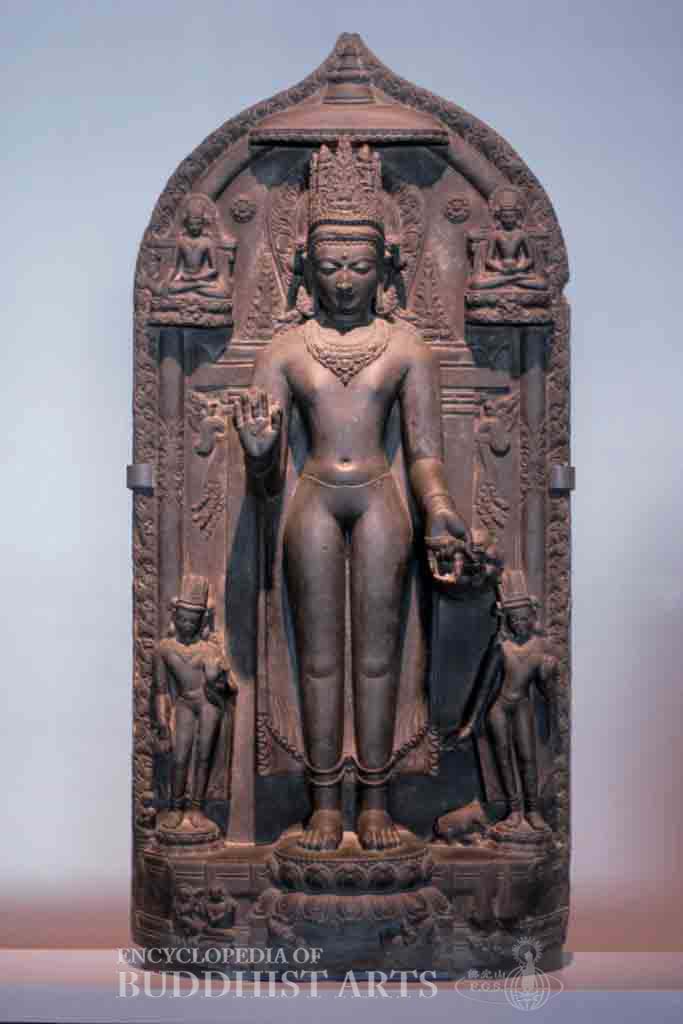
This sculpture created around the second half of the 11th century was discovered in Bihar. The features of the Buddha’s face have been highlighted with incised lines, reflecting the artistic style of the time.
The Buddha wears a tall headdress and has a prominent urna. A heavy necklace decorates the otherwise bare, upper body. The diaphanous robe is discernible only by the lines around the waist and shins. While the left hand holds a corner of the robe, the Buddha’s right hand has a Dharma wheel in the center of the palm and forms the abhaya (fearlessness) mudra. There is a canopy above the Buddha with a stupa on top.
A seated Buddha is located on either side of the Buddha’s head, while a standing Buddha in tribhanga posture stands on either side of his legs. The Buddhas signify four events in the Buddha’s life. In the lower left corner the figure represents the Buddha descending from Trayastrimsa Heaven, while the one on the right shows him taming a drunken elephant; a small image of an elephant lies at his feet. The seated Buddha on the right holds a bowl, which refers to the incident where a monkey offers honey to the Buddha, and the image of a monkey can be found on his throne. On the left, the Buddha forms the bhumisparsa (earth-touching) mudra, which refers to the Buddha’s victory over Mara and attaining enlightenment. Prthivi, the Earth Goddess, who was called to witness this event, is depicted at the front of the throne. There are two kneeling female figures at the bottom of the sculpture, one making the anjali (reverence) mudra and the other making an offering. They are probably the donors of this work of art.
For more details, go to the Encyclopedia of Buddhist Arts: Sculpture A-F, page 148.
Cite this article:
author = Hsingyun and Youheng and Lovelock, Yann and Chou, Yuan and Huntington, Susan and Edson, Gary and Neather, Robert,
booktitle = {Encyclopedia of Buddhist Arts: Sculpture A-F},
pages = 148,
title = {{Bihar: Life of the Buddha}},
volume = 10,
year = {2016}}