
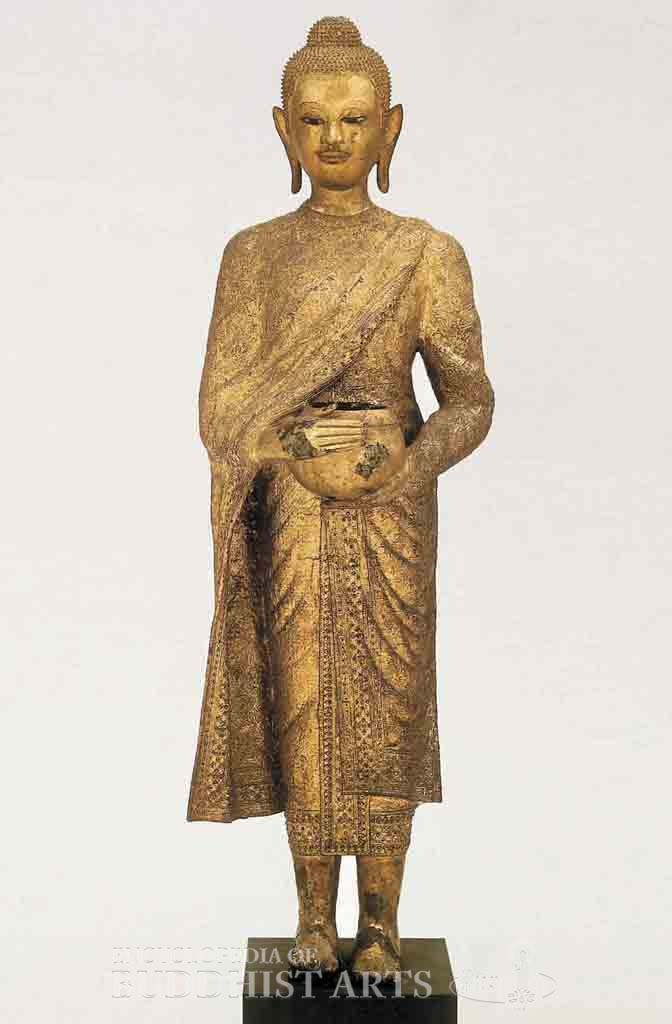
Nakhon Sri Thammarat: Sakyamuni Buddha
Bronze
Nakhon Sri Thammarat: Sakyamuni Buddha
THAILAND, Nakhon Sri Thammarat
During the reign of King Rama III (reigned 1824–1851), officials compiled a list of 40 postures suitable for Buddha sculptures, each related to some incident in his life. According to that list, the standing Buddha with an alms bowl represents his return to Kapilavastu and going to collect alms in the city where he was raised. This signified abandonment of his past royal identity and identification with the longer line of the Buddhas of the past.
The Buddha holds an alms bowl in his left hand while the right supports it at the top. The monastic robe covers both shoulders, as prescribed for wear outside the monastery, with its right hem flaring outward from the movement of the arm. The robe is decorated with numerous miniature Buddhas on the outside and intricate designs on the inside.
For more details, go to the Encyclopedia of Buddhist Arts: Sculpture N-Sr, page 748.
Cite this article:
author = Hsingyun and Youheng and Lovelock, Yann and Chou, Yuan and Huntington, Susan and Edson, Gary and Neather, Robert,
booktitle = {Encyclopedia of Buddhist Arts: Sculpture N-Sr},
pages = 748,
title = {{Nakhon Sri Thammarat: Sakyamuni Buddha}},
volume = 12,
year = {2016}}