
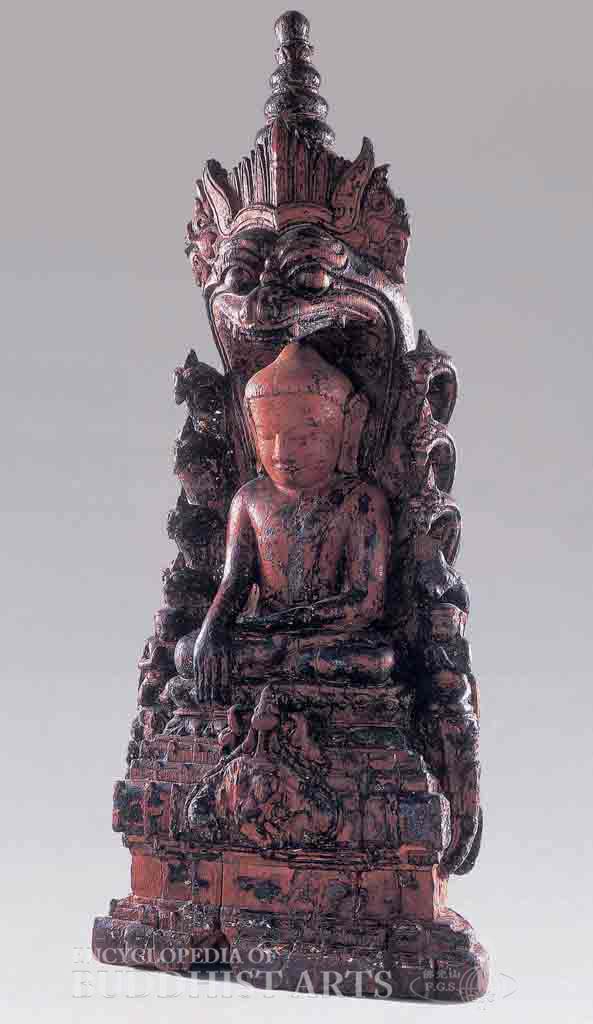
Bagan: Buddha Protected by Mucalinda
Wood with lacquer and gold leaf
Bagan: Buddha Protected by Mucalinda
MYANMAR, Mandalay, Bagan
This sculpture depicts the Naga King, Mucalinda, protecting the Buddha, who had just attained enlightenment. The Buddha is seated in full lotus position upon a square lotus throne on a multi-tier base. He makes the bhumisparsa (earth-touching) mudra with the right hand. The figure’s head is disproportionately large, has a short neck, flat usnisa, and smooth hair, which are all features seen in the late Bagan Empire (circa 849–1287). Mucalinda, the nine-headed, crowned naga is positioned behind the Buddha, providing protection. Eight of the naga heads are small and located evenly on either side, forming the mandorla.
The two merchants, Tapussa and Bhallika, kneel on either side of the lotus throne with their palms joined in reverence. These were the first people to make offerings to the Buddha after his enlightenment, and were the first lay people to take refuge. The simplicity of the Buddha image is in stark contrast with the exquisitely carved Naga King.
For more details, go to the Encyclopedia of Buddhist Arts: Sculpture A-F, page 108.
Cite this article:
author = Hsingyun and Youheng and Lovelock, Yann and Chou, Yuan and Huntington, Susan and Edson, Gary and Neather, Robert,
booktitle = {Encyclopedia of Buddhist Arts: Sculpture A-F},
pages = 108,
title = {{Bagan: Buddha Protected by Mucalinda}},
volume = 10,
year = {2016}}