
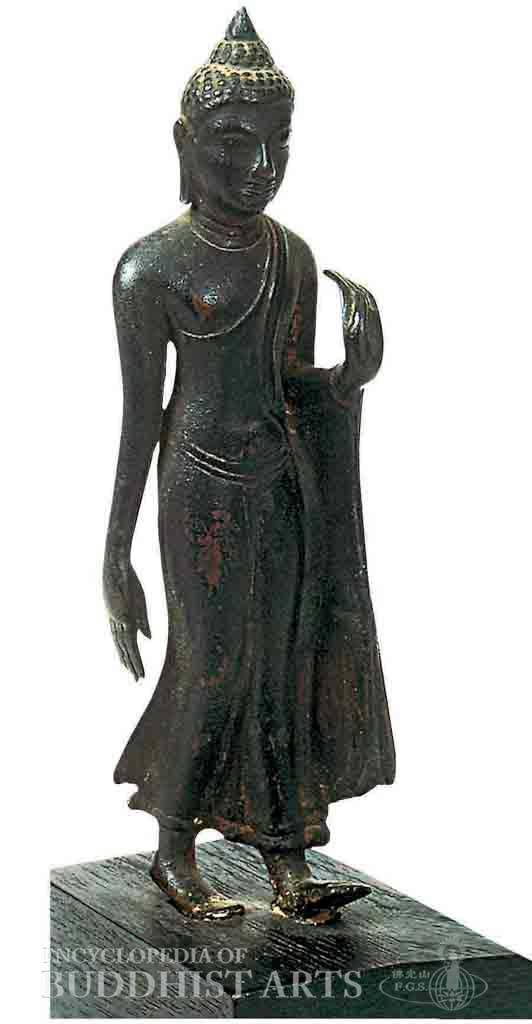
Nakhon Sri Thammarat: Walking Buddha
Bronze
Nakhon Sri Thammarat: Walking Buddha
THAILAND, Nakhon Sri Thammarat
The Buddha is said to have practiced walking meditation during the third week after his enlightenment. It is popularly supposed that this particular type of portrayal of the Buddha, which was developed in the Thai area during the 14th century, depicts that incident.
The heel of the left foot of this figure is pressed down while the sole is lifted as if the figure is taking a step. The head on the neck, with its three lines, is held slightly forward and wears a large crest jewel on the usnisa. The monastic robe leaves the right shoulder bare and the body’s movement can clearly be seen through it. The flexible fingers of the left hand bend back as they form the abhaya (fearlessness) mudra. The long right arm, at knee length, symbolizes one of the Buddha’s Thirty-Two Marks of Excellence.
For more details, go to the Encyclopedia of Buddhist Arts: Sculpture N-Sr, page 749.
Cite this article:
author = Hsingyun and Youheng and Lovelock, Yann and Chou, Yuan and Huntington, Susan and Edson, Gary and Neather, Robert,
booktitle = {Encyclopedia of Buddhist Arts: Sculpture N-Sr},
pages = 749,
title = {{Nakhon Sri Thammarat: Walking Buddha}},
volume = 12,
year = {2016}}