
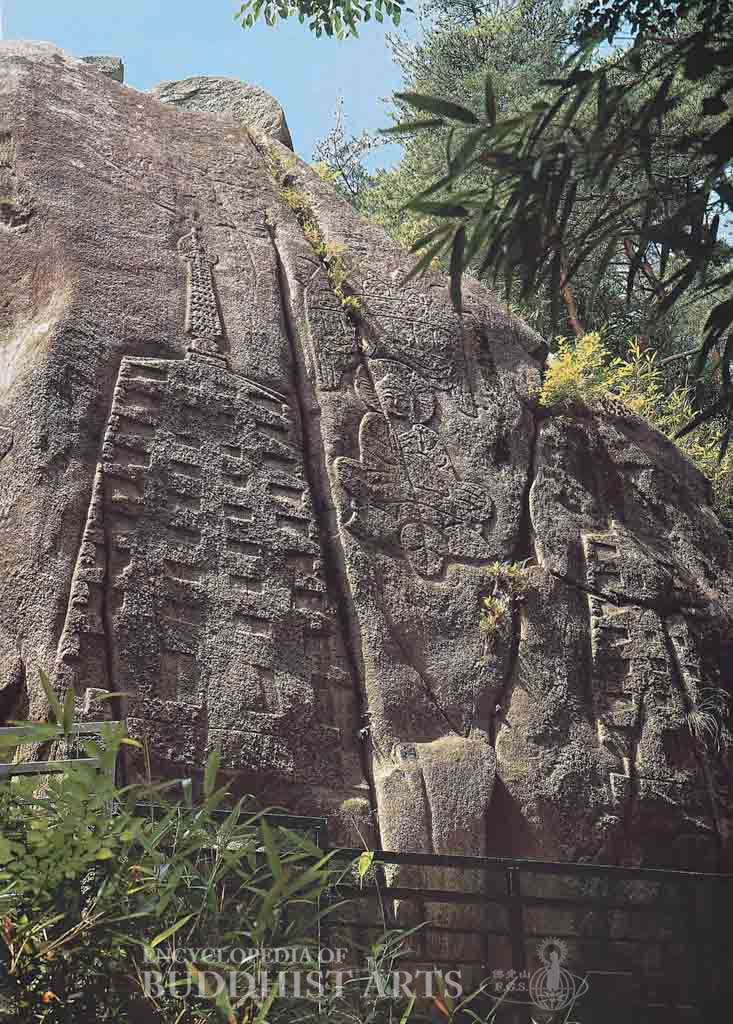
Namsan Tapgol Valley Rock Carvings: Buddha and Two Pagodas (north side)
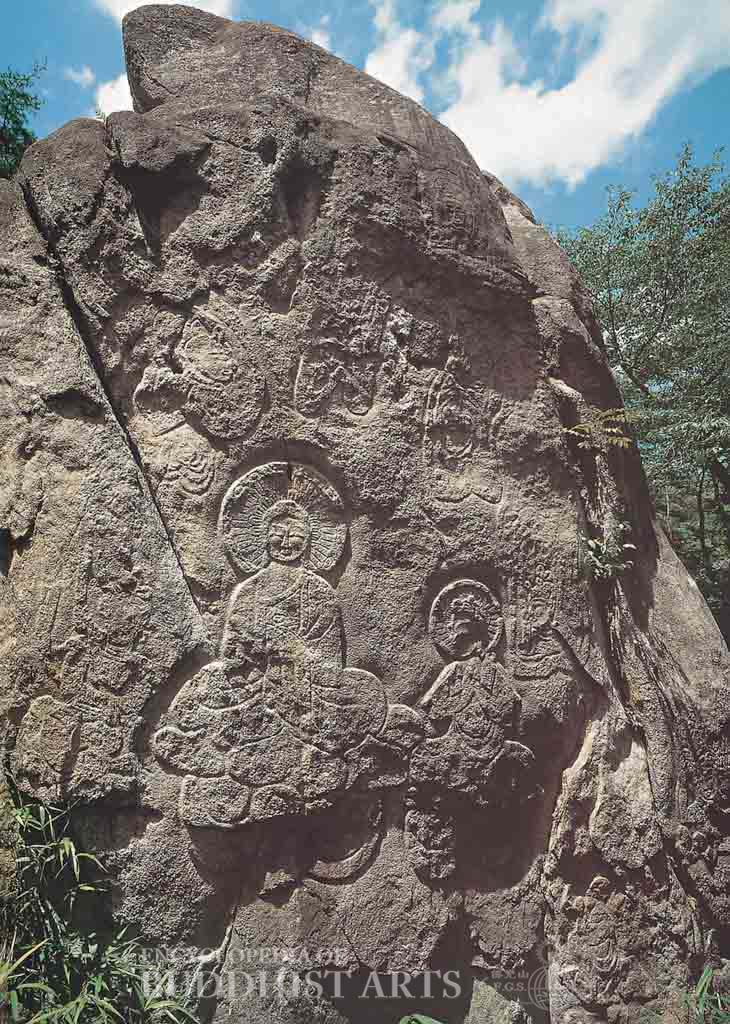
Namsan Tapgol Valley Rock Carvings: Figures (east side)
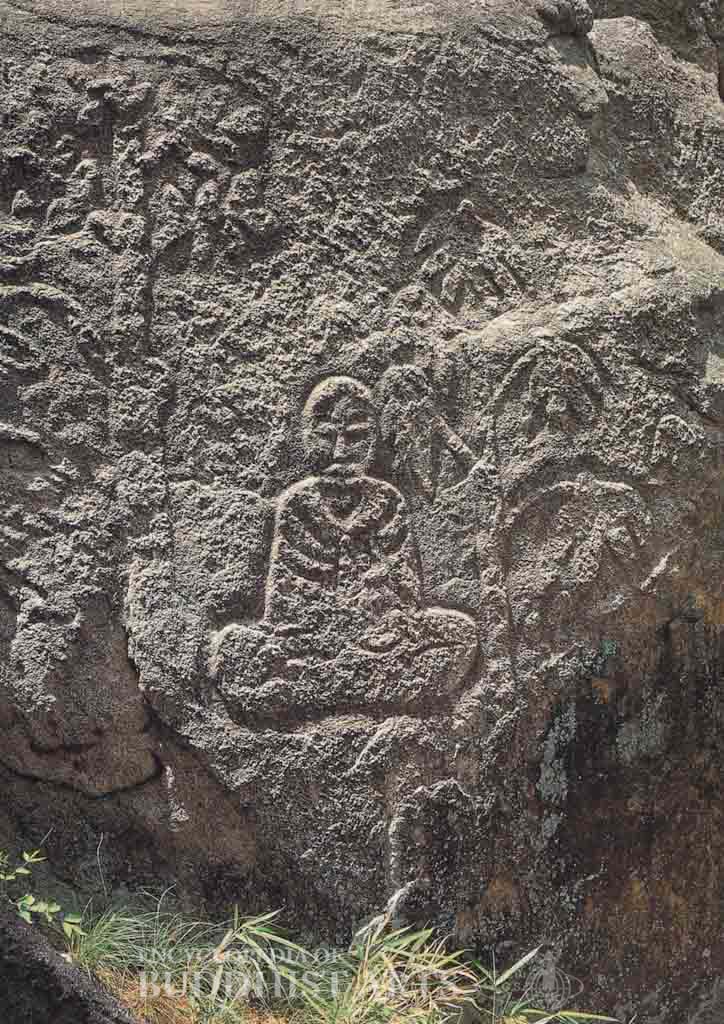
Namsan Tapgol Valley Rock Carvings: Meditating Monk (east side)
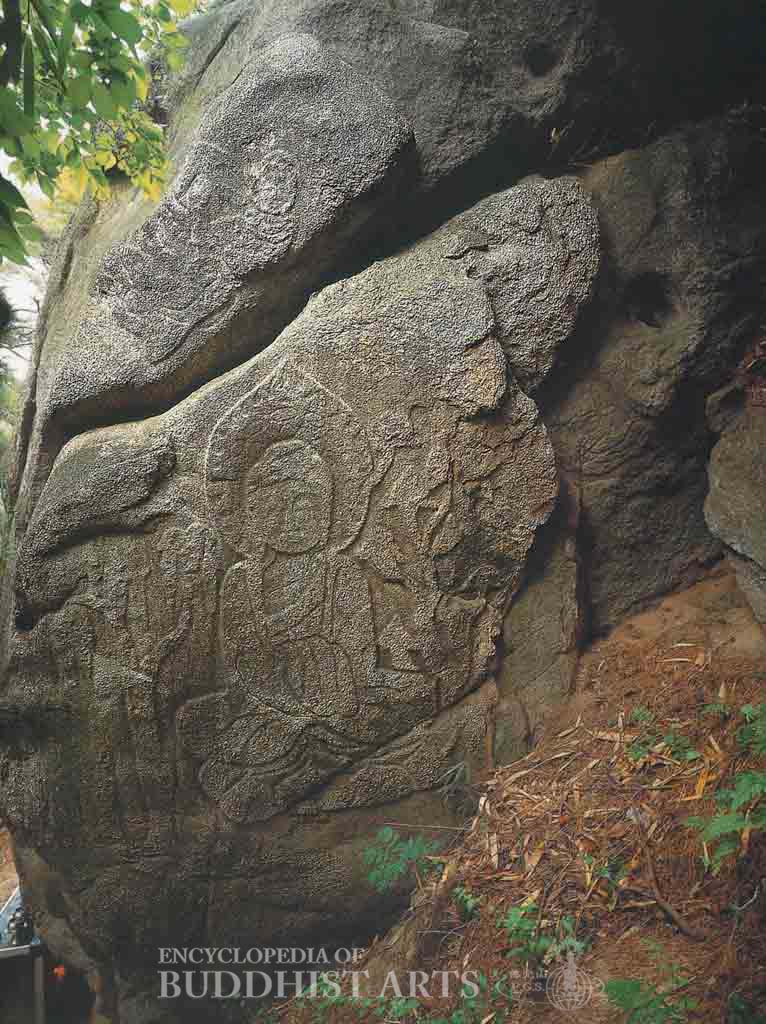
Namsan Tapgol Valley Rock Carvings: Seated Buddha (west side)
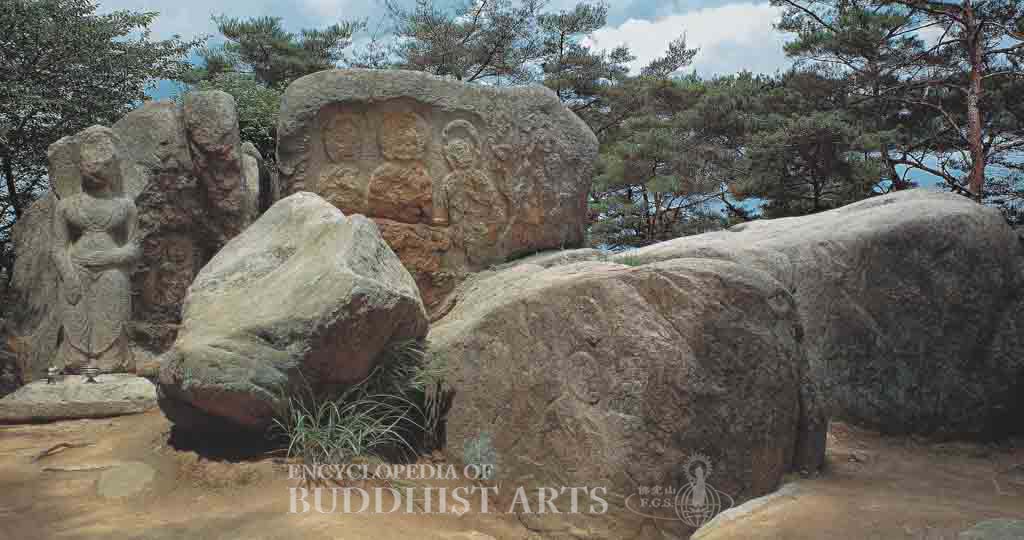
Namsan Tapgol Valley Rock Carvings: Figures (south side)
Namsan Tapgol Valley Rock Carvings
SOUTH KOREA, North Gyeongsang, Gyeongju
These reliefs are carved on a large rock located in Namsan Tapgol Valley, and date to the Unified Silla dynasty (668–935). They were listed as Treasure No. 201 in 1963.
The large rock, known locally as the Great Rock of the Buddha, measures 9 m in height and 26 m in length. Two pagodas are carved on the north side of the rock. The smaller one has seven tiers and the larger one has nine. The eaves at each tier of both pagodas are decorated with wind chimes, and apsaras flying above the spires. A seated Buddha with a canopy overhead is found between the pagodas.
The east side of the rock features a Buddha, Bodhisattva, donor, and monk. The Buddha sits in full lotus position on a lotus throne, with a round nimbus that has radiating lines. There are apsaras flying above him. A Bodhisattva sits facing the Buddha on the right with hands joined in the anjali (reverence) mudra. A donor on one knee, holding up offerings with both hands, is depicted below. A monk sitting in meditation beneath a tree is found on the left of the Buddha.
On the west side, a Buddha is seated underneath some trees with apsaras flying above. The Buddha’s hands are hidden within the sleeves of a monastic robe.
On the south side, a Buddha is flanked by two Bodhisattvas. The Bodhisattva on the right has palms joined in the anjali (reverence) mudra. Another Buddha stands to the far left, and on the far right is an Arhat.
For more details, go to the Encyclopedia of Buddhist Arts: Caves Mo-S, page 1257.
Cite this article:
author = Hsingyun and Youheng and Johnson, Peter and Mankuang and Huntington, Susan and Edson, Gary and Neather, Robert,
booktitle = {Encyclopedia of Buddhist Arts: Caves Mo-S},
pages = 1257,
title = {{Namsan Tapgol Valley Rock Carvings}},
volume = 8,
year = {2016}}