
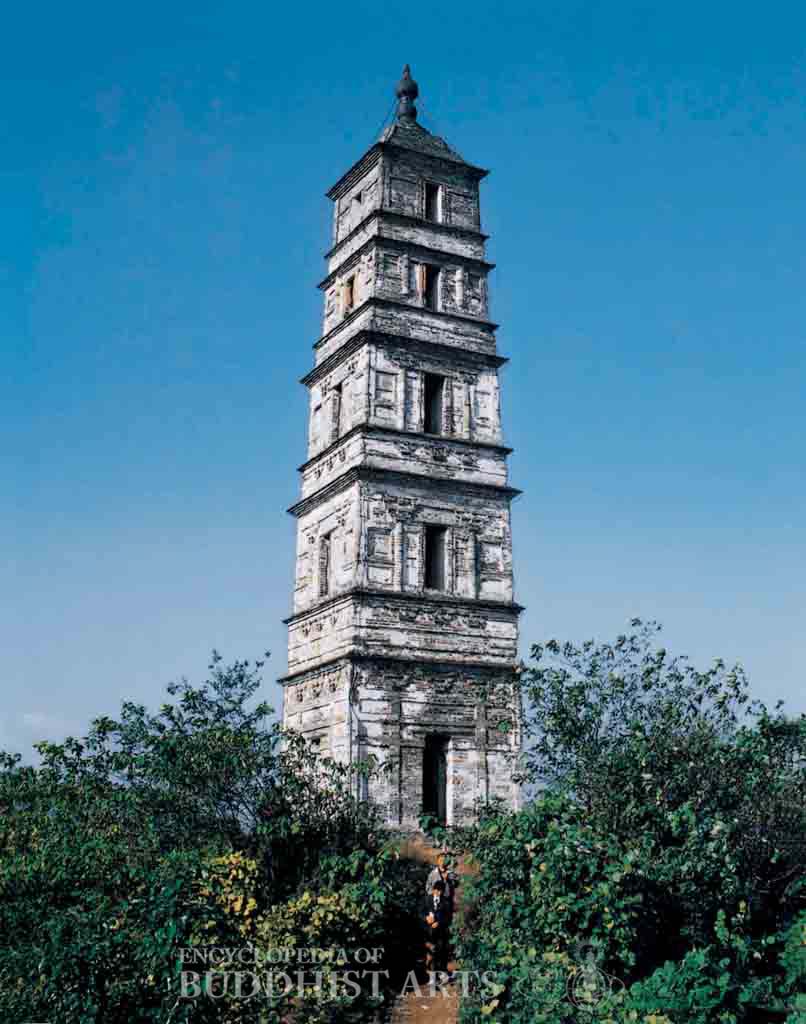
Gongchen Pagoda
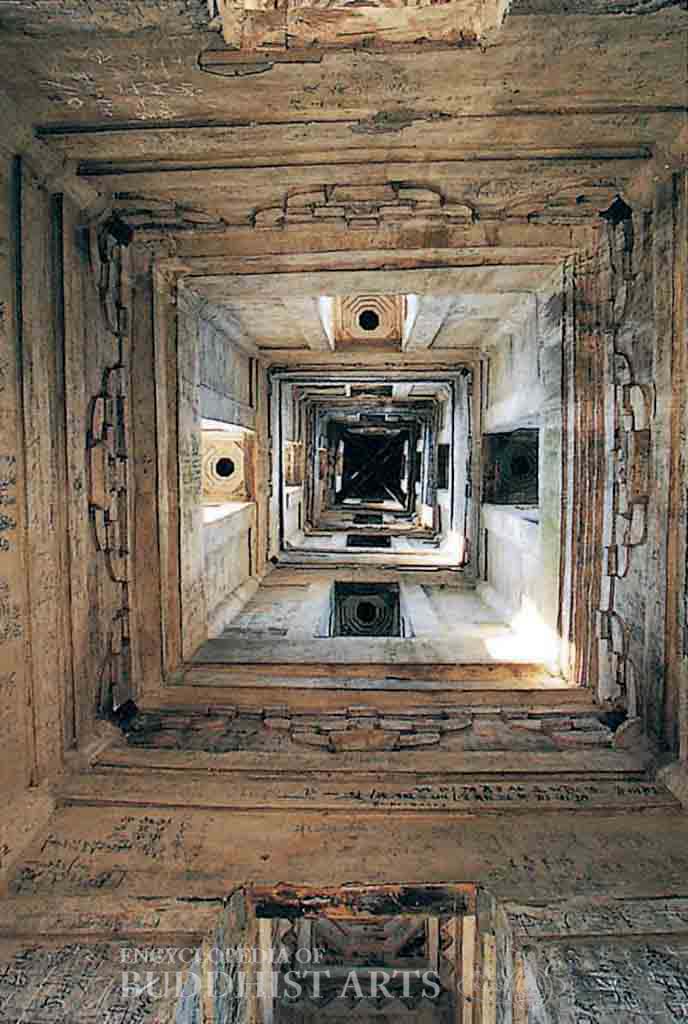
Gongchen Pagoda (interior)
Gongchen Pagoda
CHINA, Zhejiang, Hangzhou
The pagoda is located on top of Gongchenshan (Outstanding Minister Mountain). It was built in 915 during the Later Liang dynasty. It has been repaired a number of times and was last renovated in 1982. It was listed as a National Cultural Heritage Site in 2001.
The five-story, square, brick pagoda is 23.5 m high. It stands on a base that is 0.4 m high, with each side measuring 5 m. The base is built on a rock and its underground palace was constructed by chiseling into the rock beneath. On every story and every side of the pagoda, architectural elements such as architraves and pilasters are visible. The eaves are quite narrow and consist of brick corbeling. They are supported by bracket sets. There is a doorway at the center of every side on every story. On the first four stories, there is a shallow niche on either side of the doorway. The spire is made of iron and consists of an inverted bowl and jewels.
Inside the pagoda, there is an octagonal caisson ceiling. The wooden floors have rotted away and have not been replaced, so that the pagoda is completely hollow. When it was renovated in 1982, evidence was found of wooden joints and burnt timber, which suggests that the pagoda once had a wooden structure. This pagoda displays the typical square-shape style of the Tang dynasty (618–907).
For more details, go to the Encyclopedia of Buddhist Arts: Architecture G-L, page 379.
Cite this article:
author = Hsingyun and Youheng and Johnson, Peter and Mankuang and Lancaster, Lewis,
booktitle = {Encyclopedia of Buddhist Arts: Architecture G-L},
pages = 379,
title = {{Gongchen Pagoda}},
volume = 2,
year = {2016}}