
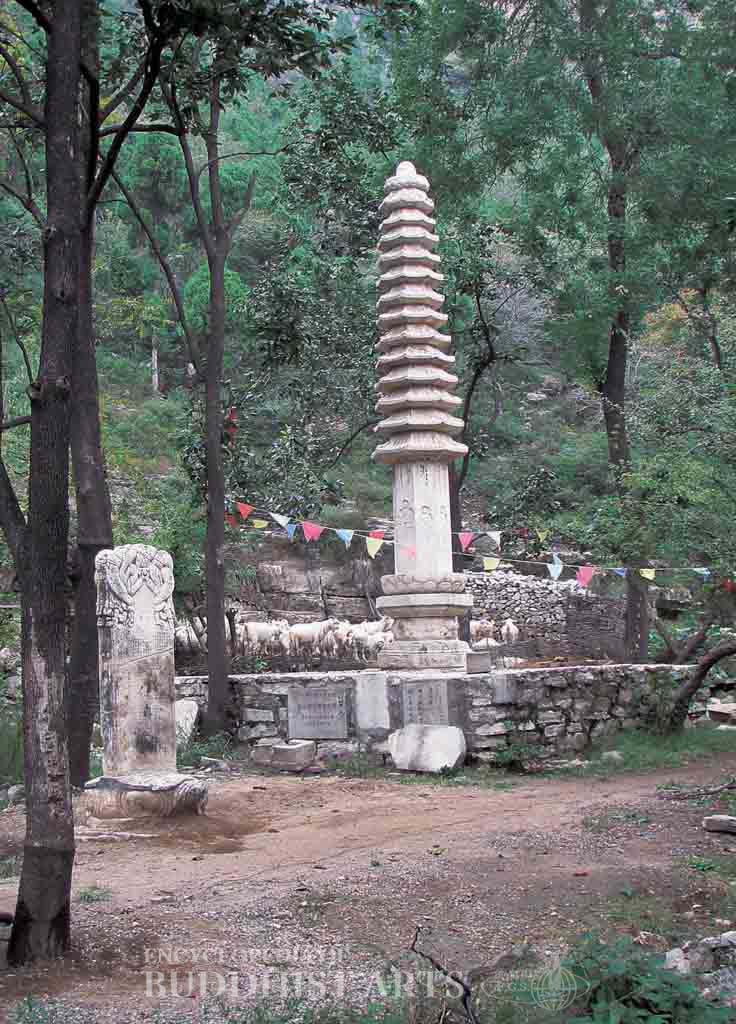
Jinshan Temple Thousand Buddha Relic Pagoda
Jinshan Temple Thousand Buddha Relic Pagoda
CHINA, Hebei, Baoding
The pagoda was constructed in 1300 during the Yuan dynasty. It was listed as a Provincial Cultural Heritage Site in 1993.
The octagonal 8.2 m high pagoda is carved from white marble and is divided into a base, body, a series of dense eaves, and a spire. On the Sumeru base there are delicate carvings of marine creatures, intertwining branches, pomegranate flowers, and rectangular patterns. Above the base there is an upturned lotus supporting the body. Each side of the body is deeply engraved with a seated Buddha and a myriad of smaller Buddhas in the background. Apart from the first row, where their bodies can be seen, the rest only have their heads and their round nimbuses showing. The thirteen eaves gradually decrease in diameter, giving the structure a tapered shape. At the top there is an upturned lotus and a gourd-shaped spire.
For more details, go to the Encyclopedia of Buddhist Arts: Architecture G-L, page 536.
Cite this article:
author = Hsingyun and Youheng and Johnson, Peter and Mankuang and Lancaster, Lewis,
booktitle = {Encyclopedia of Buddhist Arts: Architecture G-L},
pages = 536,
title = {{Jinshan Temple Thousand Buddha Relic Pagoda}},
volume = 2,
year = {2016}}