
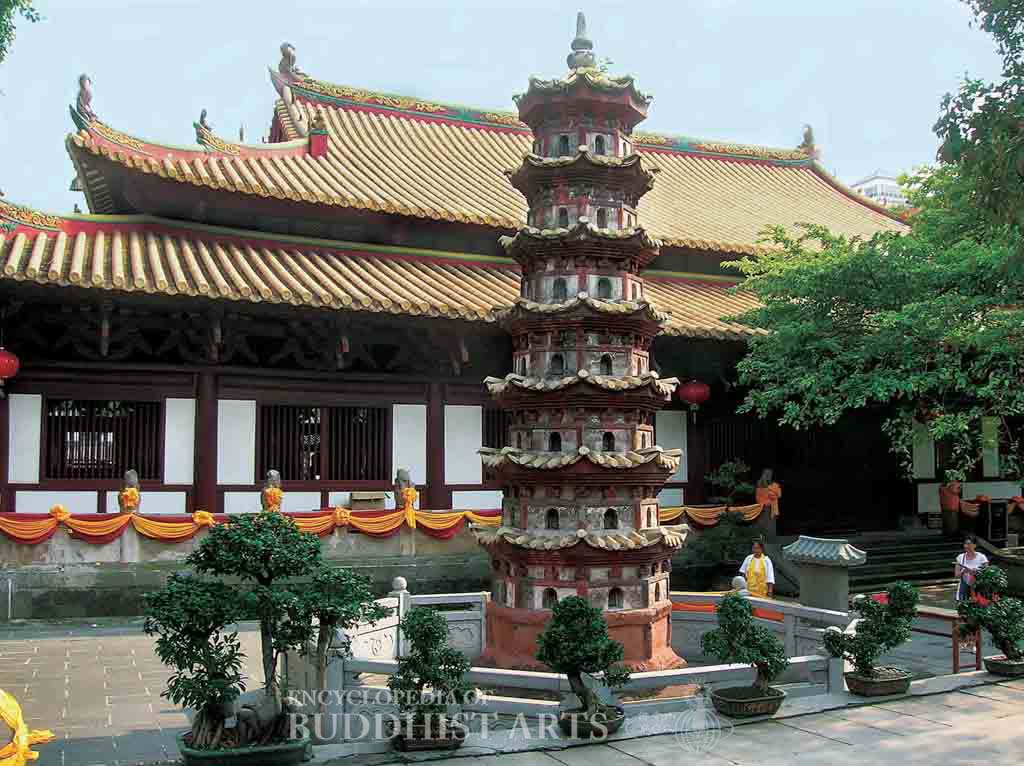
Guangxiao Temple Buried Hair Pagoda
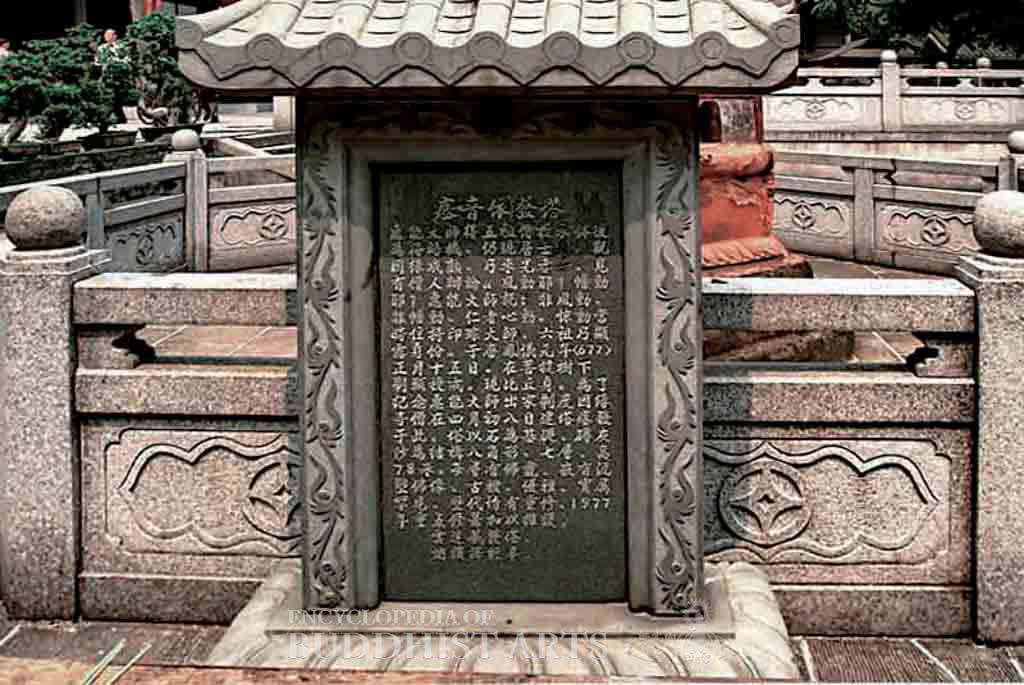
Guangxiao Temple Buried Hair Pagoda: Stele
Guangxiao Temple Buried Hair Pagoda
CHINA, Guangdong, Guangzhou
Master Huineng, the Sixth Patriarch of Chinese Chan Buddhism, was tonsured here under a Bodhi tree in 676 during the Tang dynasty. The abbot Facai later interred Huineng’s hair beneath the tree and constructed a pagoda, together with a stele, in memory of the occasion.
The octagonal seven-tier stone pagoda is solid inside and is 7.8 m high. Its base is constructed from red sandstone. The pagoda body is built from gray sandstone with red sandstone used for pilasters and architraves. Each level has eight Buddha niches. The corners of the eaves are upturned, making them seem to be curved. A gourd-shaped finial is located on top of the octagonal pyramidal roof. Next to the pagoda, there are steles of the Sixth Patriarch and Bodhidharma dating back to the Yuan dynasty (1271–1368).
For more details, go to the Encyclopedia of Buddhist Arts: Architecture G-L, page 400.
Cite this article:
author = Hsingyun and Youheng and Johnson, Peter and Mankuang and Lancaster, Lewis,
booktitle = {Encyclopedia of Buddhist Arts: Architecture G-L},
pages = 400,
title = {{Guangxiao Temple Buried Hair Pagoda}},
volume = 2,
year = {2016}}