
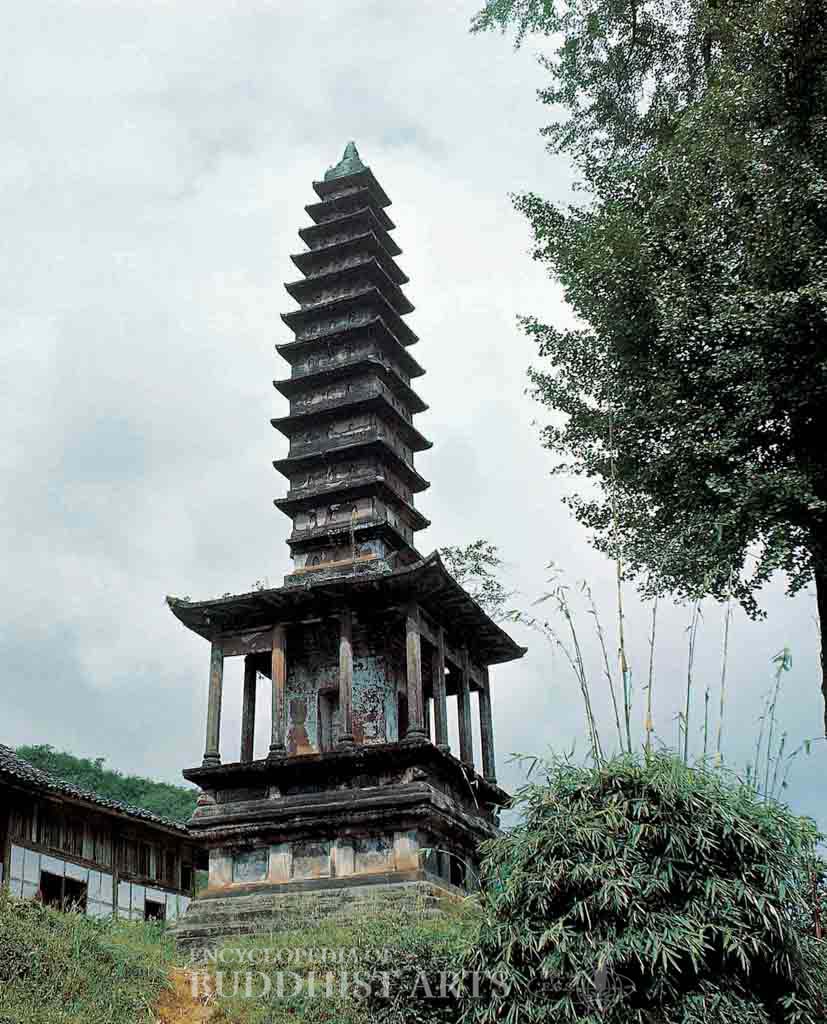
Shita Temple Stone Pagoda
Shita Temple Stone Pagoda
CHINA, Sichuan, Chengdu
The pagoda was originally called Sakyamuni Buddha’s True Body Pagoda. The temple and pagoda were built in 1169 during the Southern Song dynasty. The pagoda is located at the front of the temple, which emphasizes its importance at that time. It was listed as a National Cultural Heritage Site in 2001.
The 13-tier square pagoda is 17 m high and is built in red sandstone. A double Sumeru base stands on a plain base platform. The Sumeru base is decorated with carvings and pilasters. On the first tier, a niche containing a Buddha image is located on every side. The first tier has a roof above it supported by 12 pillars and architraves. The remaining tiers have eaves in the form of corbeling, and three shallow arched niches with a Buddha carved inside are featured on each side. The second to sixth tiers become wider, whereas the seventh to twelfth tiers gradually become narrower. This produces a tapered curved effect, which makes the pagoda appear graceful. The spire consists of an inverted bowl and a stone jewel.
For more details, go to the Encyclopedia of Buddhist Arts: Architecture M-S, page 999.
Cite this article:
author = Hsingyun and Youheng and Johnson, Peter and Mankuang and Lancaster, Lewis,
booktitle = {Encyclopedia of Buddhist Arts: Architecture M-S},
pages = 999,
title = {{Shita Temple Stone Pagoda}},
volume = 3,
year = {2016}}