
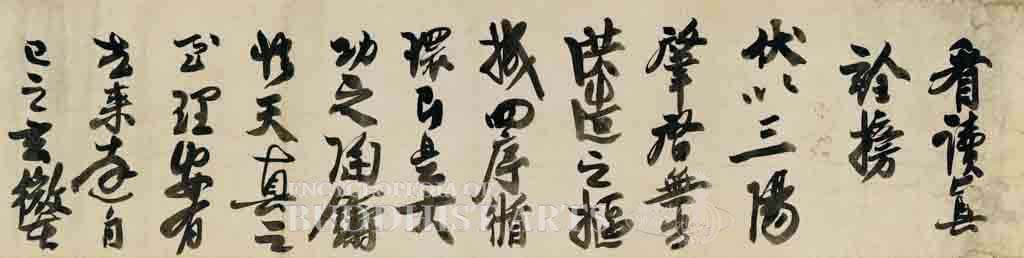
Shinjuan Temple: Sutra Announcement Board (right end section)
Ink on paper
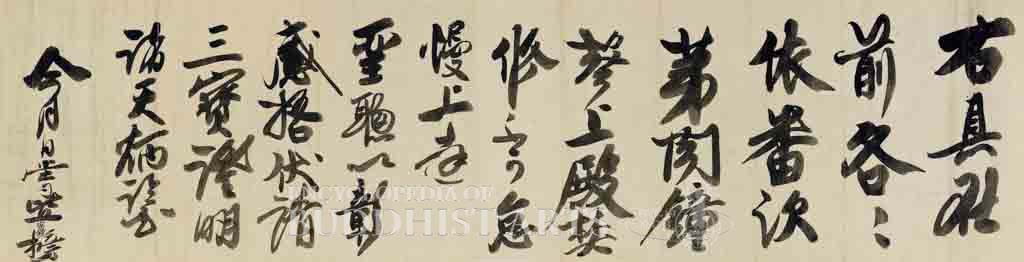
Shinjuan Temple: Sutra Announcement Board (left end section)
Shinjuan Temple: Sutra Announcement Board
JAPAN, Kyoto; Kamakura period
Zen Master Shuho Myocho scripted this note when he was 45. This calligraphic item was mounted in the monks’ quarters of the temple, and includes teachings on reality, as well as sutra and dharani texts. It was listed as a National Treasure of Japan in 1951.
Buddhist Chan calligraphy was greatly influenced by the works of Huang Tingjian since the Southern Song dynasty (1127–1279) in China. There is a blend of Huang and Mi Fu’s styles in this work. The sinuous and articulated strokes resemble Mi’s highly diversified strokes, while the long strokes that typify Huang provide a sturdy character framework that countered Mi’s free-formed outlook. There is a generous use of space and an upright stance in the character positioning, while variations in the brushstrokes add to the vibrancy of the composition. The piece is considered to be one of the best works of calligraphy.
Shuho Myocho was posthumously known as National Master Daito (Great Lamp). A Rinzai Zen master during the late Kamakura (1185–1333) and early Nanbokucho 1336–1392) period, he was also the founder of Daitokuji Temple in Kyoto. Emperor Hanazono (reigned 1308–1318) took refuge under Master Shuho, while Emperor Daigo (reigned 897–930) of the Heian period showed great faith in his teachings. He was regarded as one of the two eminent Zen Buddhist monks during his time, along with Master Muso Soseki.
For more details, go to the Encyclopedia of Buddhist Arts: Calligraphy, page 227.
Cite this article:
author = Hsingyun and Youheng and Youlu and Pokorski, Stefanie and Mankuang and Edson, Gary,
booktitle = {Encyclopedia of Buddhist Arts: Calligraphy },
pages = 227,
title = {{Shinjuan Temple: Sutra Announcement Board}},
volume = 17,
year = {2016}}