
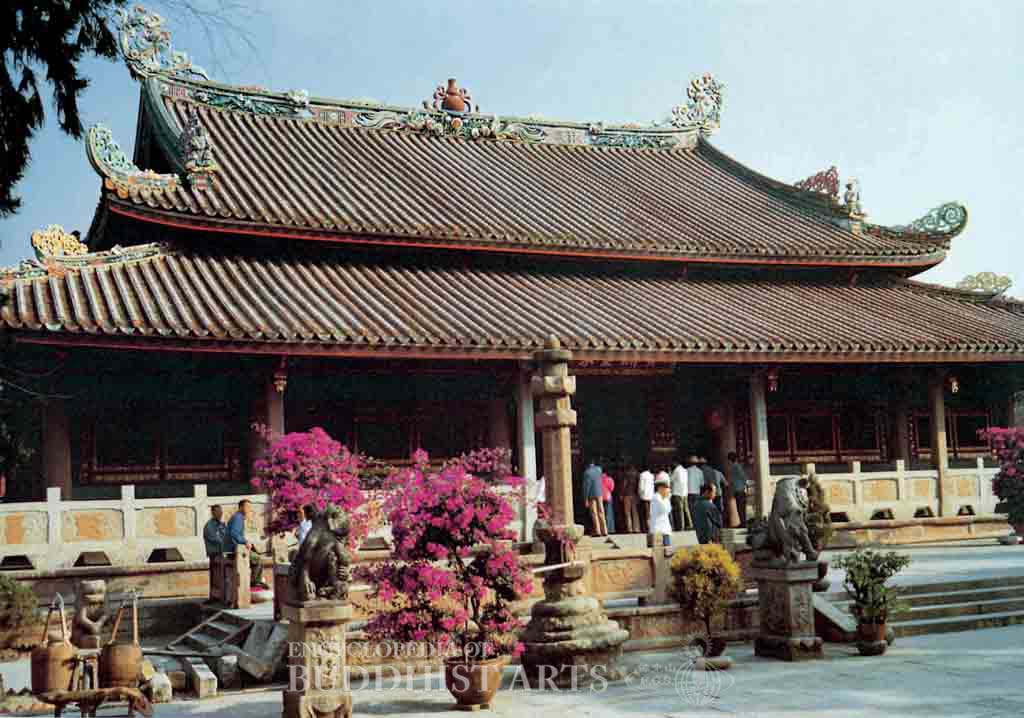
Kaiyuan Temple: Great Hero Hall
Kaiyuan Temple
CHINA, Guangdong, Chaozhou
The temple was built between 712 and 756 during the Tang dynasty. Lingdong Buddhist College was founded at this temple in 1933 by Master Taixu. The temple was listed as a National Cultural Heritage Site in 2001.
Along the central axis of the temple, there are the Vajra Hall, which is the main temple gate, the Heavenly King Hall, Great Hero Hall, and the sutra repository. The seven-by-three bay Vajra Hall has a single-eave hip-and-gable roof. The eleven-by-four bay Heavenly King Hall also has a single-eave hip-and-gable roof, and measures 50.5 m wide, 15.8 m deep, and 9.9 m high.
Located at the center of the temple compound, the Great Hero Hall has a double-eave hip-and-gable roof and is five bays wide. A glazed, gourd-shaped ridge ornament is located in the center of the main roof ridge and there are other decorations on the edges. The panels on the balustrades outside the building are decorated with stone carvings depicting the Life of the Buddha. There are 78 panels in total dating back to the Tang (618–907) and Song (960–1279) dynasties. Inside the hall, there are 5 m high seated statues of Sakyamuni Buddha, the Medicine Buddha, and Amitabha Buddha. Lining either side of the hall are the Eighteen Arhats, all in different postures. In front of the Buddha statues, there is a hexagonal seven-tier Thousand Buddha pagoda constructed in gilded wood during the Ming dynasty. On the east side of the hall there hangs a giant bell measuring 1.7 m cast in 1114 during the Northern Song dynasty. A pair of stone sutra pillars from the Tang dynasty stands outside the hall. They are engraved with the Cundi Dharani and the Usnisavijaya Dharani.
The temple houses the Qing Tripitaka totaling 7,240 fascicles. There is a 140 cm high incense burner made from a meteorite and crafted in 1325 during the Yuan dynasty (1271–1368). There is also a well-known copy of the Avatamsaka Sutra containing around 800,000 characters written in blood from the tongue of Zhicheng, the abbot during the Second Sino-Japanese War (1937–1945).
For more details, go to the Encyclopedia of Buddhist Arts: Architecture G-L, page 581.
Cite this article:
author = Hsingyun and Youheng and Johnson, Peter and Mankuang and Lancaster, Lewis,
booktitle = {Encyclopedia of Buddhist Arts: Architecture G-L},
pages = 581,
title = {{Kaiyuan Temple}},
volume = 2,
year = {2016}}