
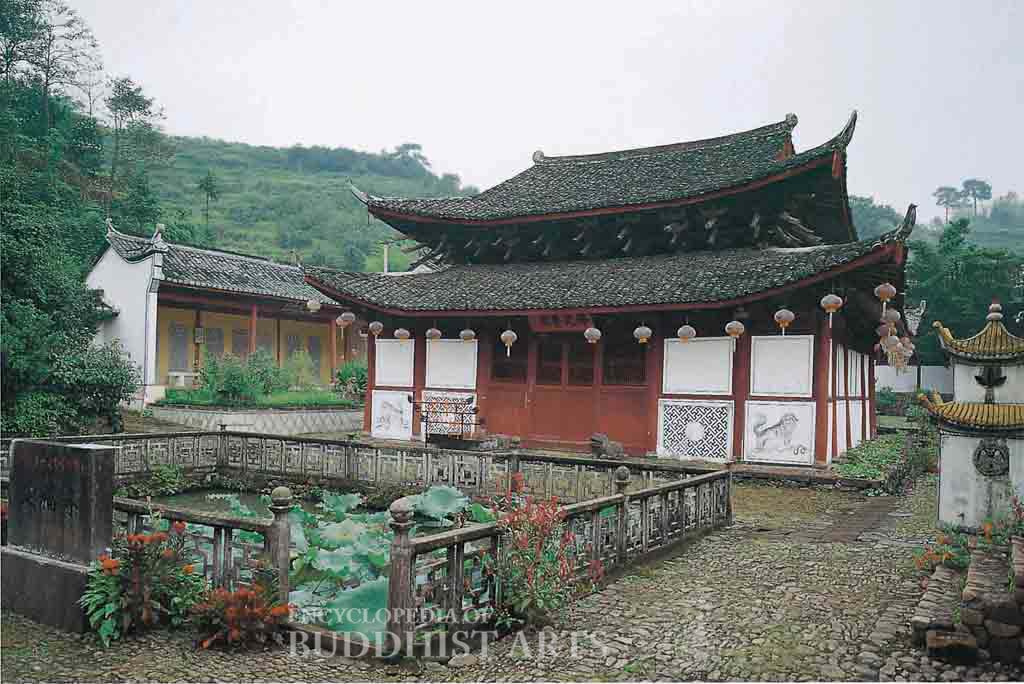
Yanfu Temple: Great Hero Hall
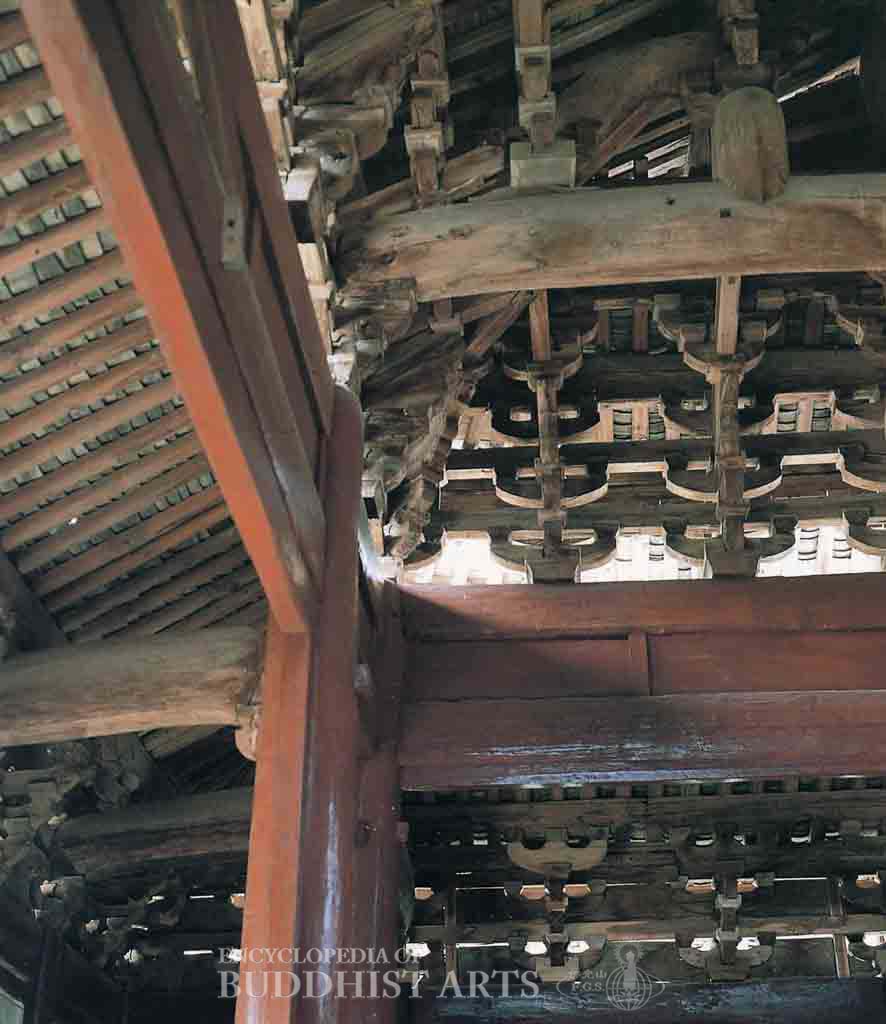
Yanfu Temple: Great Hero Hall (interior)
Yanfu Temple
CHINA, Zhejiang, Jinhua
Yanfu means Prolonged Blessings. It was built in 927 during the Five Dynasties period by the monk Zongyi. It was expanded between 1190 and 1194 during the Southern Song dynasty. Apart from the Great Hero Hall, which was rebuilt in 1317 during the Yuan dynasty, the other buildings were rebuilt during the Qing dynasty (1644–1911). The temple was listed as a National Cultural Heritage Site in 1996.
Built following the contours of the mountain, the temple occupies more than 4,500 sq m. Running from the south to north along the central axis, there are the main temple gate, Heavenly King Hall, Great Hero Hall, and Avalokitesvara Hall. Subsidiary buildings are located on either side of the rear courtyard. Between the Heavenly King Hall and the Great Hero Hall there is the Free Life Pond. The Great Hero Hall is the main hall of the temple. It originally had a single-eave hip-and-gable roof and was three bays wide. During the Ming dynasty (1368–1644) another eave was added and the structure was expanded to make it five bays wide. The bracket sets supporting the upper eaves are accompanied by unusually long double downward-pointing cantilevers. Only the columns that support the exterior eaves were replaced during the Ming dynasty; the rest are tapered, which is a typical Song dynasty (960–1279) style. The columns that support the front eaves and the interior columns are joined by tie beams. At the very top, the king post is curved while its lower end is shaped like an eagle’s beak. There are no roof decorations. The hall houses a statue of Sakyamuni Buddha flanked by two disciples as well as four figures making offerings.
For more details, go to the Encyclopedia of Buddhist Arts: Architecture T-Z, page 1341.
Cite this article:
author = Hsingyun and Youheng and Johnson, Peter and Mankuang and Lancaster, Lewis,
booktitle = {Encyclopedia of Buddhist Arts: Architecture T-Z},
pages = 1341,
title = {{Yanfu Temple}},
volume = 4,
year = {2016}}