
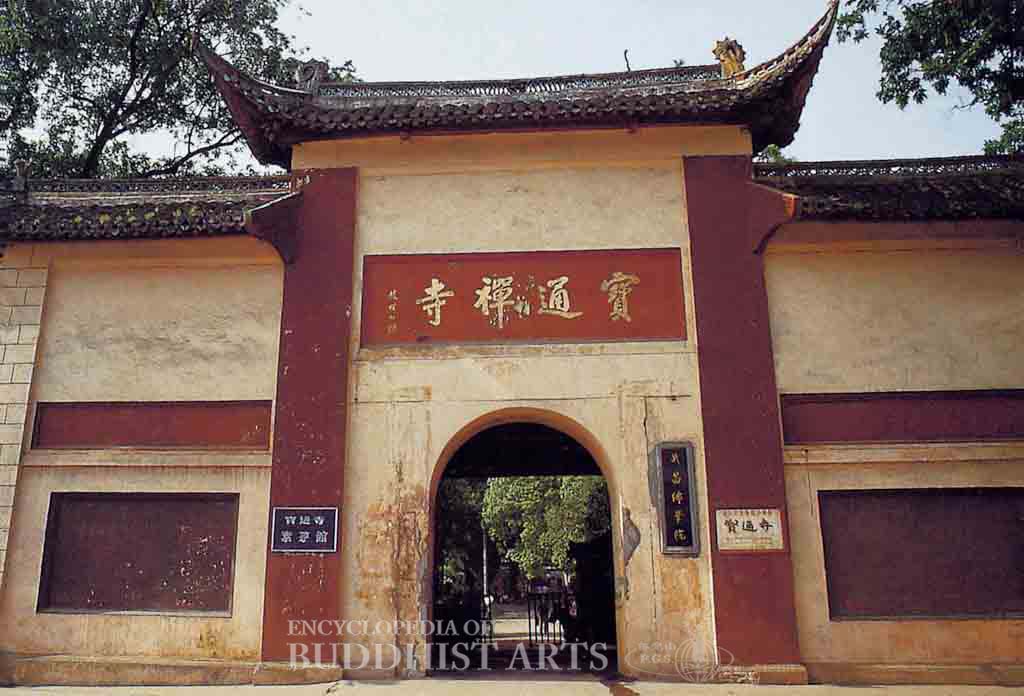
Baotong Temple: Main Temple Gate
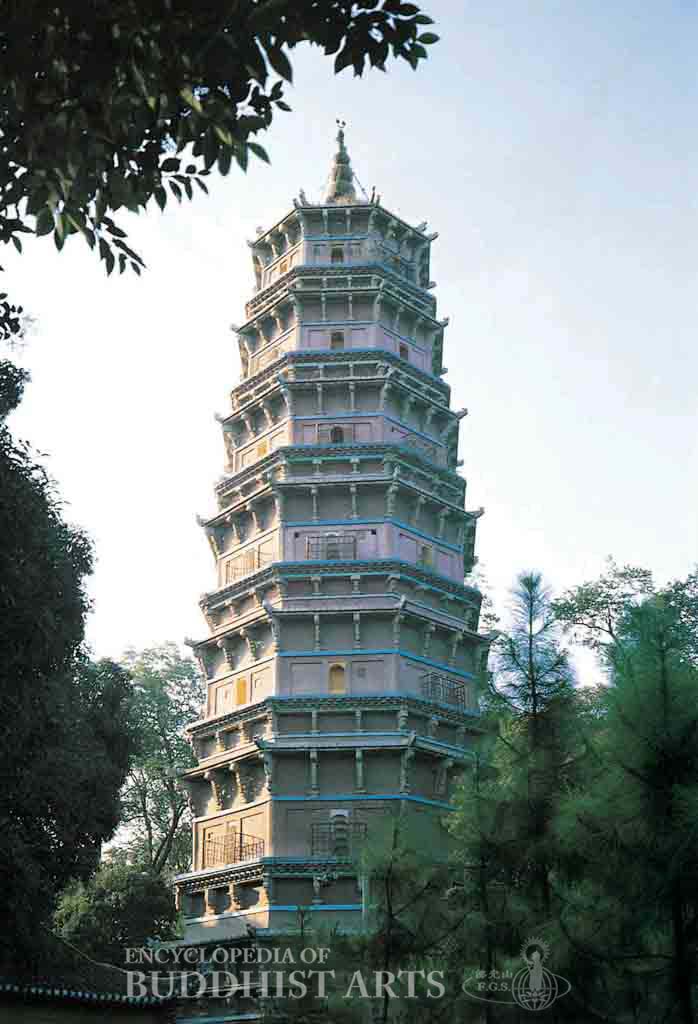
Baotong Temple: Hongshan Pagoda
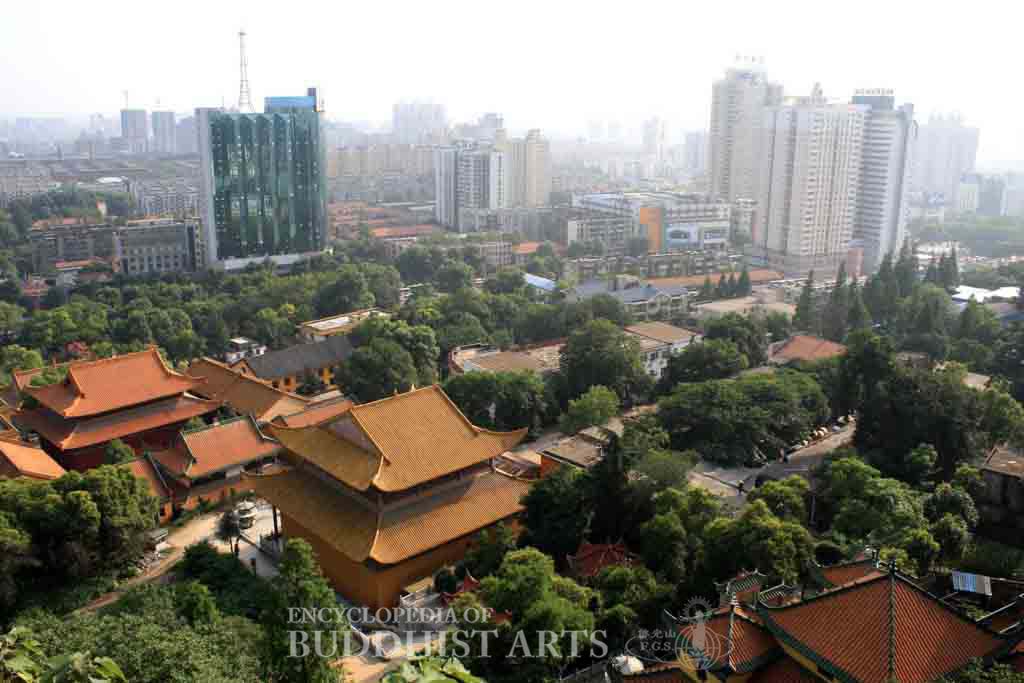
Baotong Temple (aerial view)
Baotong Temple
CHINA, Hubei, Wuhan
The temple is situated at the southern foot of Hongshan (Vast Mountain). It is well known for following the Pure Land teachings and is one of the Four Major Temples in Wuhan. It is said that the temple was built in 826 during the Tang dynasty and was originally located on Dahongshan (Great Vast Mountain) in Suizhou. It was moved to its current location during the Southern Song dynasty. It has flourished and declined throughout its history. Most of the existing buildings were constructed between 1865 and 1879 during the Qing dynasty. It was listed as a key Buddhist temple in the Han region of China in 1983.
Built to integrate with the contours of the mountain, the temple occupies 10 ha. The principal structures include the main temple gate, Sacred Sangha Bridge, Free Life Pond, the bell and drum towers, Maitreya Hall, Great Hero Hall, sutra repository, Patriarch Hall, Sangharama Hall, chanting hall, meditation hall, the abbot’s quarters, and the Hongshan Pagoda. Built at the end of the Ming dynasty (1368–1644), the five-bay wide Great Hero Hall has a hip roof. Wooden railings connect the columns on the portico.
The Hongshan Pagoda is located at the back of the temple. It is a seven-story, octagonal, brick pagoda built in imitation of a wooden structure. It is 44 m high with a width at the base of 37.3 m. The eaves and bases of every story are supported by brackets sets. It has undergone a number of repairs throughout its history.
For more details, go to the Encyclopedia of Buddhist Arts: Architecture A-F, page 55.
Cite this article:
author = Hsingyun and Youheng and Johnson, Peter and Mankuang and Lancaster, Lewis,
booktitle = {Encyclopedia of Buddhist Arts: Architecture A-F},
pages = 55,
title = {{Baotong Temple}},
volume = 1,
year = {2016}}