
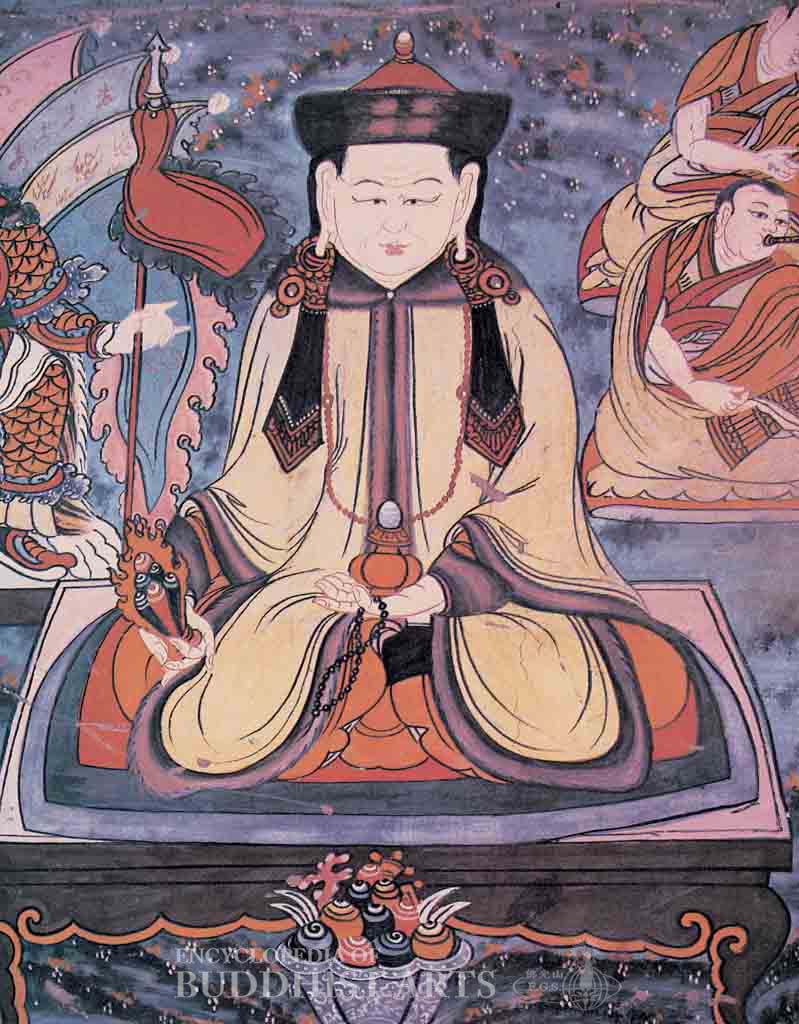
Maidari Juu Temple Murals: Great Hero Hall - Third Lady (west wall)
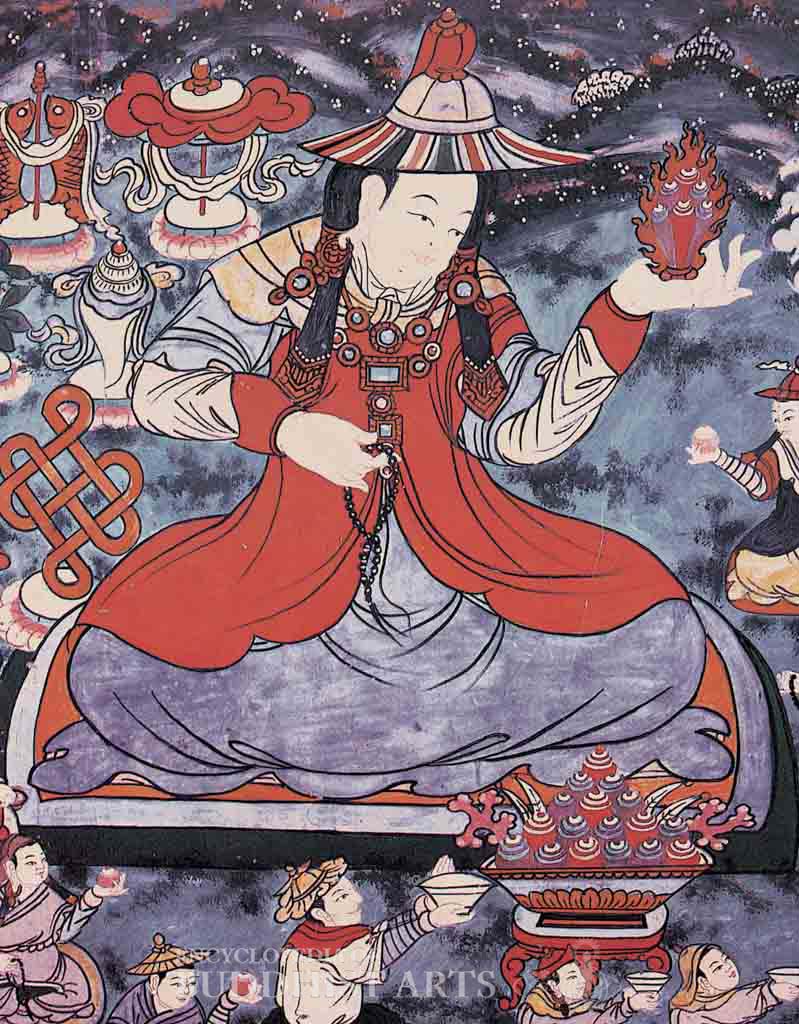
Maidari Juu Temple Murals: Great Hero Hall - Young Woman (west wall)
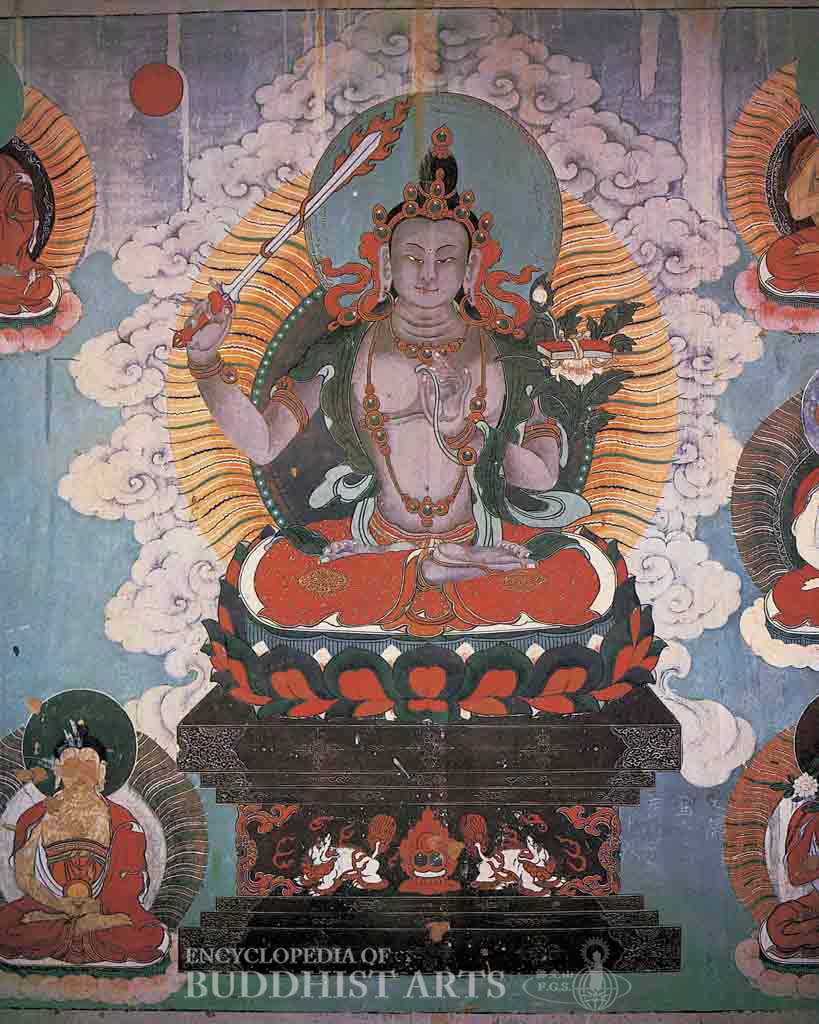
Maidari Juu Temple Murals: Pavilion of the Three Buddhas - Manjusri Bodhisattva
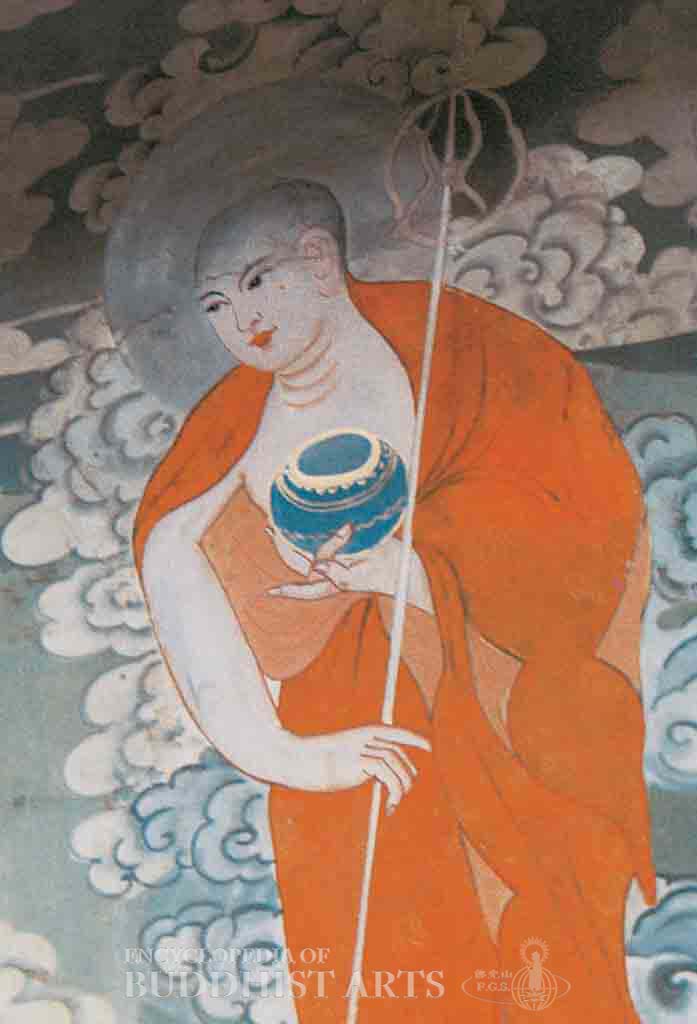
Maidari Juu Temple Murals: Monk
Maidari Juu Temple Murals
CHINA, Inner Mongolia, Baotou; Qing dynasty
Maidari Juu Temple, built in 1606, combined the functions of a palace, monastery, and residence. The main structures in the temple include the Great Hero Hall, Pavilion of the Three Buddhas, Naiqiong Shrine, and Empress Shrine. There are murals painted throughout the these buildings, most of them repainted during the Qing dynasty (1644–1911).
The Great Hero Hall consists of a portico, the assembly hall, and the Buddha hall. The murals on the four walls of the Buddha hall include depictions of the Four Heavenly Kings, the monk Budai, stories from the Life of the Buddha, and the enlightenment of Tsongkhapa. A group of Mongolian figures making offerings painted at the bottom of the four walls are a valuable visual record of Mongolian dress and customs during the Ming and Qing dynasties.
On the bottom of the west wall, there is a large mural thought to depict the Third Lady paying respect to the Buddha. The Third Lady was the third wife of Altan Khan (reigned 1531–1582), a leader of the Tumed Mongols who was responsible for the spread of Tibetan Buddhism into Mongolia. She played an important role in maintaining a harmonious relationship between the Tumed Mongols and the Ming court for 40 years. The mural is 300 cm high and 1,600 cm long, and contains a total of 62 figures. One of the main figures is a bearded Mongolian man, probably a representation of Altan Khan, who holds prayer beads in his right hand and a snuff bottle in his left. The other figure, an elderly woman with a serene, kind expression, is probably the Third Lady. She has a round, slightly wrinkled face and long braids, and wears a conical hat, large earrings, and a beaded necklace. Dressed in a Mongolian robe with a fur collar, the Third Lady holds a vase and string of prayer beads in her left hand and a jewel in her right hand. There is also an image of a young woman sitting in full lotus position on a semicircular cushion with her robe tucked beneath her legs. She wears a colorful hat, and holds prayer beads and a flaming jewel. Below her, smaller figures hold up offerings.
The other halls are decorated with images of Buddhist figures. Manjusri Bodhisattva, seated in lotus position on a lotus atop a Sumeru throne, is depicted on the second story of the Pavilion of the Three Buddhas. The Bodhisattva has a high topknot and wears a crown, earrings, and ornaments. The raised right hand holds a sword symbolizing wisdom, while the left hand is placed in front of the chest, holding the stem of a lotus that extends upwards to support a sutra. The nimbus and aureole are surrounded by billowing white clouds.
For more details, go to the Encyclopedia of Buddhist Arts: Painting I-O, page 498.
Cite this article:
author = Hsingyun and Youheng and Youlu and Wilson, Graham and Manho and Mankuang and Huntington, Susan,
booktitle = {Encyclopedia of Buddhist Arts: Painting I-O},
pages = 498,
title = {{Maidari Juu Temple Murals}},
volume = 15,
year = {2016}}