
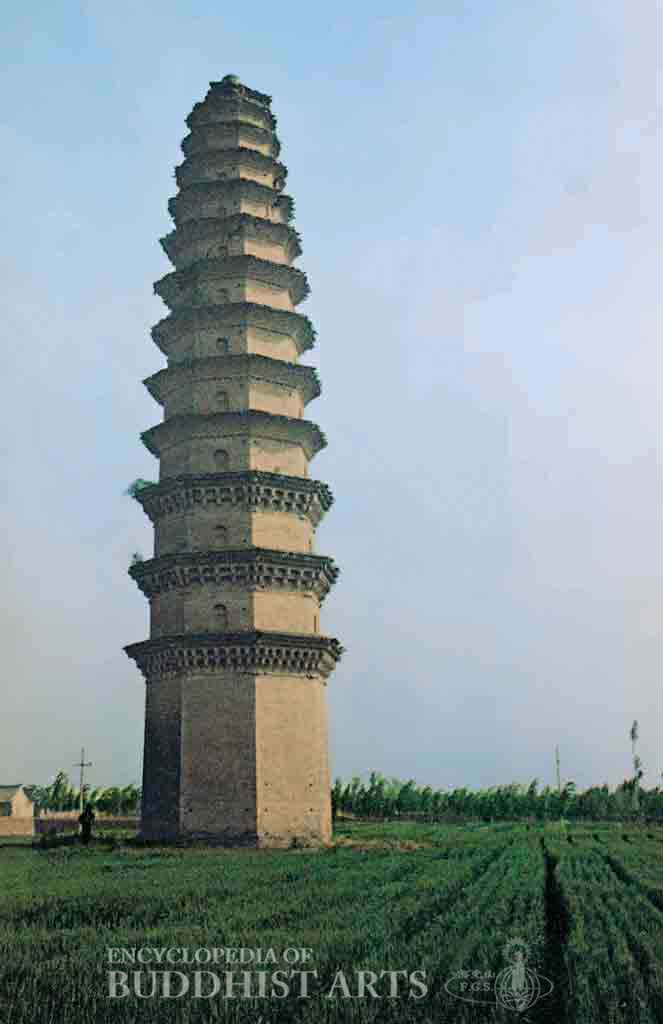
Shengshou Temple Relic Pagoda
Shengshou Temple Relic Pagoda
CHINA, Shanxi, Yuncheng
Shengshou means Sacred Lifespan. The pagoda was built between 1023 and 1032 during the Northern Song dynasty. It was originally located within Shengshou Temple which no longer exists. It has been repaired a number of times. It was listed as a Provincial Cultural Heritage Site in 1996.
The 13-story, octagonal, brick pagoda is 46 m high. The first story is higher than the other stories. The entrance is located on the south side and all the remaining stories have false doors on the four cardinal sides. Imitation wooden bracket sets made from brick support the eaves of the first, second, and third stories, while the remaining eaves are all formed by corbeling, which was a style made popular during the Tang dynasty (618–907). The spire no longer exists and only its inverted bowl base is still present. The structure is hollow and originally had wooden floors and stairs. This is a rare transitional form from the hollow Tang dynasty pagodas to the central pillar Song dynasty (960–1279) pagodas. Sections of Song-style murals can still be found on the interior walls depicting Buddhas, Bodhisattvas, and donors.
For more details, go to the Encyclopedia of Buddhist Arts: Architecture M-S, page 985.
Cite this article:
author = Hsingyun and Youheng and Johnson, Peter and Mankuang and Lancaster, Lewis,
booktitle = {Encyclopedia of Buddhist Arts: Architecture M-S},
pages = 985,
title = {{Shengshou Temple Relic Pagoda}},
volume = 3,
year = {2016}}