
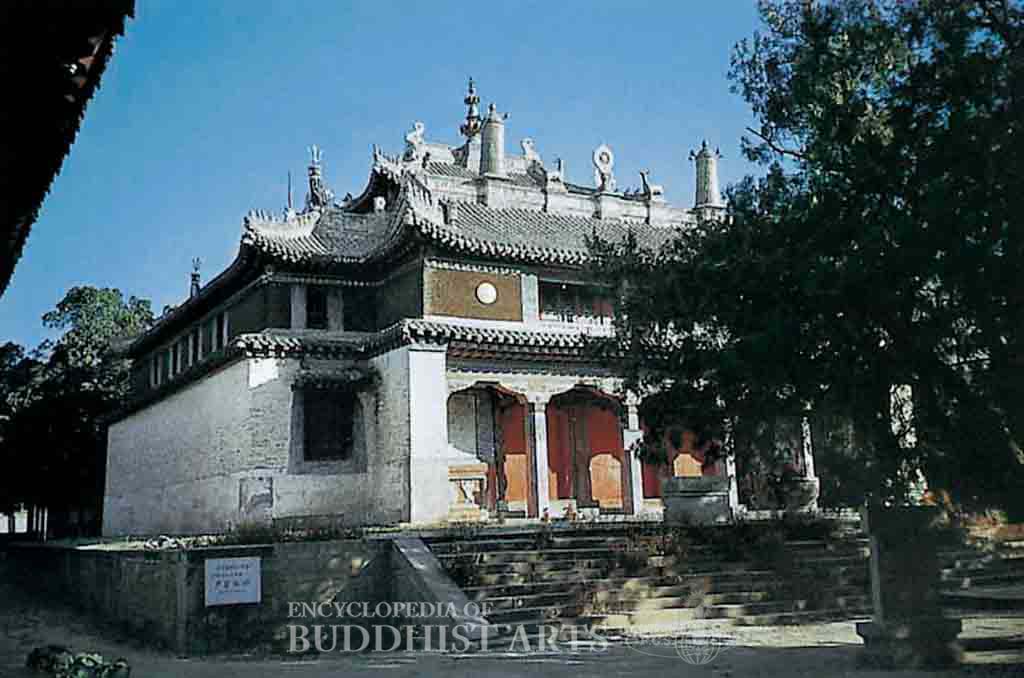
Huining Temple: Assembly Hall
Huining Temple
CHINA, Liaoning, Chaoyang
It is the largest Tibetan Buddhist temple in the northeast of China. According to a stele in Mongolian, the temple was founded during the early Qing dynasty (1644–1911), and was later expanded in 1738, 1750, and 1757, resulting in a large temple complex. It was listed as a Provincial Cultural Heritage Site in 1988.
The temple occupies an area of around 1.2 ha. Along the central axis there are the main temple gate, Heavenly King Hall, assembly hall, sutra repository, and the Seven Bay Hall. Side buildings include the bell and drum towers. The seven-by-six bay assembly hall is constructed upon a high square base platform. It contains a total of 81 rooms. The veranda is five bays wide and one bay deep. There are 30 red columns within the building. The assembly hall is a combination of Tibetan and Chinese architectural styles. The white-washed walls on the first level and red ocher bands on the second level are Tibetan. While the hip-and-gable roof is Chinese, the deer, Dharma wheels and canopies are clearly Tibetan.
For more details, go to the Encyclopedia of Buddhist Arts: Architecture G-L, page 471.
Cite this article:
author = Hsingyun and Youheng and Johnson, Peter and Mankuang and Lancaster, Lewis,
booktitle = {Encyclopedia of Buddhist Arts: Architecture G-L},
pages = 471,
title = {{Huining Temple}},
volume = 2,
year = {2016}}