

Mogao Cave 428: Main Chamber
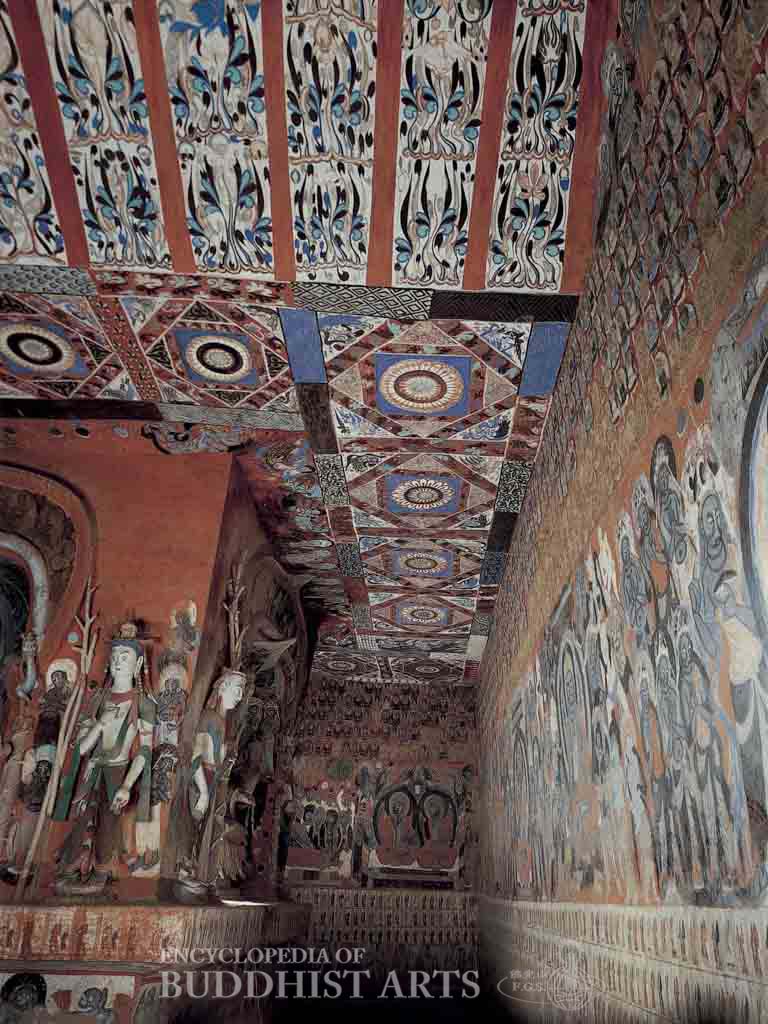
Mogao Cave 428: Main Chamber (right side)
Mogao Cave 428
CHINA, Gansu, Dunhuang
This central pillar cave is situated on the third level in the central section of the south area. It is the largest cave with a central pillar built during the Northern Dynasties (386–581). According to historical documents, the Lord of Jianping, Yu Yi, was the governor of Guazhou during the Northern Zhou dynasty (557–581) and constructed a large cave at Mogao, believed to be this one. The cave was renovated in the Five Dynasties (907–960), and consists of an antechamber and a main chamber connected by a corridor. The antechamber was painted over during the Five Dynasties, and the murals in the corridor display Cao Yijin, and his wife, the Uighur princess.
The main chamber has a gabled ceiling painted with imitation rafters and honeysuckle, lotus, and bird motifs. The rear of the main chamber has a flat ceiling with a central pillar. All four sides of the pillar house niches which each contain statues of a seated Buddha in full lotus position and two disciples. Bodhisattvas making offering and apsaras are painted on the walls around the flame-patterned mandorlas of the Buddhas, and two carved Bodhisattvas stand outside each niche, one on each side. The niche lintels are embellished with reliefs of intertwining lotus flowers, while the side columns feature Bodhi trees. Paintings of donors surround the platform beneath the niches, and dancing yaksas with musical instruments are depicted on the base of the central pillar. The upper portion of the pillar and the ceiling around it display flying apsaras.
The four walls of the main chamber have Thousand Buddha images along the top and donor images along the bottom, with a total of over 1,200 donors painted along the bottom of the walls and on the central pillar. On the back (west) wall are Sakyamuni and Prabhutaratna Buddhas, a Buddha teaching the Dharma, the Diamond Throne Stupa, and the Buddha’s Parinirvana. In the center of the north wall are murals of a Buddha teaching the Dharma and the Defeat of Mara, while on the south wall are Vairocana Buddha and a Buddha teaching the Dharma. On the front (east) wall, illustrations of the Prince Sudana Jataka and the Prince Mahasattva Jataka flank the entrance.
For more details, go to the Encyclopedia of Buddhist Arts: Caves Mo-S, page 1208.
Cite this article:
author = Hsingyun and Youheng and Johnson, Peter and Mankuang and Huntington, Susan and Edson, Gary and Neather, Robert,
booktitle = {Encyclopedia of Buddhist Arts: Caves Mo-S},
pages = 1208,
title = {{Mogao Cave 428}},
volume = 8,
year = {2016}}