
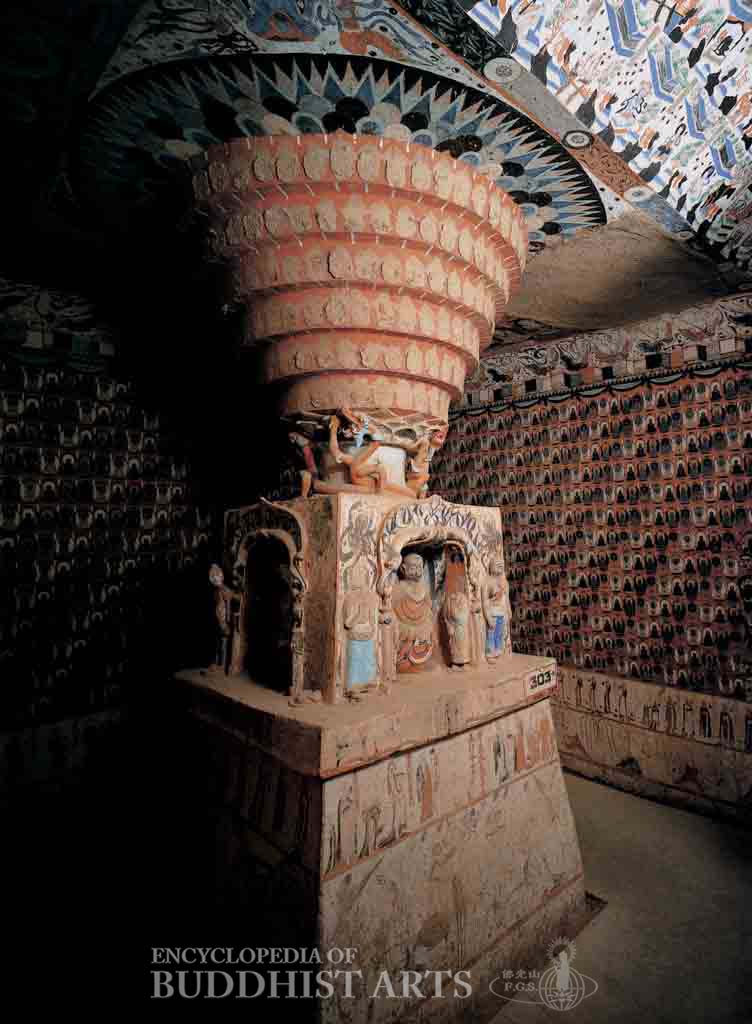
Mogao Cave 303: Main Chamber - Central Pillar
Mogao Cave 303
CHINA, Gansu, Dunhuang
Located on the second level in the northern section of the south area, this central pillar cave was constructed during the Sui dynasty (581–618) and consists of an antechamber and a main chamber connected by a corridor. The extant murals in the antechamber and corridor were repainted during the Song dynasty (960–1279). The front of the main chamber has a gabled ceiling while the rear ceiling is flat with a painted lattice and Thousand Buddha images. The gabled ceiling has illustrations of the “Universal Gateway Chapter” of the Lotus Sutra on the east slope, and the Thirty-Three Manifestations of Avalokitesvara on the west slope.
There is a central pillar in the main chamber that is shaped like Mount Sumeru with an inverted seven-tier pagoda at the top connected to a square base. The ceiling surrounding the top of the pillar is painted with petal and pennant patterns, which are encompassed within a square frame with a seated Buddha and two apsaras in each corner. The six upper tiers of the pagoda were covered with Thousand Buddha reliefs, which have fallen off; the lowest tier is shaped like a lotus with a stem encircled by four dragons. There is an arched niche cut into each side of the square body of the pillar, which house statues from the Qing dynasty (1644–1911). Images of monastics and lay devotees making offerings are painted on the upper part of the pillar base, while lions and yaksas are painted on the lower part.
Thousand Buddhas cover much of the four walls of the cave. A row of apsaras lines the top of each wall, and figures making offering and landscape scenes are painted at the bottom. Below the gabled ceiling on the south wall is a standing Buddha image, and on the north wall is a painting of Sakyamuni and Prabhutaratna Buddhas seated together.
For more details, go to the Encyclopedia of Buddhist Arts: Caves Mo-S, page 1133.
Cite this article:
author = Hsingyun and Youheng and Johnson, Peter and Mankuang and Huntington, Susan and Edson, Gary and Neather, Robert,
booktitle = {Encyclopedia of Buddhist Arts: Caves Mo-S},
pages = 1133,
title = {{Mogao Cave 303}},
volume = 8,
year = {2016}}