
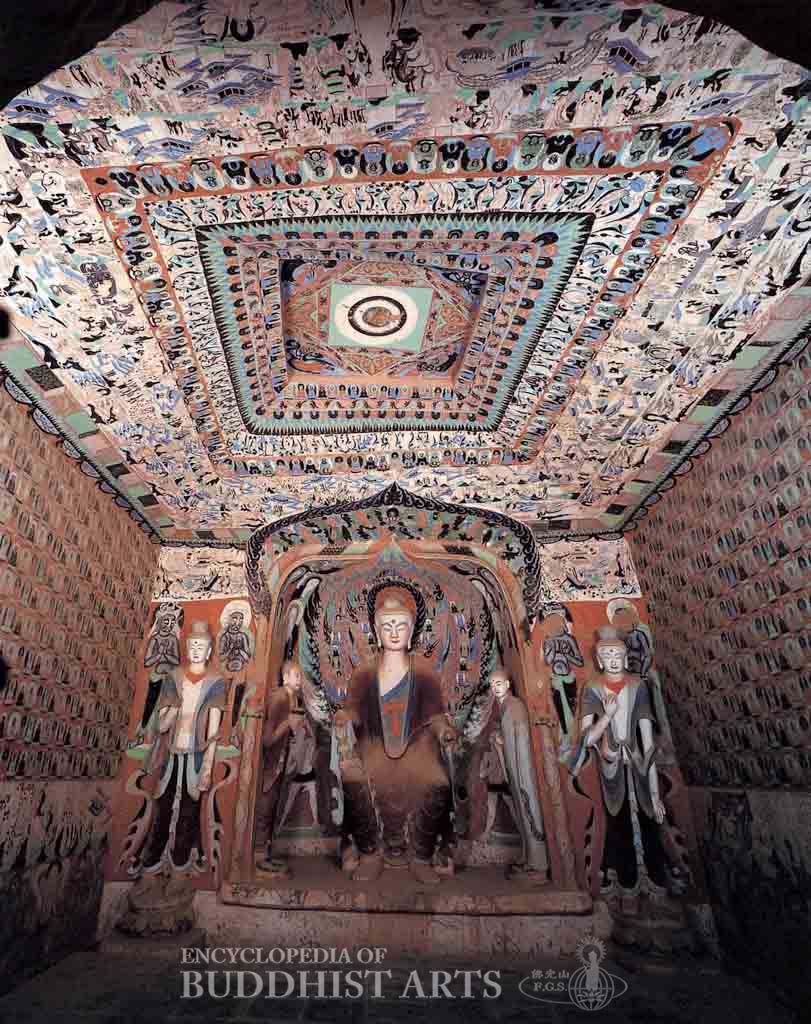
Mogao Cave 296

Mogao Cave 296: Ceiling
Mogao Cave 296
CHINA, Gansu, Dunhuang
Located in the south area of the site, this shrine cave was constructed during the Northern Zhou dynasty (557–581), and consists of an antechamber and a main chamber. The main chamber is approximately 4 m in both width and depth, and has a low truncated pyramidal ceiling.
In the center of the ceiling is a lotus surrounded by apsaras and concentric border motifs, including honeysuckle flowers, valance patterns, and Thousand Buddha images. On the slopes of the ceiling are narrative illustrations of the Tragic Past of the Nun Suksma, the Sutra on the Field of Merits, and the Good Prince Going to Sea. Apsaras are painted below these narrative illustrations.
Inside the arched niche on the back (west) wall are statues of a seated Buddha and two disciples, and outside the niche are two attendant Bodhisattvas. The statues were repaired during the Qing dynasty (1644–1911). On the back wall of the niche are paintings of apsaras, disciples, and Bodhisattvas, as well as a large flame-patterned mandorla behind the Buddha statue, and images of Mrgasirsa and Vasu. At the top of the wall to either side of the niche are images of imperial chariots pulled by dragons and phoenixes that patrol the heavens, and below, two Bodhisattvas are painted behind each Bodhisattva statue.
The north and south walls are largely covered with Thousand Buddha images. On the lower portions of the walls are narrative illustrations of the Conversion of Five Hundred Bandits and the Prince Sujata Jataka, with donor figures and yaksas along the bases of the walls. Donor figures are also painted along the front (east) wall.
For more details, go to the Encyclopedia of Buddhist Arts: Caves Mo-S, page 1120.
Cite this article:
author = Hsingyun and Youheng and Johnson, Peter and Mankuang and Huntington, Susan and Edson, Gary and Neather, Robert,
booktitle = {Encyclopedia of Buddhist Arts: Caves Mo-S},
pages = 1120,
title = {{Mogao Cave 296}},
volume = 8,
year = {2016}}