
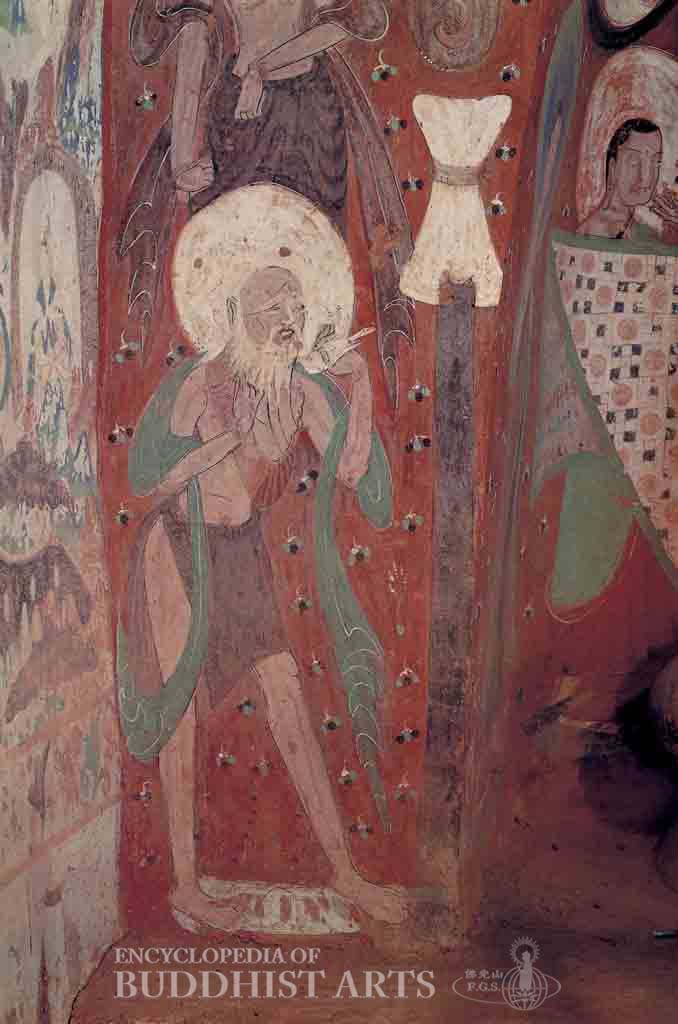
Mogao Cave 285: Vasu
Mogao Cave 285: Vasu
CHINA, Gansu, Dunhuang; Western Wei dynasty
This mural is located to the left of the niche on the left side of the back (west) wall. According to the sutras, Vasu was a king of ancient India who grew world-weary, became a monk, and eventually became immortal. During his time, an assembly was held to debate whether it was acceptable to kill animals as offerings to the heavens. As Vasu supported the killing, future generations had a basis on which to continue the practice of sacrificing and consuming meat. Because of this, Vasu eventually fell into hell, but after countless sufferings he was liberated by Flower Assembly Bodhisattva.
In the mural, Vasu is depicted as a half-naked old man with white hair and the lean body of an ascetic. He wears a simple brown cloth around his waist and a long stole draped around his arms. The bird he holds in his raised hand represents his past sin of killing.
For more details, go to the Encyclopedia of Buddhist Arts: Caves Mo-S, page 1112.
Cite this article:
author = Hsingyun and Youheng and Johnson, Peter and Mankuang and Huntington, Susan and Edson, Gary and Neather, Robert,
booktitle = {Encyclopedia of Buddhist Arts: Caves Mo-S},
pages = 1112,
title = {{Mogao Cave 285: Vasu}},
volume = 8,
year = {2016}}