
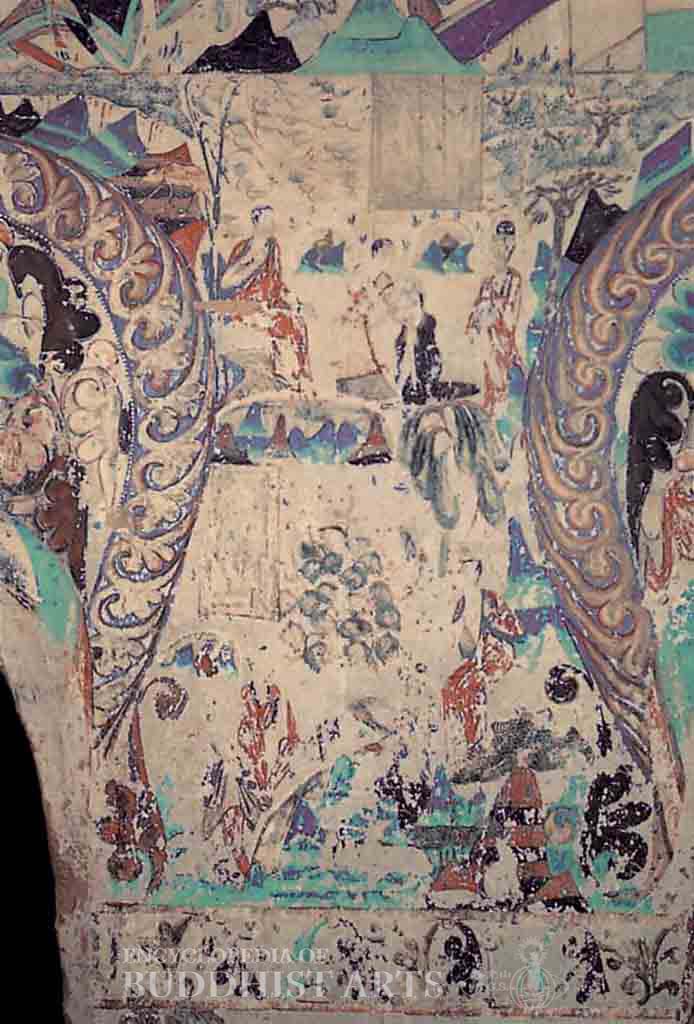
Mogao Cave 285: Novice Monk Committing Suicide to Uphold the Precepts (detail)
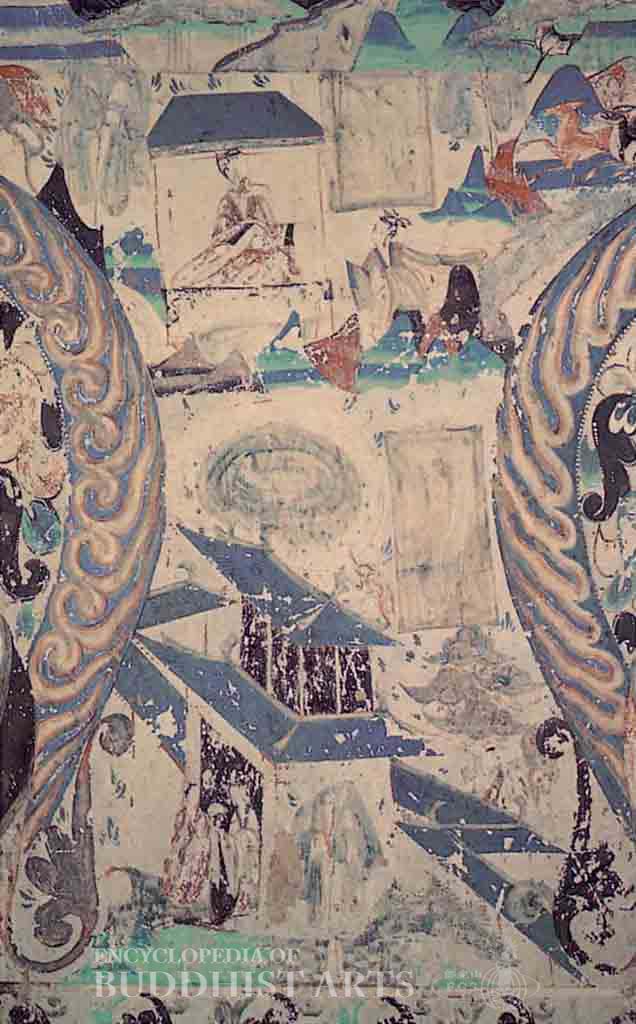
Mogao Cave 285: Novice Monk Committing Suicide to Uphold the Precepts (detail)
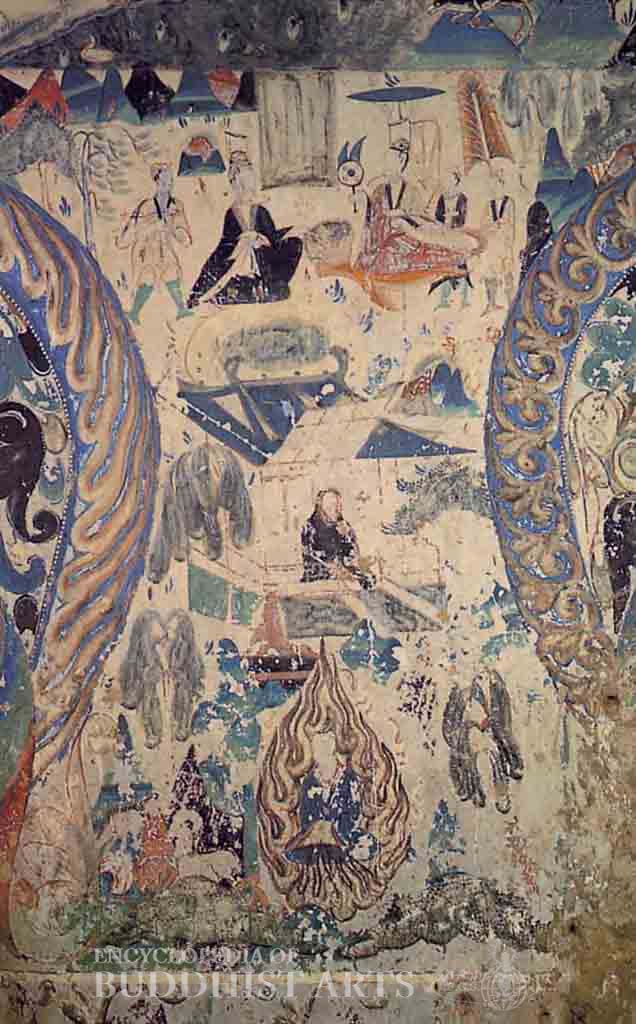
Mogao Cave 285: Novice Monk Committing Suicide to Uphold the Precepts (detail)
Mogao Cave 285: Novice Monk Committing Suicide to Uphold the Precepts
CHINA, Gansu, Dunhuang; Western Wei dynasty
This mural is located between the meditation cells on the south wall. It illustrates a story from the Sutra of the Wise and the Foolish. The narrative begins between the two cells on the left and ends between the two on the right. Between the cells on the left, a man sends his son to study as a novice under a master renowned for his virtuous practice, and the master imparts the precepts to the young novice. Between the cells in the center, an elder takes leave of his home while his young daughter stays behind. Below on the left, the novice monk knocks on their door to beg for alms. The young woman falls in love with him and implores him to resume the secular life. On the right, sitting beneath a tree, the novice uses a knife to take his own life in order to avoid breaking the precepts. Between the cells on the right are three scenes: at the top, the young woman’s father reports the case to the king; in the middle, the king praises the act of the novice monk and builds a stupa as an offering; and at the bottom, the young novice is cremated with sandalwood in a ceremony hosted by the king.
The figures in the mural wear clothing characteristic of the Southern Dynasties (420–589). The young woman wears an open-collared robe with large sleeves, while the king carries a whisk in his hand and is dressed in a gauze hat and dark robe, typical of a southern aristocrat. The painting technique is very different from that seen in the caves from the Northern Wei dynasty (386–534), such as Cave 257, which is more reflective of a Central Asian style.
For more details, go to the Encyclopedia of Buddhist Arts: Caves Mo-S, page 1111.
Cite this article:
author = Hsingyun and Youheng and Johnson, Peter and Mankuang and Huntington, Susan and Edson, Gary and Neather, Robert,
booktitle = {Encyclopedia of Buddhist Arts: Caves Mo-S},
pages = 1111,
title = {{Mogao Cave 285: Novice Monk Committing Suicide to Uphold the Precepts}},
volume = 8,
year = {2016}}