
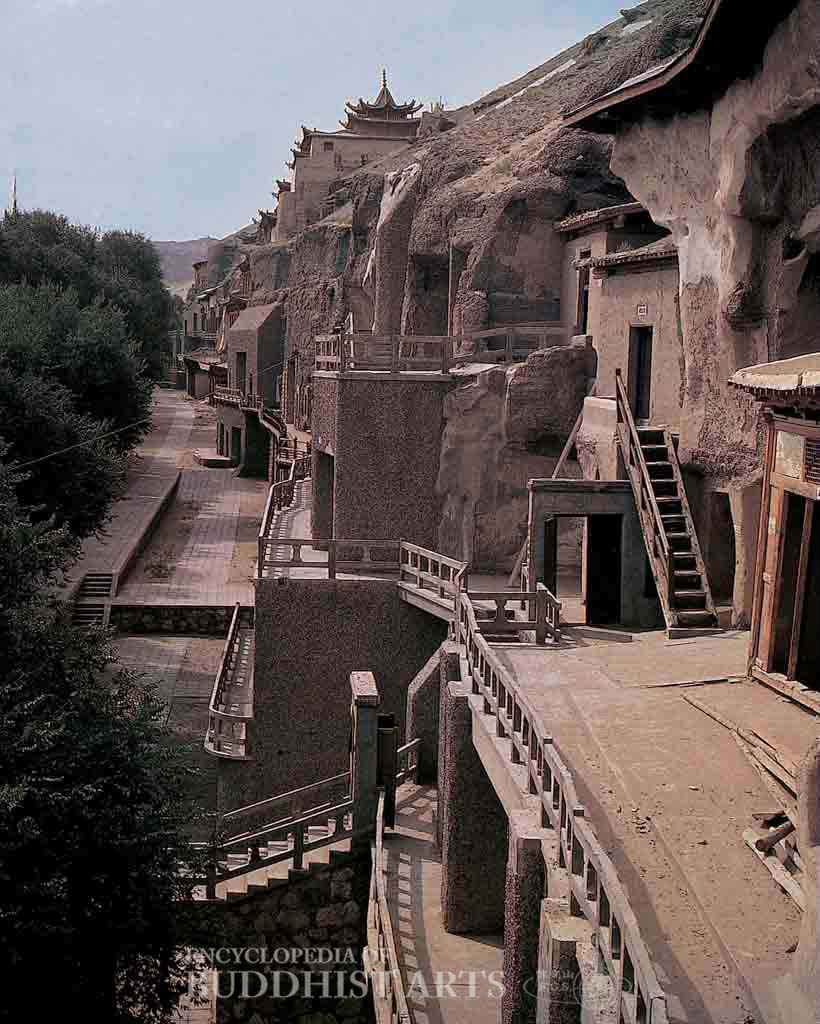
Mogao Caves
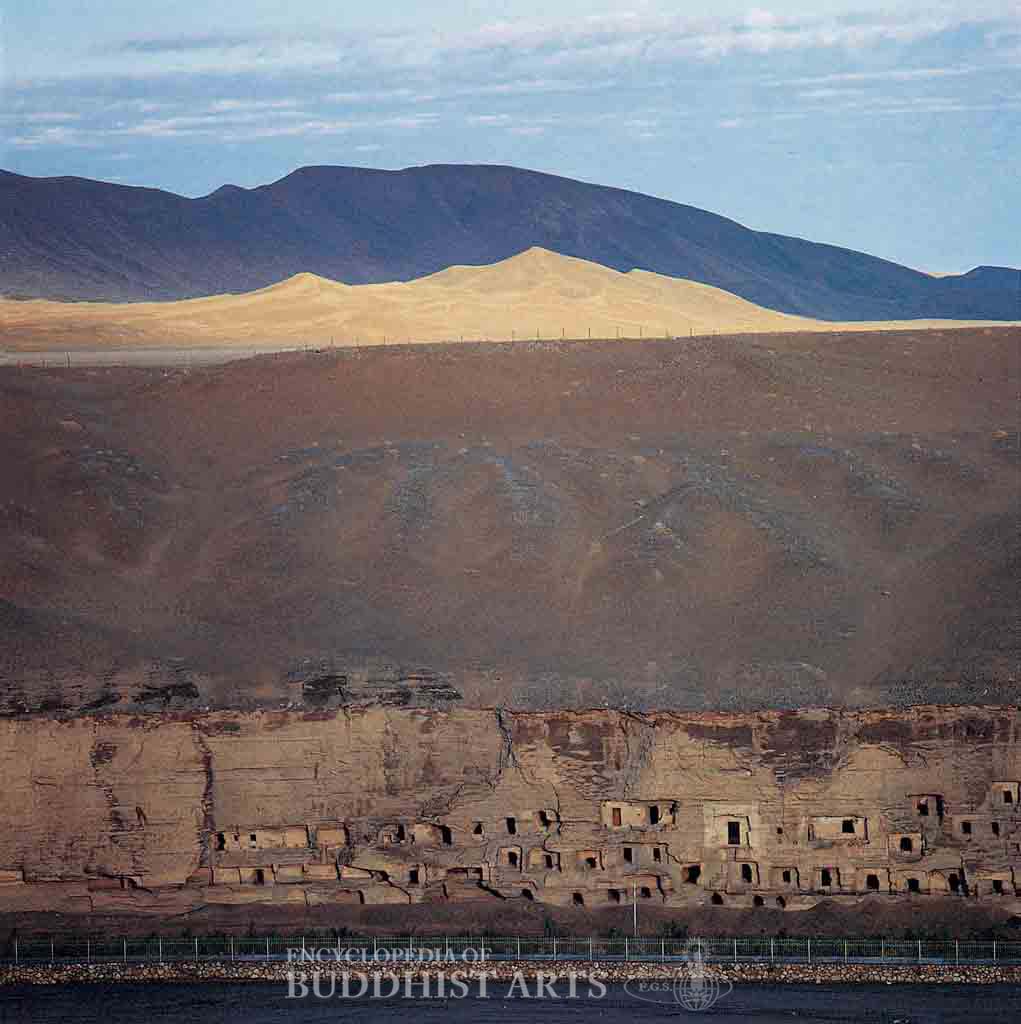
Mogao Caves
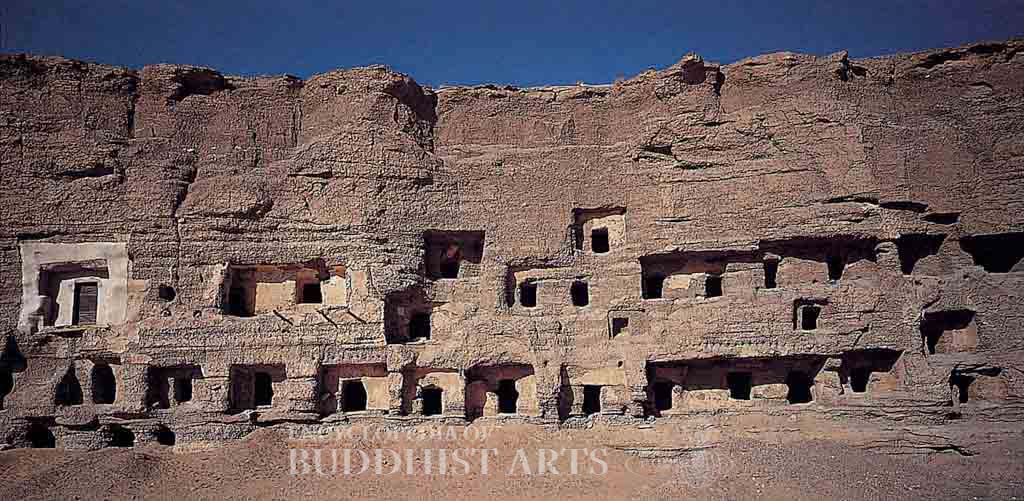
Mogao Caves
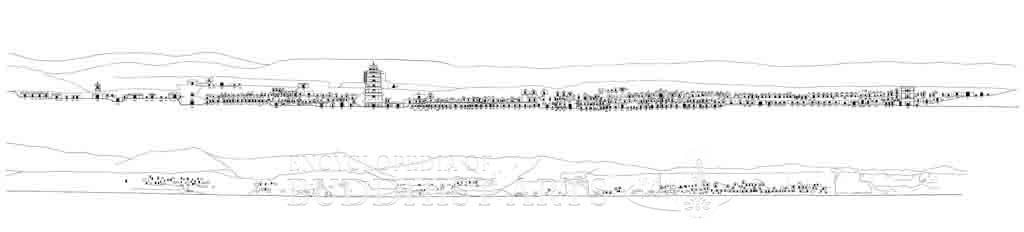
Mogao Caves (elevation drawing)
Mogao Caves
CHINA, Gansu, Dunhuang
Also known as the Thousand Buddha Caves, the Mogao Caves are located 25 km southeast of Dunhuang in Gansu province. All of the caves face east, and they are scattered along the west side of Mingshashan (Singing Sand Mountain), on the banks of the Dangquan River. Extending some 1.7 km along the 15 m to 20 m high cliff face, the caves vary in size and are divided into north and south areas, with the vast majority of artworks preserved in the south. Dunhuang Research Academy, the research institute devoted to the management, preservation, and study of the caves, has identified a total of 735 caves. The Mogao Caves were listed as a National Cultural Heritage Site in 1961, and were listed as a UNESCO World Heritage Site in 1987.
According to stele inscriptions dated to 698, the first caves were constructed in 366 during the Sixteen Kingdoms period. The development of the site can be divided into four distinct phases based on the dominant artistic styles of the time. The first phase covers the Sixteen Kingdoms (303–439) to the Northern Dynasties (386–581), the second was from the Sui dynasty (581–618) to the Tang dynasty (618–907), the third was from the Five Dynasties (907–960) to the Song dynasty (960–1279), and the last covers the Western Xia period (1032–1227) to the Yuan dynasty (1271–1368). The development of the caves continued unabated for over 1,000 years. About 45,000 sq m of murals and more than 2,400 statues have survived to the present day. Numerous styles of Buddhist art from this multicultural region are represented, making the caves an important resource for the study of Buddhist art and a significant source for research into regional art history.
There are 36 caves from the first phase, built during the Sixteen Kingdoms, Northern Wei (386–534), Western Wei (535–556), and Northern Zhou (557–581) dynasties. The oldest are Caves 268, 272, and 275. Caves 254, 257, and 259 date to the Northern Wei dynasty, while Caves 290, 296, 297, and 428 were made during the Northern Zhou dynasty. The basic layouts of these constructions include meditation caves, central pillar caves, and shrine caves. The most common layout is the central pillar cave, with a square support pillar situated at the rear of the cave and a gabled ceiling at the front, usually with imitation wooden architectural features. Shrine caves, also known as truncated pyramidal ceiling caves, began to gain popularity in the later part of the Northern Dynasties, and became the standard in the Sui, Tang, and later dynasties.
From the year 525, when Prince Wang Yuanrong became governor of the region, until the Western Wei dynasty, the style of the statues was heavily influenced by the Buddhist art of the Central Plain. The figures have delicate features, slim builds, and wear loose robes. The Northern Zhou dynasty put more emphasis on veneration of the Buddha, who was usually depicted within a triad or pentad. By that time, the faces and bodies of the statues had become increasingly rounded, a style which came to its full expression during the Sui and Tang dynasties. The Northern Dynasties murals mainly depict Jataka tales, karma stories, and scenes from the Life of the Buddha in two styles of presentation: single illustration and horizontal scroll painting style. Stories from the Life of the Buddha were only displayed in individual scenes during the early Northern Dynasties period, whereas since the Northern Zhou dynasty the stories were presented as sequential illustrations.
The golden age of the Mogao Caves came with the unification of China during the Sui and Tang dynasties. During this second phase, approximately 80 caves were built in the Sui dynasty and more than 200 caves in the Tang dynasty. The dominant styles during the earlier period were shrine caves and altar caves, whereas during the Tang dynasty, a number of great Buddha caves and parinirvana caves were added. Shrine caves were constructed with a main niche on the back wall, or a niche in each of the side and back walls. The style evolved from the truncated pyramidal ceiling caves of the Northern Dynasties. In contrast, altar caves have centrally situated altars with statues, and a backscreen which connects to the ceiling. This style was influenced by the caves of Xi’an and Luoyang during the High Tang period (712–756). The great Buddha caves, such as Caves 96 and 130, have a giant seated Buddha carved into the back wall, with a passageway around the statue for circumambulation. The parinirvana caves, such as Caves 148 and 158, have transverse rectangular layouts with a platform that displays a Reclining Buddha.
From the Early Tang (618–712) to the High Tang (712–756) period, the statues became more refined and realistic. They have plump faces and rounded figures, and Buddhas are depicted with broad shoulders and narrow waists. Bodhisattvas are usually portrayed standing in the tribhanga posture with a gentle and refined gaze. Mid-Tang (756-846) to Late Tang (846–907) statues continued in the High Tang style. Sutra illustrations were a common subject matter for murals in the Sui and Tang dynasties, specifically the Amitabha Sutra, Maitreya Sutras, Lotus Sutra and Vimalakirti Sutra. Illustrations of the Western Pure Land were the most popular, comprising over 100 murals from the Tang dynasty. Murals illustrating the Medicine Buddha Sutra increased in number during the Mid-Tang and Late Tang periods. In addition to these, Vajrayana themes and Buddhist history were also popular in the Tang dynasty.
During the Five Dynasties (907–960) and the Northern Song dynasty (960–1127), Dunhuang was under the rule of the Cao family (914–1036), who established art academies modeled after those in the Central Plain. In this third phase, there are 55 caves built by the Cao family, the majority with large, U-shaped altars in the center. Many of these caves are located low on the cliffs with easy public access; as a result, most of the statues are damaged or missing. Following trends from the Late Tang, the murals mainly contain illustrations from the Medicine Buddha Sutra, Vimalakirti Sutra, Maitreya Sutras, and Avatamsaka Sutra. The Usnisavijaya Dharani Sutra and the Sutra of the Wise and the Foolish emerged as new subjects for sutra illustrations during this period, and depictions of historical locations such as Wutaishan (Five Plateau Mountain) were also popular. Depictions of donors tended to become more prominent in the murals during this time.
In the fourth phase, there are 77 caves that date from the Western Xia period. According to new research, some can be attributed to the Cao regime and others to the Uighurs. The majority of these caves are conversions from earlier periods. The structure and style of the murals and donor images became systematic, and featured new subjects including the Sixteen Arhats, Vajrapani images, and the Mandala of the Five Buddhas. Approximately 10 caves from the Yuan dynasty are preserved, most with truncated pyramidal ceilings, but there are some with central pillar caves modeled after the early layout. Vajrayana themes such as mandalas, and Thousand-Armed, Thousand-Eyed Avalokitesvara exhibit the marvelous skill and complex technique of the artists during this period.
For more details, go to the Encyclopedia of Buddhist Arts: Caves M-Mo, page 821.
Cite this article:
author = Hsingyun and Youheng and Johnson, Peter and Mankuang and Huntington, Susan and Edson, Gary and Neather, Robert,
booktitle = {Encyclopedia of Buddhist Arts: Caves M-Mo},
pages = 821,
title = {{Mogao Caves}},
volume = 7,
year = {2016}}