
Arhat
Ink on silk
Arhat
CHINA; Qing dynasty
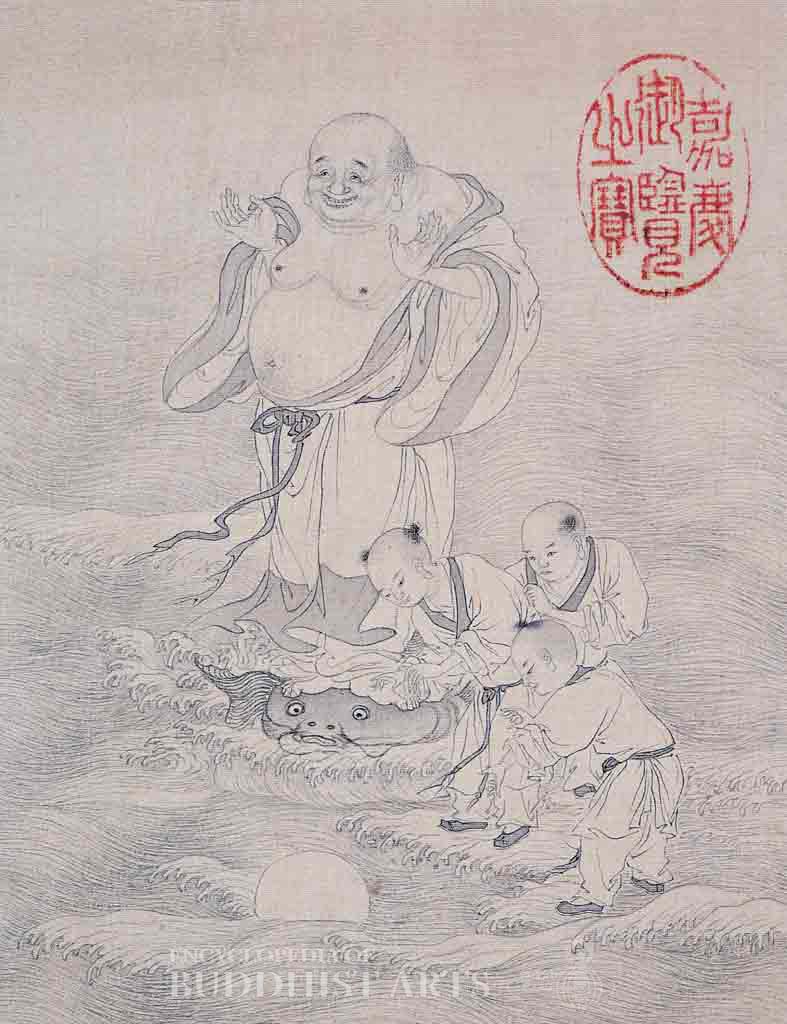
The seal in the upper right corner of this picture from Jin Tingbiao’s Line Drawings of Arhats indicates that it was part of the Qing dynasty Imperial Art Collection. During the Southern Inspection Tour of Emperor Qianlong (reigned 1736–1795), Jin presented Line Drawings of Arhats for imperial review, and was later summoned to work at the Emperor’s court.
This picture portrays an Arhat that resembles the legendary monk Qieci of the Later Liang dynasty (907–923). Qieci, considered to be a manifestation of Maitreya Bodhisattva, is popularly known as Budai (“cloth sack”) because he often carried a cloth sack hanging from a stick. The Arhat has a round, joyful face and a bulging bare belly. Dressed in a wide-sleeved robe, Budai stands on the back of a wide-eyed fish that appears to be flattened out under the weight of the heavyset Arhat. On the right, three young attendants stand upon waves and reach for a pearl. Portrayed with fluid lines of varying pressure, the undulations of the waves are beautifully depicted.
For more details, go to the Encyclopedia of Buddhist Arts: Painting A-H, page 56.
Cite this article:
author = Hsingyun and Youheng and Youlu and Wilson, Graham and Manho and Mankuang and Huntington, Susan,
booktitle = {Encyclopedia of Buddhist Arts: Painting A-H},
pages = 56,
title = {{Arhat}},
volume = 14,
year = {2016}}