
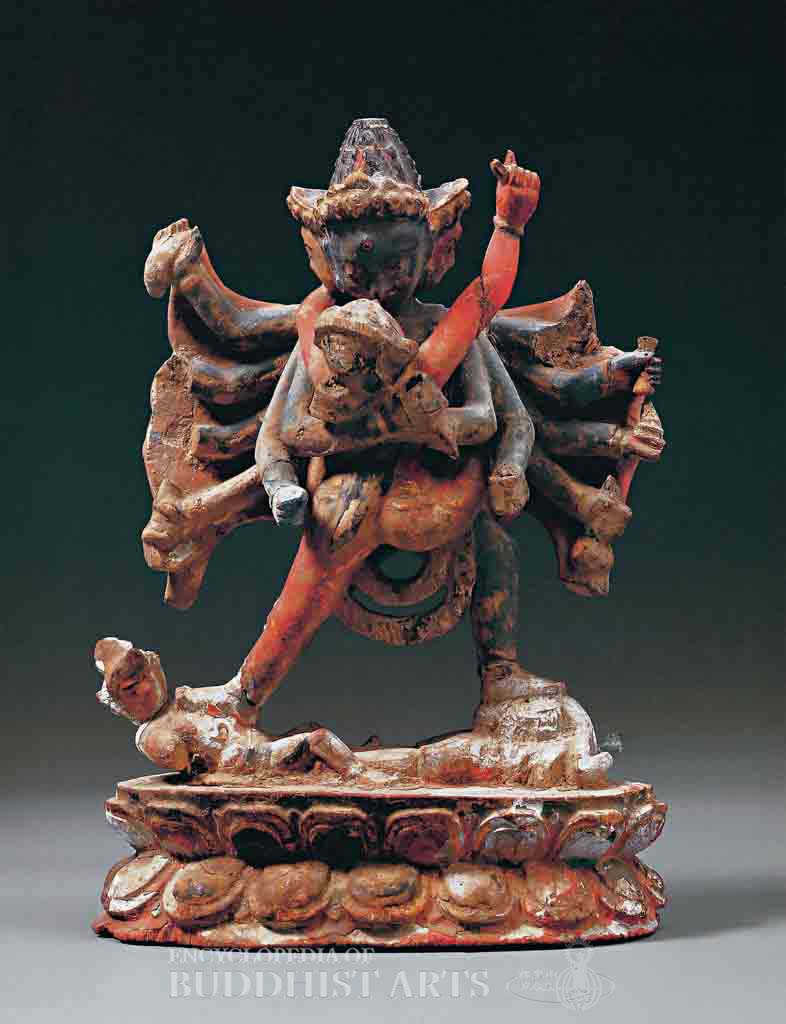
Baisikou Twin Pagodas: Statuette of Cakrasamvara
Wood
Baisikou Twin Pagodas: Statuette of Cakrasamvara
CHINA, Ningxia, Yinchuan; Western Xia period
This Vajrayana Buddhist statuette was recovered from the west pagoda of the Baisikou Twin Pagodas in 1986. It is a colored wood carving that was created during the Western Xia period (1032–1227).
Cakrasamvara has four heads colored in blue, red, white, and yellow, and a blue body with 12 arms. Each head is crowned with skulls and every face has three protruding eyes and a high-bridged nose. The left leg is bent, while the right leg is outstretched. Both legs trample on two demons reclining on a double lotus pedestal.
Two of the four prominent arms of Cakrasamvara are wrapped around his consort, Vajravarahi, and the remaining arms are outstretched holding items such as a vajra and bell. Vajravarahi is red and has a bare upper body. She wears a five-skull crown and peers into the eyes of Cakrasamvara while holding a chopper in the right hand, and securing her left arm around the neck of Cakrasamvara.
For more details, go to the Encyclopedia of Buddhist Arts: Artifacts, page 6.
Cite this article:
author = Hsingyun and Youheng and Youji and Pokorski, Stefanie and Mankuang and Fan, Wen,
booktitle = {Encyclopedia of Buddhist Arts: Artifacts },
pages = 6,
title = {{Baisikou Twin Pagodas: Statuette of Cakrasamvara}},
volume = 18,
year = {2016}}