
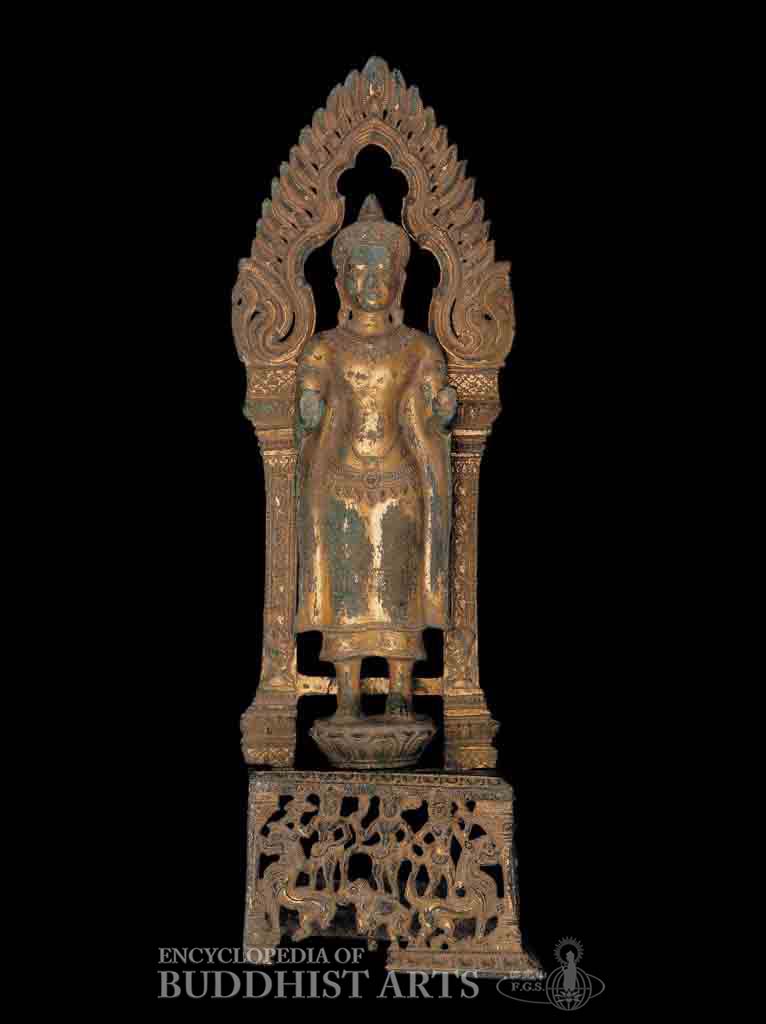
Crowned Buddha
Gilt bronze
Crowned Buddha
THAILAND
This type of sculpture was prevalent during the 13th century. The gilded Buddha image, mandorla, and base were cast separately then combined.
The mandorla is shaped like a doorway with an exquisitely decorated pillar on either side. A makara stands on top of each capital and their tails extend upward and join to form a decorative arch with flame-like patterns along the edges.
Three figures can be seen within the openwork base. They have one hand on their hips while the other holds an object. The figure in the center balances on an elephant, while the other two stand on lions.
The Buddha stands on a lotus pedestal and is dressed like a member of royalty wearing a crown, large earrings, necklaces, armlets, and jeweled belt. The ornaments are in Khmer style but the shape of the body follows Thai aesthetics. Despite damage to the fingers, it is thought that the Buddha may be forming the vitarka (teaching) mudra. The diaphanous robe covers both shoulders and allows the shape of the figure to be visible underneath.
The openwork pedestal was influenced by the Khmer style and made popular during the 10th to 12th century. The rest of the statue, however, is more similar to the Lopburi style.
For more details, go to the Encyclopedia of Buddhist Arts: Sculpture A-F, page 268.
Cite this article:
author = Hsingyun and Youheng and Lovelock, Yann and Chou, Yuan and Huntington, Susan and Edson, Gary and Neather, Robert,
booktitle = {Encyclopedia of Buddhist Arts: Sculpture A-F},
pages = 268,
title = {{Crowned Buddha}},
volume = 10,
year = {2016}}