
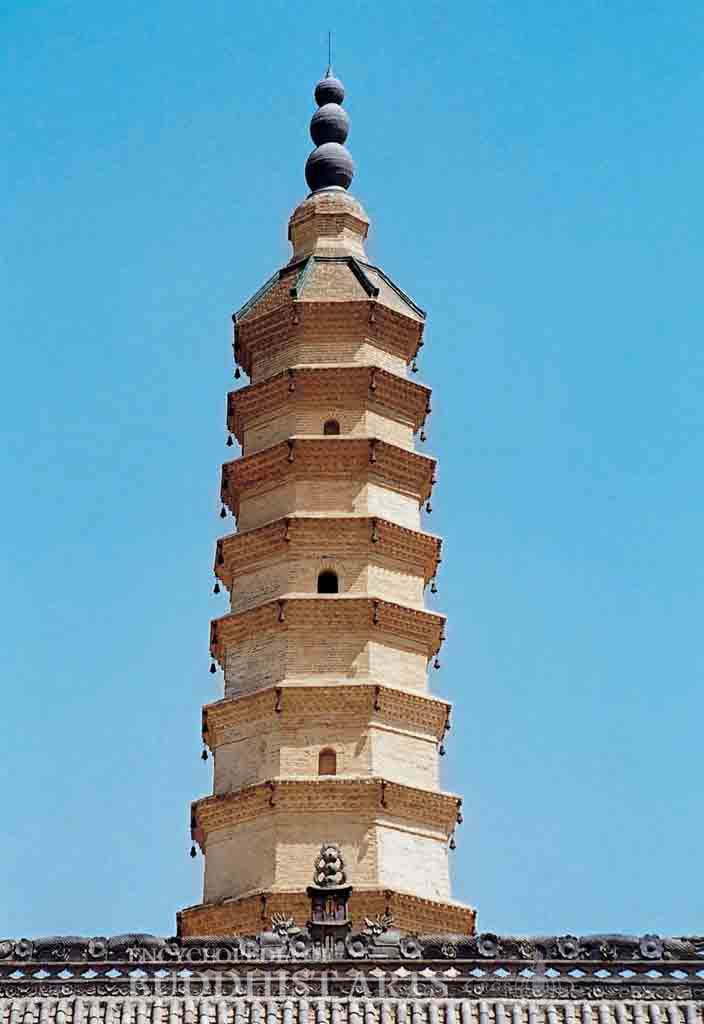
Yongshou Pagoda
Yongshou Pagoda
CHINA, Ningxia, Zhongwei
The pagoda is located within Anqing Temple and is situated on the cliff above the Yellow River. According to local records, it was built during the rule of Emperor Yizong (reigned 1048–1067) of the Western Xia period. It was destroyed by a powerful earthquake in 1561 during the Ming dynasty and was rebuilt between 1569 and 1580. It was severely damaged by another earthquake in 1709 during the Qing dynasty. It was repaired in 1985 and is listed as a Provincial Cultural Heritage Site.
The nine-story, octagonal, hollow, brick pagoda is 36 m high. Each side of the base is 3.2 m long. The first story is high and on the south side there is a doorway leading to a chamber. From the second story upwards, the position of the arched doorways alternate. The eaves consist of courses of dogtooth bricks. Above the octagonal pyramidal roof, there is a harmika in the form of an inverted bowl followed by three jewels.
For more details, go to the Encyclopedia of Buddhist Arts: Architecture T-Z, page 1362.
Cite this article:
author = Hsingyun and Youheng and Johnson, Peter and Mankuang and Lancaster, Lewis,
booktitle = {Encyclopedia of Buddhist Arts: Architecture T-Z},
pages = 1362,
title = {{Yongshou Pagoda}},
volume = 4,
year = {2016}}