
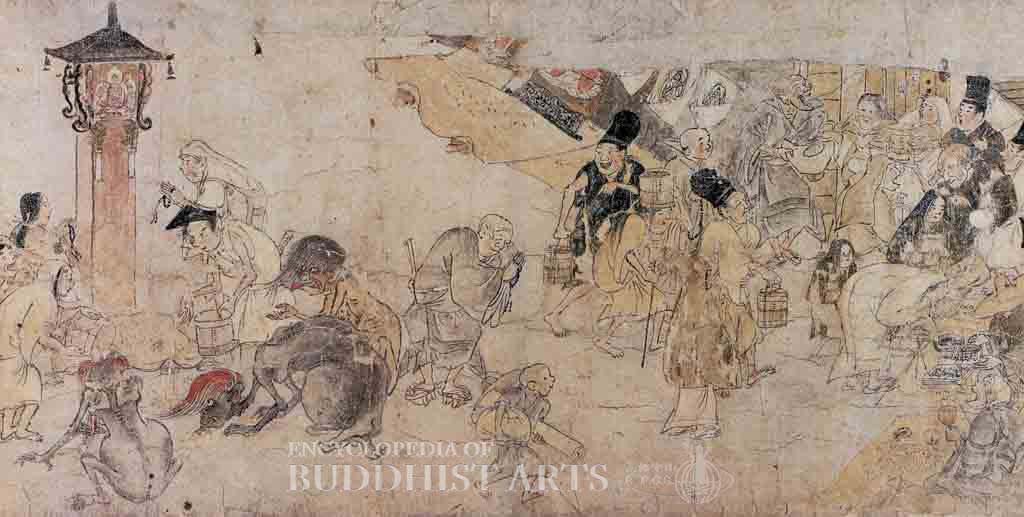
Scrolls of Hungry Ghosts: Hungry Ghosts Drinking Water (second section)
Ink and color on paper
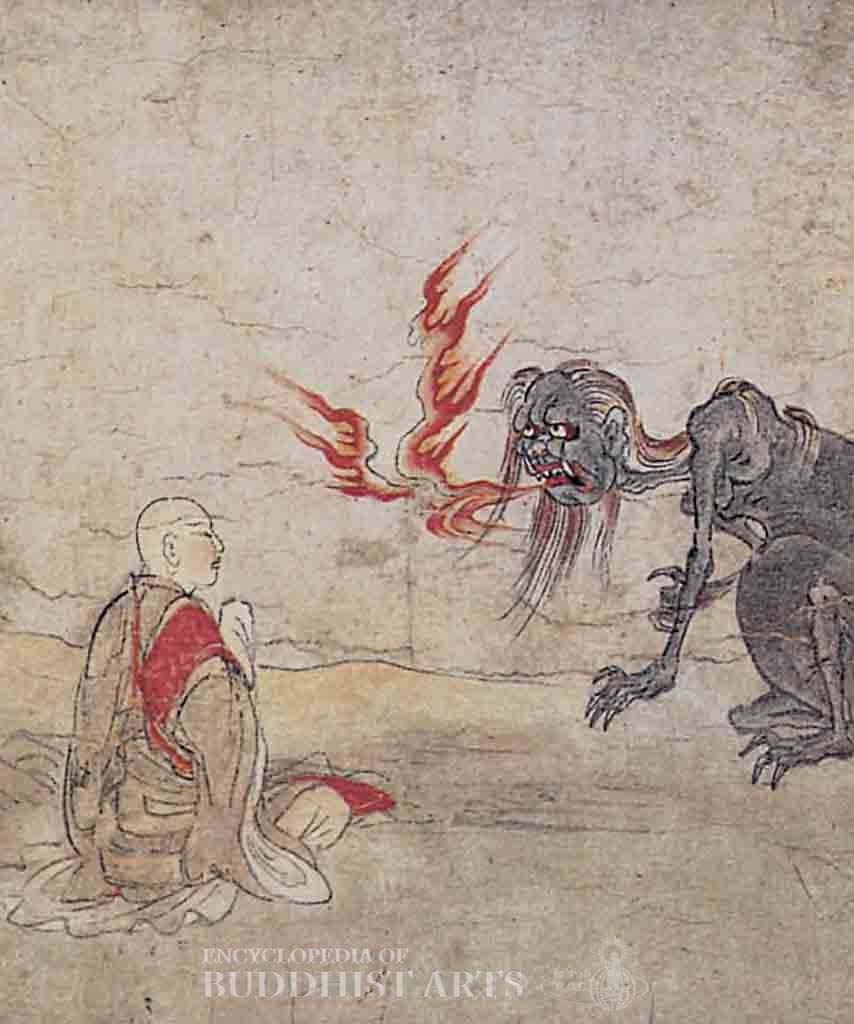
Scrolls of Hungry Ghosts: Burning-Mouth Hungry Ghost (sixth section)
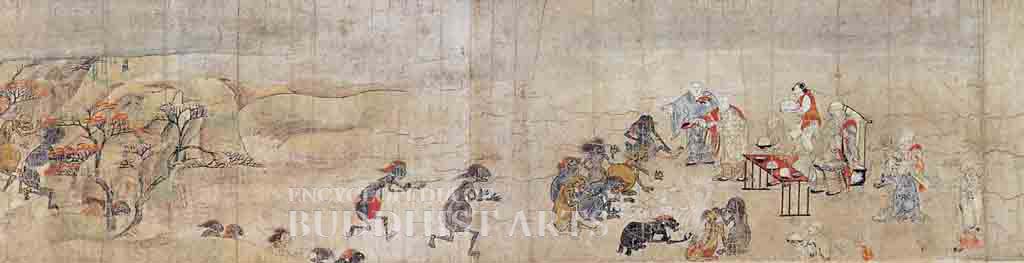
Scrolls of Hungry Ghosts: Hungry Ghosts Running to an Offering Service (seventh section)
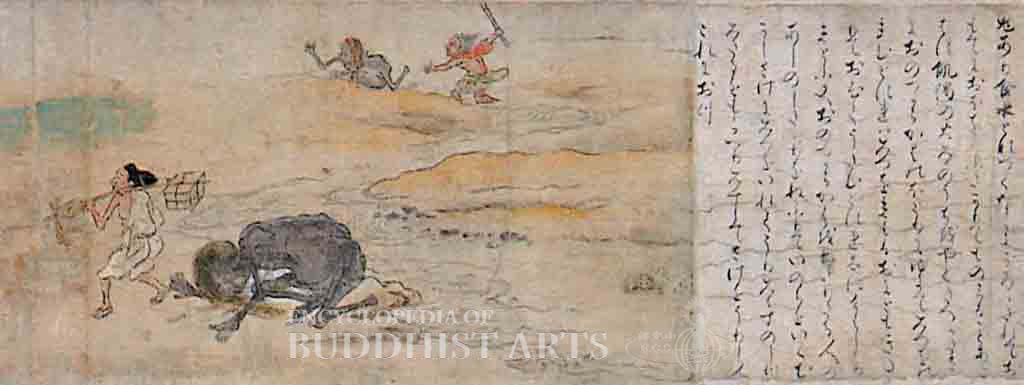
Scrolls of Hungry Ghosts: Hungry Ghosts by a River (first section)
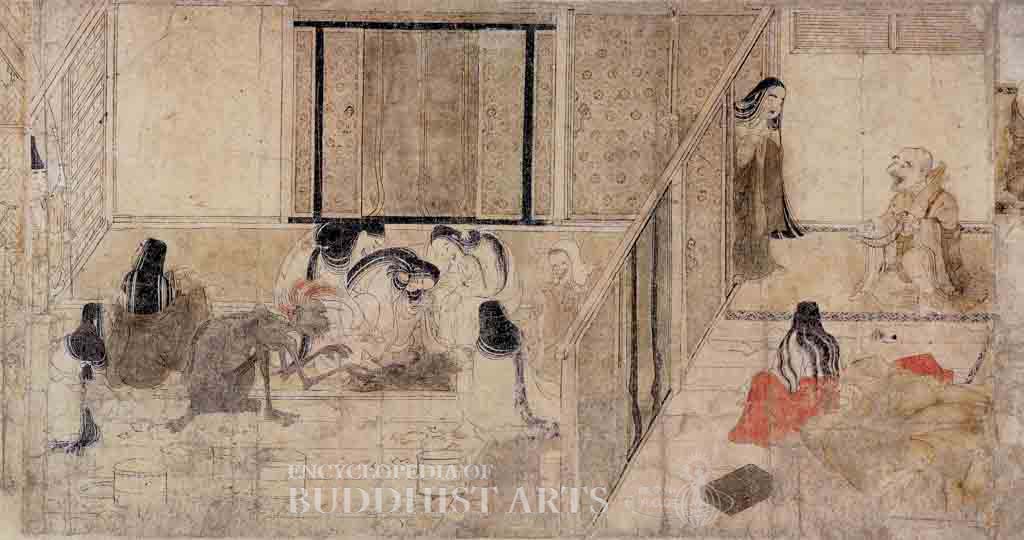
Scrolls of Hungry Ghosts: Hungry Ghost in a Birthing Room (second section)
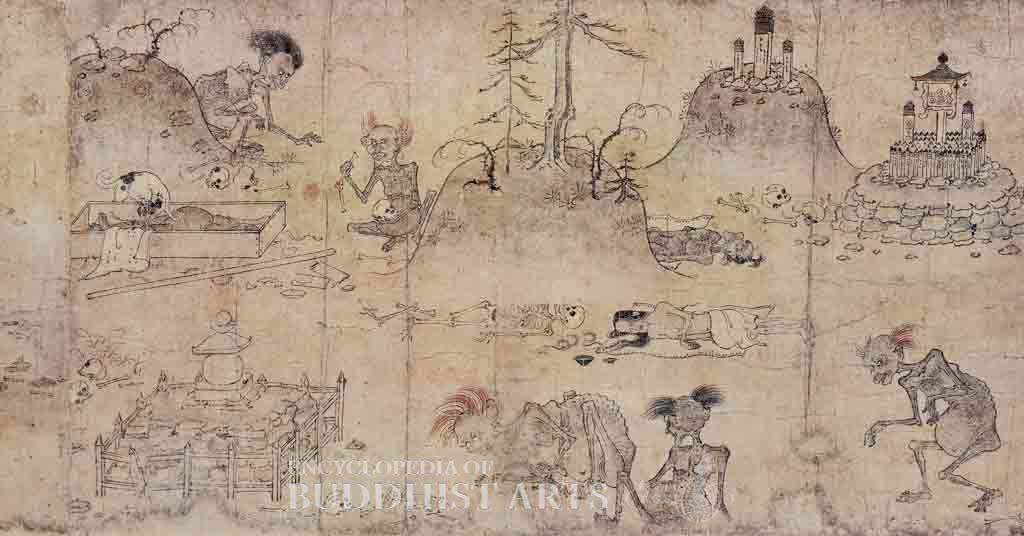
Scrolls of Hungry Ghosts: Hungry Ghosts in a Graveyard (fourth section)
Scrolls of Hungry Ghosts
JAPAN; Kamakura period
These scrolls covered with imaginative depictions of hungry ghosts were painted during the 12th century. They are known as the Gaki Zoshi in Japan. One scroll, kept by the Kyoto National Museum, is based on descriptions in the Saddharma Smrtyupasthana Sutra, the Ulka Mukha Preta Sutra, and the Ullambana Sutra. Measuring 27.3 cm in height and 541 cm in length, it is comprised of seven sections of calligraphy and seven illustrations, and was listed as a National Treasure in 1953.
The other scroll, 27.3 cm in height and 384 cm in length, is kept in the Tokyo National Museum. It contains ten sections based on the 16th and 17th fascicles of the Saddharma Smrtyupasthana Sutra, and was listed as a National Treasure in 1952.
The second section of the scroll from the Kyoto National Museum is a portrayal of a busy street scene in front of a temple gate during an Ullambana Service. The Amitabha Buddha Triad is enshrined in a pagoda on the left. Two people stand below the pagoda with their palms joined in reverence and prayer beads in hand, appearing to make offerings of food. Beside them, two other figures pour water from pails. Invisible to the surrounding people, hungry ghosts crouch on the ground and desperately lick up the water. In the lower right corner, a woman with a stole draped over her head watches a squatting figure wearing a bamboo hat print a Buddha image from a carved woodblock. The street is full of jostling people with varying expressions.
The sixth section of the same scroll depicts the Burning-Mouth Ghost King crouching on all fours before Ananda. The ghost king has disheveled hair, pointed nails, exposed fangs, and an emaciated build. In the seventh section of the scroll, monks recite dharanis and the names of the Buddhas while casting food to the floor. Hungry ghosts, wearing only loincloths, are seen racing out from the wilderness towards the Dharma service to receive the offering of nourishment. The first section of the scroll shows a hungry ghost licking up water that has dripped from the feet of a person who has just crossed a river, while in the background another hungry ghost is chased away from the river by a hell guardian.
In the second section of the scroll kept in the Tokyo National Museum, a hungry ghost who feeds on infant excrement is shown waiting anxiously in a birthing room in order to obtain the baby’s stool. The fourth section of this scroll depicts hungry ghosts roaming about in a graveyard.
Both scrolls are composed of soft mica paper. The illustrations are done in yamato-e style with quick, clean strokes, filled in with a light wash of colors. They portray lively scenes from the daily lives of common people and vividly illustrate the sufferings undergone by beings born in the realm of hungry ghosts. Some of the images have an almost comic tone; the ghosts have exaggerated features and appear frantic. However, the pictures are also a stern warning about the consequences of excessive greed and craving.
For more details, go to the Encyclopedia of Buddhist Arts: Painting P-Z, page 798.
Cite this article:
author = Hsingyun and Youheng and Youlu and Wilson, Graham and Manho and Mankuang and Huntington, Susan,
booktitle = {Encyclopedia of Buddhist Arts: Painting P-Z},
pages = 798,
title = {{Scrolls of Hungry Ghosts}},
volume = 16,
year = {2016}}