
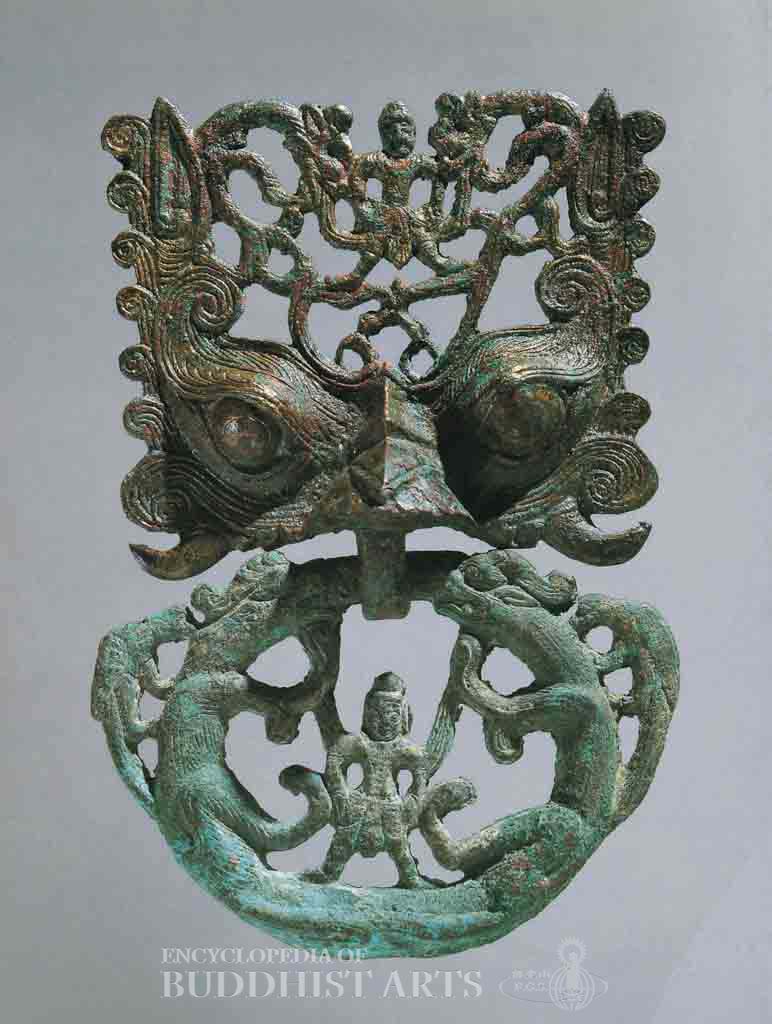
Guyuan Northern Wei Tomb: Door Knocker with Buddhas
Bronze
Guyuan Northern Wei Tomb: Door Knocker with Buddhas
CHINA, Ningxia, Yinchuan; Northern Wei dynasty
This door knocker is one of a pair that was unearthed in 1981 from the Guyuan Northern Wei Tomb at the Leizumiao Village in Yinchuan. It was attached to a coffin dated to between 471 and 499 of the Northern Wei dynasty. The square base of the knocker is known as a pushou, and this particular stylistic variety, featuring mythical creatures, was often found on the doors of buildings. It is believed that they would protect the individuals inside. As such, this usage was applied to the coffin doors. In addition, the inclusion of Buddhist images on burial items was believed to aid the deceased in ascending to heaven.
The mythical creature on this door knocker has protruding eyes and tall ears. Along the side of the ears are decorations of cloud patterns, and among the openwork design at the top center is a pair of dragons flanking a Buddha figure. The Buddha, who stands in an imposing manner, places his hands at his waist as his elbows touch the head of each dragon.
Below, the oval ring used for knocking is formed by two dragons with another image of the Buddha at the bottom center. The dragons have round eyes, curved horns and fangs, and carry phoenixes on their backs. This Buddha, appearing similar to the one above, also resembles those depicted in Gandharan narrative panels from the 3rd and 4th centuries. This aspect demonstrates the Gandharan influence on early Buddhist art in China.
For more details, go to the Encyclopedia of Buddhist Arts: Artifacts, page 114.
Cite this article:
author = Hsingyun and Youheng and Youji and Pokorski, Stefanie and Mankuang and Fan, Wen,
booktitle = {Encyclopedia of Buddhist Arts: Artifacts },
pages = 114,
title = {{Guyuan Northern Wei Tomb: Door Knocker with Buddhas}},
volume = 18,
year = {2016}}