
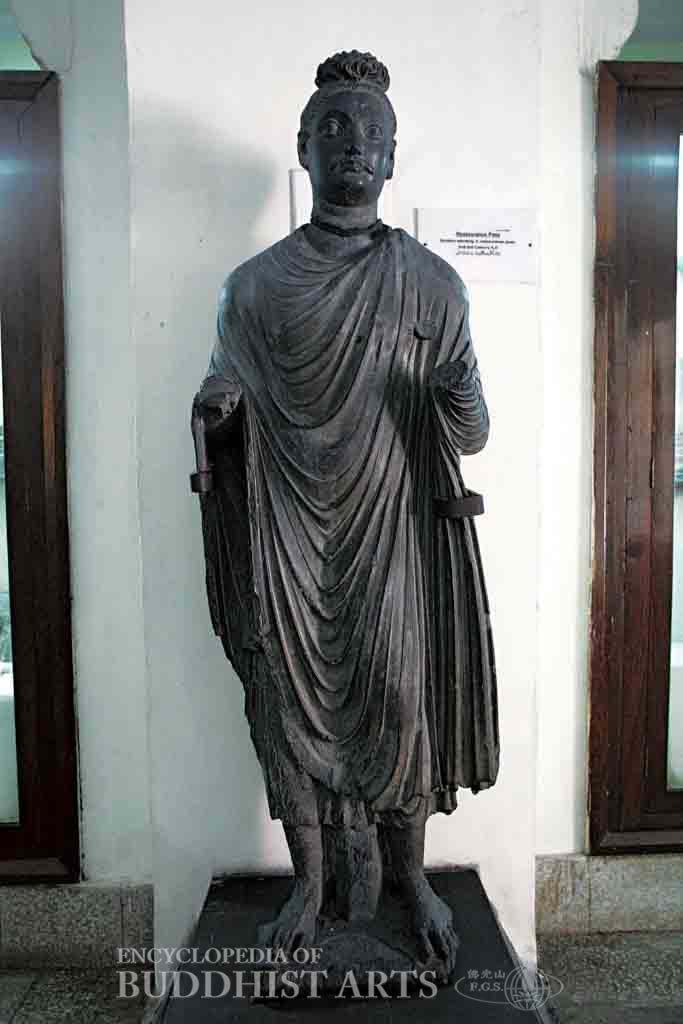
Standing Buddha
Schist
Standing Buddha
PAKISTAN
The typical Gandharan stance of one knee bent, throwing the body’s weight on the right with the waist displaced to the left and the head to the right. The wavy hair is built into a flattened topknot, below which there is an urna, mid-forehead. The wide-open eyes are characteristic of Gandharan statues. A monastic robe covers both shoulders, with thick folds descending in waves over the body but allowing the shape beneath to show through. The Buddha is barefoot and has long, slender toes.
For more details, go to the Encyclopedia of Buddhist Arts: Sculpture St-Z, page 1149.
Cite this article:
Hsingyun, et al. "Standing Buddha." Encyclopedia of Buddhist Arts: Sculpture St-Z, vol. 13, 2016, pp. 1149.
Hsingyun, Youheng, Yann Lovelock, Yuan Chou, Susan Huntington, Gary Edson, and Robert Neather. 2016. "Standing Buddha" In Encyclopedia of Buddhist Arts: Sculpture St-Z, 13:1149.
Hsingyun, Youheng, Lovelock, Y., Chou, Y., Huntington, S., Edson, G., & Neather, R.. (2016). Standing Buddha. In Encyclopedia of Buddhist Arts: Sculpture St-Z (Vol. 13, pp. 1149).
@misc{Hsingyun2016,
author = Hsingyun and Youheng and Lovelock, Yann and Chou, Yuan and Huntington, Susan and Edson, Gary and Neather, Robert,
booktitle = {Encyclopedia of Buddhist Arts: Sculpture St-Z},
pages = 1149,
title = {{Standing Buddha}},
volume = 13,
year = {2016}}
author = Hsingyun and Youheng and Lovelock, Yann and Chou, Yuan and Huntington, Susan and Edson, Gary and Neather, Robert,
booktitle = {Encyclopedia of Buddhist Arts: Sculpture St-Z},
pages = 1149,
title = {{Standing Buddha}},
volume = 13,
year = {2016}}