
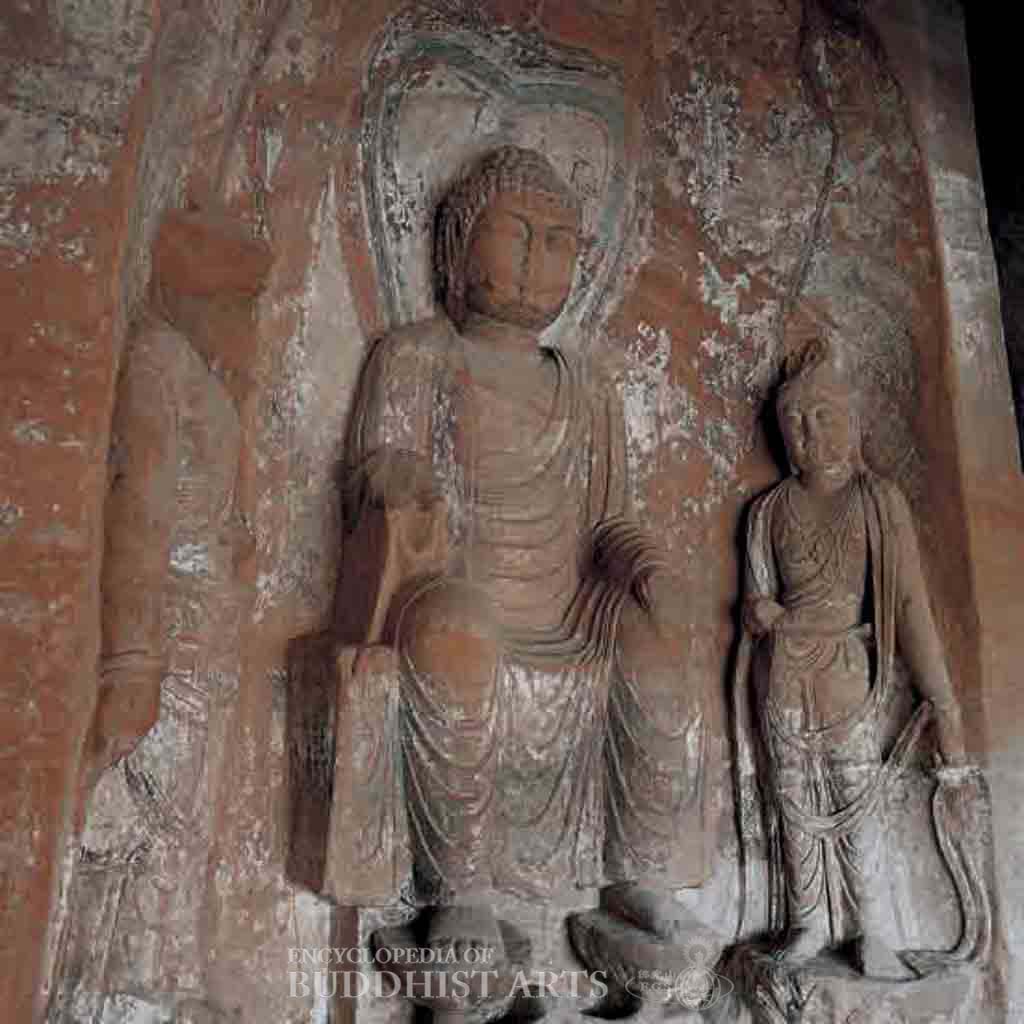
Xumishan Grotto 105: Central Pillar (east side niche)
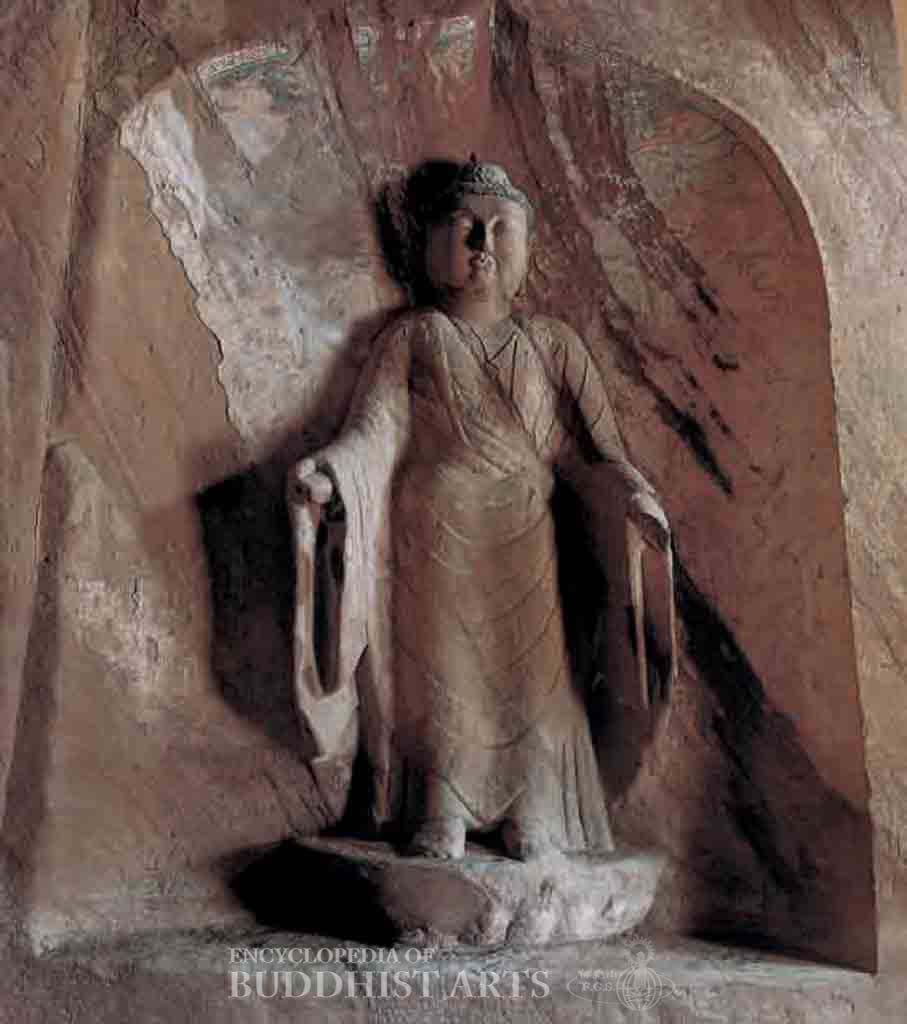
Xumishan Grotto 105: Main Chamber - Standing Buddha (north wall, left side)
Xumishan Grotto 105
CHINA, Ningxia, Guyuan
This grotto is located in the Taohua (Peach Blossom) area and contains the only central pillar grotto in the Xumishan system from the Tang dynasty (618–907). The grotto has a front and rear chamber. The north and south walls of the front chamber each have two niches stacked vertically. The rectangular rear chamber measures 8.5 m wide, 5.9 m high, and 7.3 m deep.
The central pillar has a niche on all four sides with each niche containing three statues. The central figures are Maitreya Buddha, Amitabha Buddha, Ksitigarbha Bodhisattva, and Avalokitesvara Bodhisattva. The Buddhas inside the niches wear monastic robes draped over both shoulders. A seated Maitreya Buddha with both feet resting on a lotus pedestal is enshrined in the niche on the east side. The west niche contains the Amitabha Buddha seated in full lotus position on a Sumeru throne. Avalokitesvara is in the south niche and wears a headdress with an image of a Buddha. The statue of Ksitigarbha in the north niche sits in the relaxation posture on a Sumeru throne.
The back (west), south, and north walls of the rear chamber contain two niches that form a three-wall, six-niche layout. Inside each niche there are carvings of one Buddha and two Bodhisattvas. The Buddha in the left niche of the south wall wears a monastic robe over both shoulders and is flanked by bare-chested Bodhisattvas standing on lotus pedestals. The right niche is similar to the left niche but has unfortunately been destroyed. The central figure in the right niche on the north wall wears a monastic robe that hangs from both shoulders. The flanking Bodhisattvas are slightly smaller in size and weathered. The hand of the standing Buddha in the left niche is missing.
The various representations of Sakyamuni Buddha, Maitreya Buddha, as well as Avalokitesvara and Ksitigarbha Bodhisattvas, in this grotto attest to the spread of Tang Buddhist thought in the Yuanzhou area (present day Guyuan, Ningxia).
For more details, go to the Encyclopedia of Buddhist Arts: Caves T-Z, page 1537.
Cite this article:
author = Hsingyun and Youheng and Johnson, Peter and Mankuang and Huntington, Susan and Edson, Gary and Neather, Robert,
booktitle = {Encyclopedia of Buddhist Arts: Caves T-Z},
pages = 1537,
title = {{Xumishan Grotto 105}},
volume = 9,
year = {2016}}