
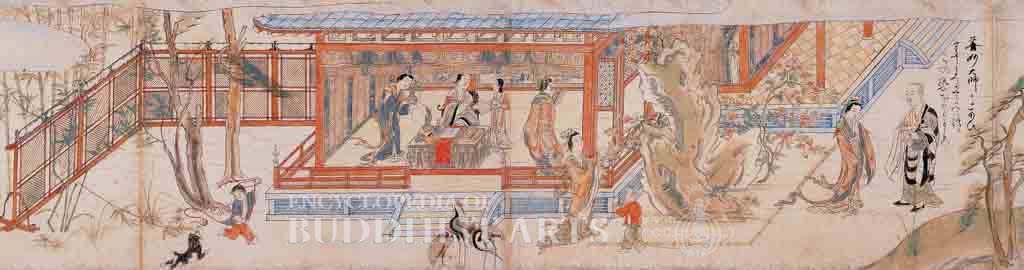
Kozanji Temple: Patriarchs of the Hwaeom School - Uisang - Scroll 2 (detail)
Ink and color on paper
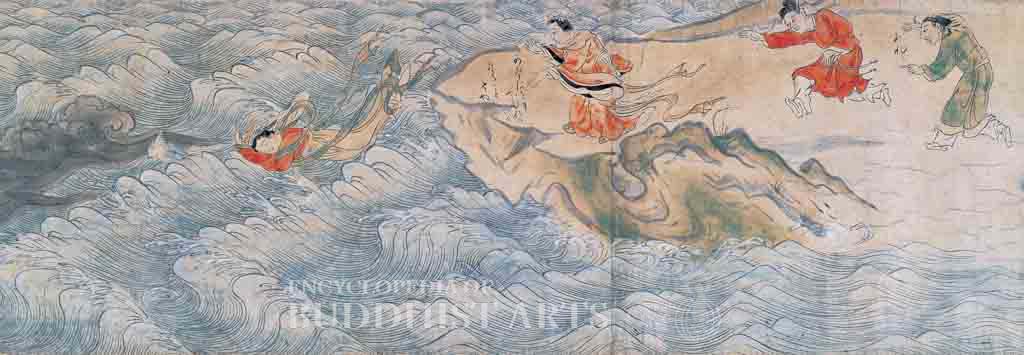
Kozanji Temple: Patriarchs of the Hwaeom School - Uisang - Scroll 3 (detail)
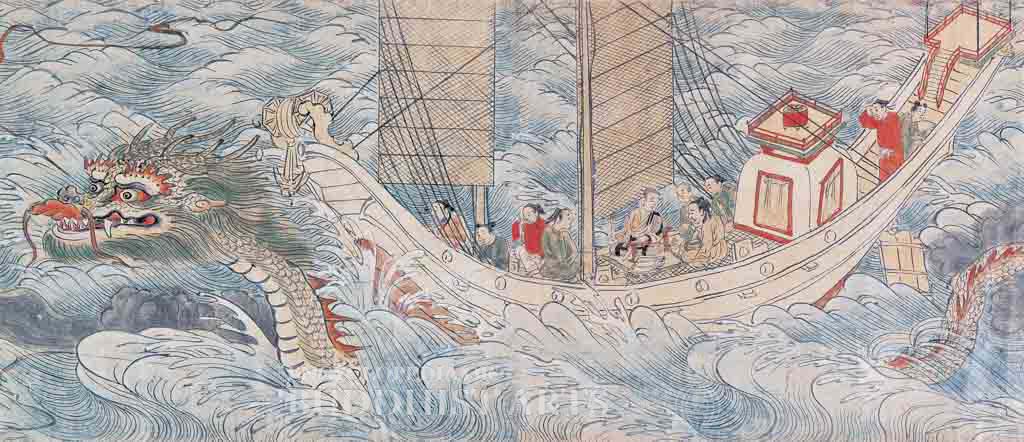
Kozanji Temple: Patriarchs of the Hwaeom School - Uisang - Scroll 3 (detail)
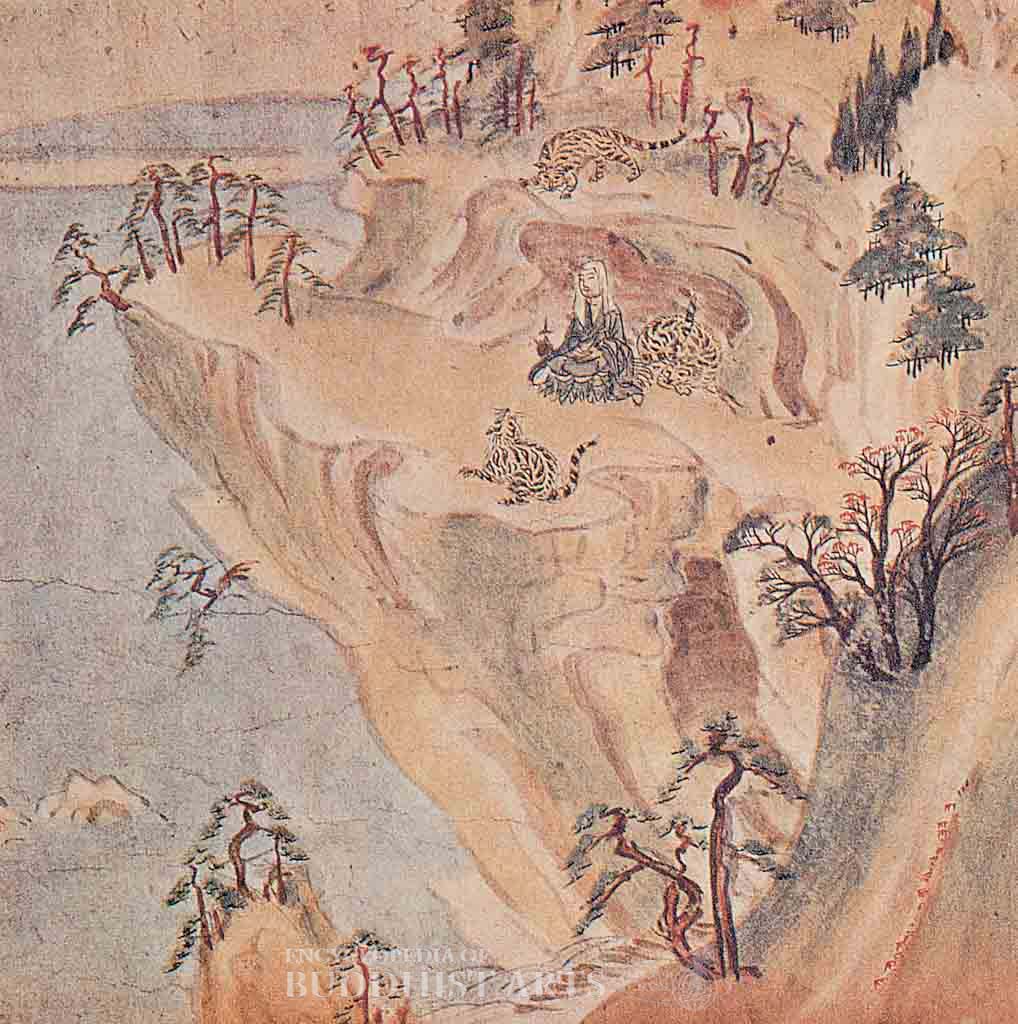
Kozanji Temple: Patriarchs of the Hwaeom School - Wonhyo - Scroll 2 (detail)f
Kozanji Temple: Patriarchs of the Hwaeom School
JAPAN, Kyoto; Kamakura period
Also known as the Origin of the Hwaeom School, this set of scrolls, based on the Chinese Song dynasty version of Biographies of Eminent Monks, illustrate the lives of the Korean masters Uisang and Wonhyo, the founders of the Hwaeom school of Korean Buddhism in the 7th century of the Silla dynasty (57 BCE–935 CE). The postscripts were written by the Japanese monk Myoe of Kozanji Temple, Kyoto. There are seven scrolls, three of which are the biography of Wonhyo, and four that illustrate the biography of Uisang. The scrolls are 31.7 cm high and vary in length from 748.3 cm to 1,712 cm. The resemblance of the images of Wonhyo in the scroll to the painting of Myoe kept in Kozanji Temple suggests the scrolls were painted by Jonin. They date from the 13th century and were listed as National Treasures in 1952.
The scrolls depict Uisang and Wonhyo journeying to China during the Tang dynasty (618–907) to study the Dharma. Along the way, Wonhyo attained spontaneous enlightenment after accidentally drinking water from a skull, and felt that it was unnecessary to continue the journey. He returned to Korea, where, according to legend, he received the Vajrasamadhi Sutra from the naga king and began to teach and write commentaries on it. He became highly respected after he cured the illness of a royal consort. Meanwhile, Uisang continued his studies in China. During his travels, he met a beautiful girl named Shanmiao. She fell in love with Uisang, but he could not break his monastic vows, and urged her to open her heart and embrace the teachings of the Buddha instead. When Uisang was about to leave China, Shanmiao rushed to see him off, but she came to the harbor too late. She jumped into the water, and through the strength of her love, transformed into a dragon and escorted his ship back to Korea.
The second scroll of Uisang’s biography depicts Shanmiao expressing her love to Uisang, who is making his alms round in the courtyard of a large house. The two are shown on the right, standing between two trees. Within the house, a man sits behind a table examining records, accompanied by two attendants. The third scroll depicts Shanmiao jumping off a cliff into the water, and as a large dragon swimming beside Uisang’s ship. The boat, the waves, and the dragon are painted with fine dotted lines.
The second scroll of the biography of Wonhyo depicts him meditating on a cliff. He is surrounded by three tigers. One tiger sleeps beside him, and looks down at another tiger crouched by the edge of the cliff. A third tiger stands on a rock above Wonhyo. Small trees are shown on the sides on the mountain.
For more details, go to the Encyclopedia of Buddhist Arts: Painting I-O, page 454.
Cite this article:
author = Hsingyun and Youheng and Youlu and Wilson, Graham and Manho and Mankuang and Huntington, Susan,
booktitle = {Encyclopedia of Buddhist Arts: Painting I-O},
pages = 454,
title = {{Kozanji Temple: Patriarchs of the Hwaeom School}},
volume = 15,
year = {2016}}