
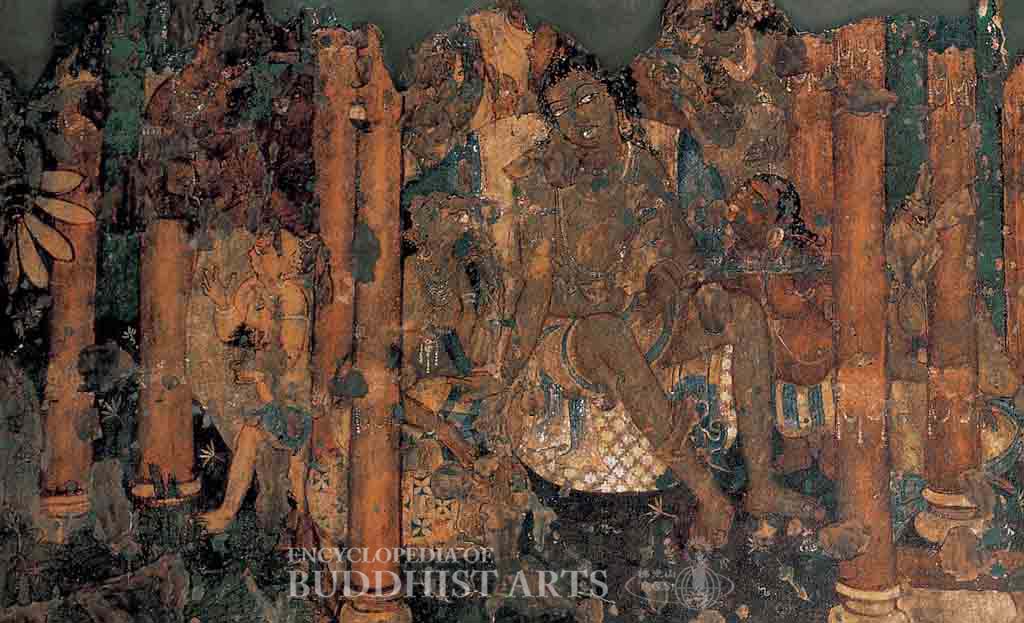
Ajanta Cave 1: Campeya Jataka (detail)
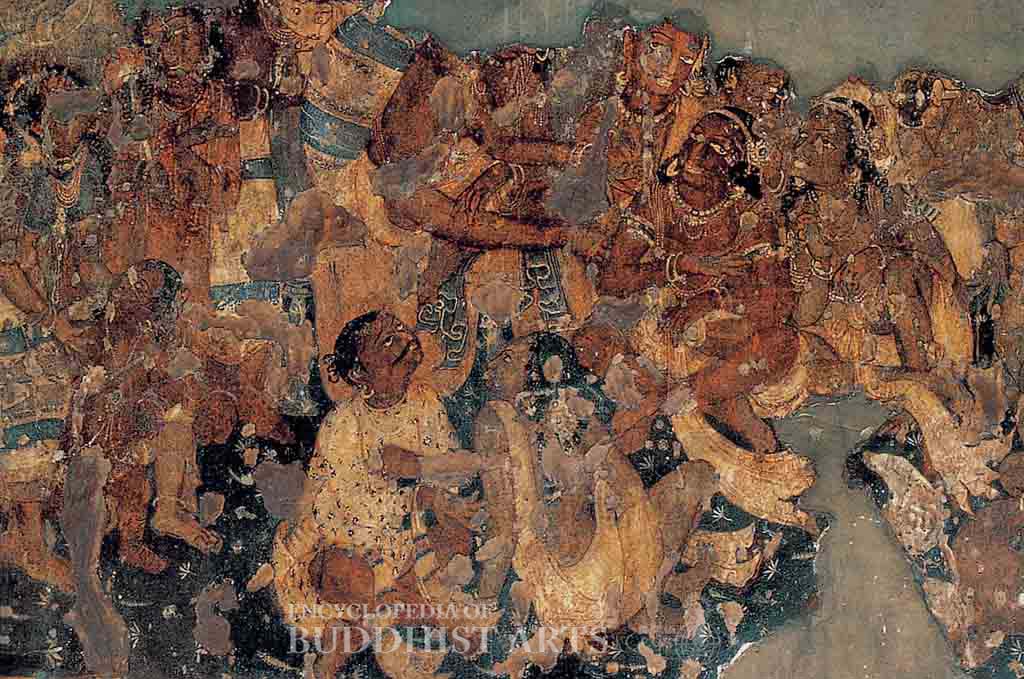
Ajanta Cave 1: Campeya Jataka (detail)
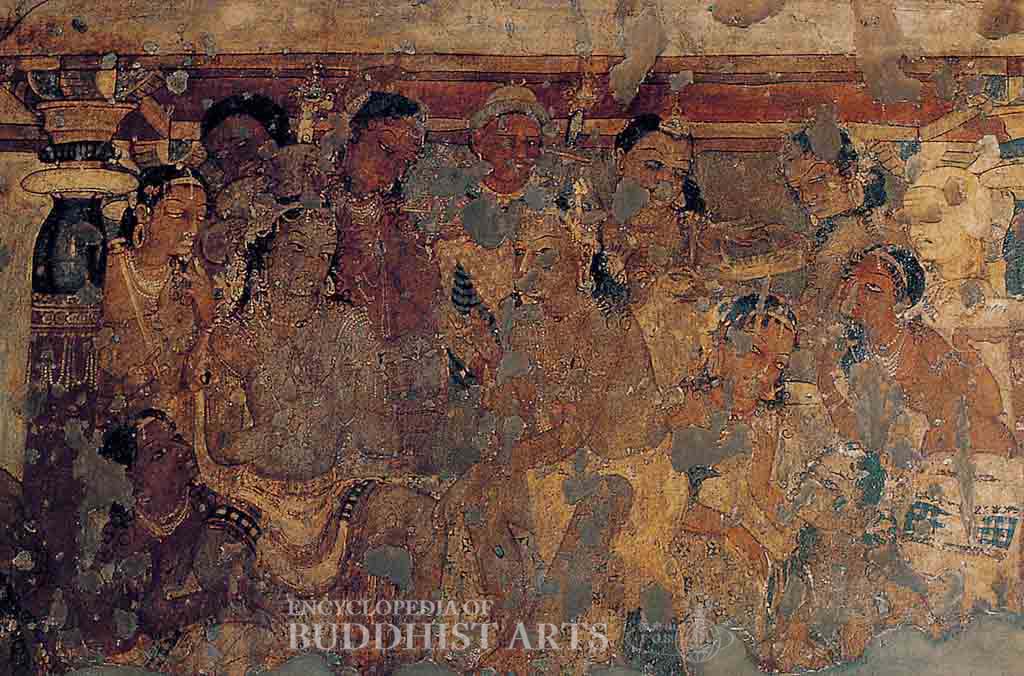
Ajanta Cave 1: Campeya Jataka (detail)
Ajanta Cave 1: Campeya Jataka
INDIA, Maharashtra, Aurangabad
This mural is located on the right side of the back wall within the main hall. The story describing one of the Buddha’s past lives as Campeya is found in the Pali Jataka No. 506. Campeya was a poor man who admired the luxurious life of the naga king of the Campa River. His wish to become a naga king was granted in his next life; however, after a few years, he grew discontented with the life of wealth and riches and turned to the practice of asceticism. One day he laid himself upon an ant-hill, intent to allow the ants to eat his body in order to be rid of his physical form. A Brahmin happened along at this time and captured Campeya in his snake form, taking him to Benares to perform dances for King Uggasena. The naga king’s devoted wife, Sumana, came to rescue him and pleaded with King Uggasena for his release. The king was touched by Sumana’s actions and offered riches to the Brahmin for Campeya’s release. The Brahmin, ashamed of himself, refused the gifts and released Campeya on the spot. Campeya and his wife manifested in human form and taught the Dharma to the king.
The painting depicts the Naga King Campeya first enjoying the pleasures of royal life, then performing as a snake, and finally teaching the Dharma. Much of the mural has deteriorated but the key events are still recognizable, and the vivid expressions of the characters continue to stand out.
For more details, go to the Encyclopedia of Buddhist Arts: Caves A-E, page 12.
Cite this article:
author = Hsingyun and Youheng and Johnson, Peter and Mankuang and Huntington, Susan and Edson, Gary and Neather, Robert,
booktitle = {Encyclopedia of Buddhist Arts: Caves A-E},
pages = 12,
title = {{Ajanta Cave 1: Campeya Jataka}},
volume = 5,
year = {2016}}