
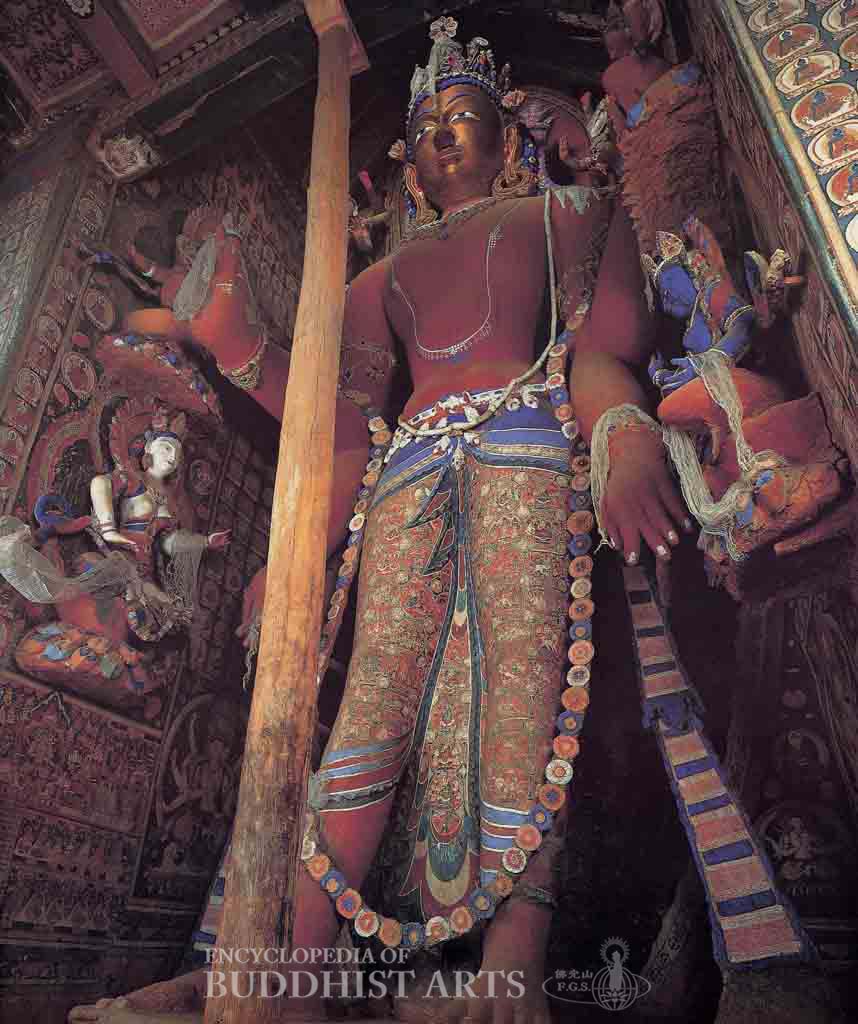
Alchi Monastery Three Story Hall: Painted Dhotis - Maitreya
Color on clay sculptures
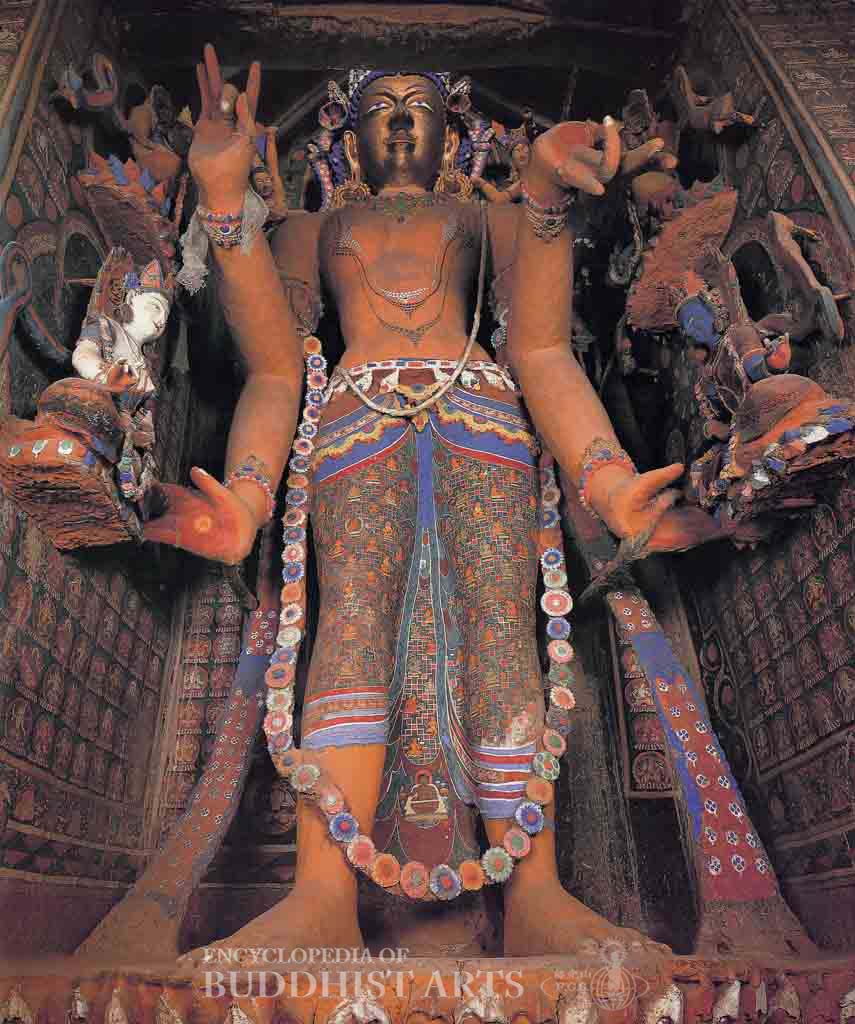
Alchi Monastery Three Story Hall: Painted Dhotis - Manjusri

Alchi Monastery Three Story Hall: Painted Dhotis - Maitreya - Life of the Buddha - Birth of Prince Siddhartha and Initiation by the Naga King
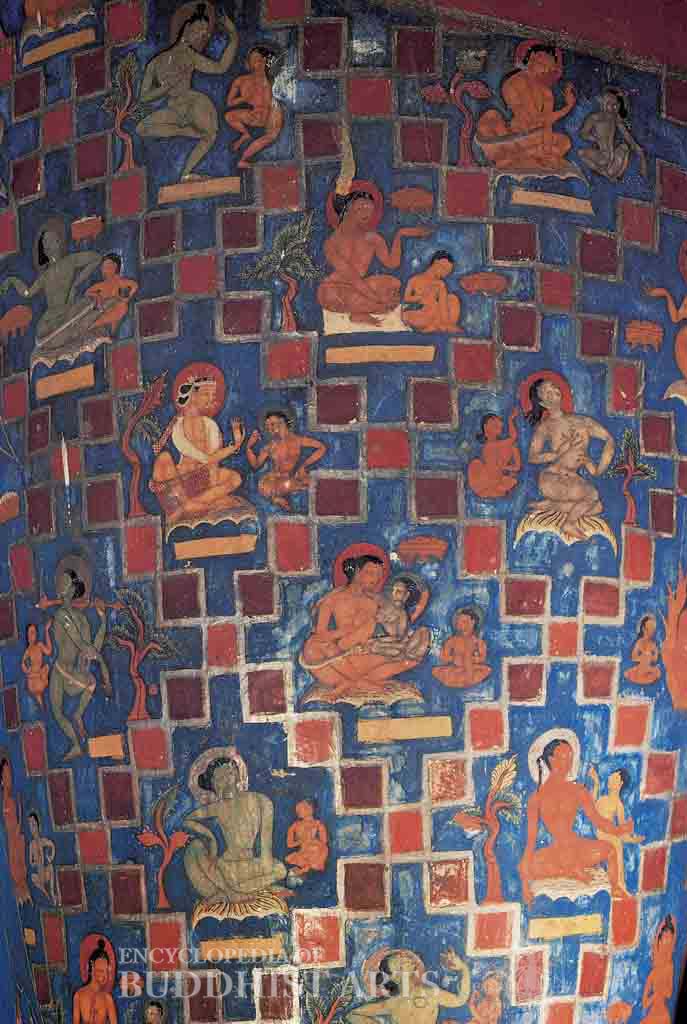
Alchi Monastery Three Story Hall: Painted Dhotis - Manjusri - Mahasiddhas

Alchi Monastery Three Story Hall: Painted Dhotis - Avalokitesvara - Green Tara Hall
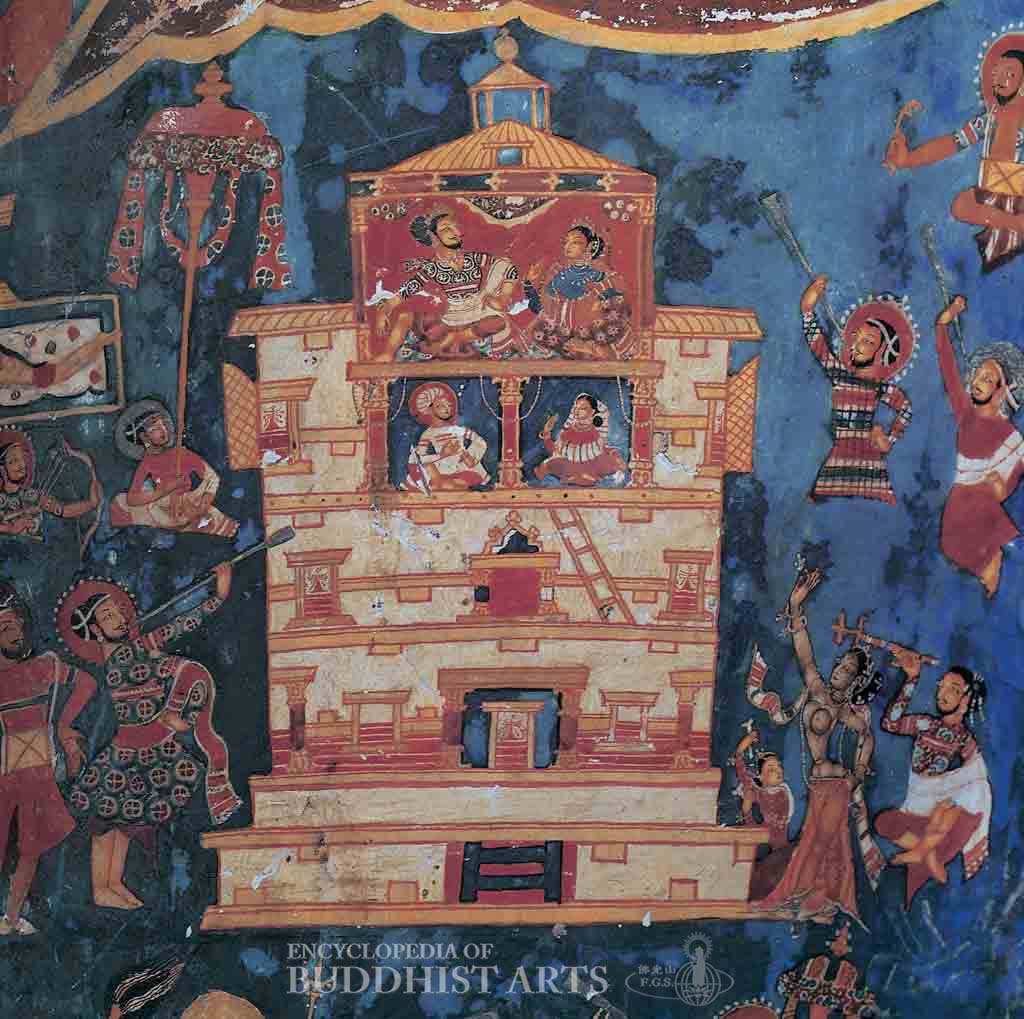
Alchi Monastery Three Story Hall: Painted Dhotis - Avalokitesvara - Palace
Alchi Monastery Three Story Hall: Painted Dhotis
INDIA, Jammu and Kashmir, Ladakh
Statues of Maitreya, Manjusri, and Avalokitesvara Bodhisattvas are enshrined within the large niches on the north, east, and west walls of the first story of the Three Story Hall. The Bodhisattvas wear knee-length dhotis decorated with detailed painted images. The dhoti of Maitreya is covered with neatly arranged circles containing over 60 scenes from the Life of the Buddha, such as Birth of Prince Siddhartha, Initiation by the Naga King, and the Defeat of Mara and Enlightenment. Also included are scenes of the Buddha residing in Tusita Heaven as a Bodhisattva. These scenes seem to symbolize the deeds that Maitreya, the Buddha of the future, will perform when he descends to the world to attain enlightenment and guide sentient beings just as Sakyamuni Buddha did.
The dhoti of Manjusri portrays the great wisdom possessed by the Bodhisattva through images of the 86 mahasiddhas. The images are separated by small, colorful grids. A large seated image of Naropa is painted on the lower hem of the dhoti between Manjusri’s legs.
On the dhoti of Avalokitesvara, there are 14 buildings, including Buddhist monasteries and halls, Indian shrines, palaces, and houses. These buildings contain images of the Buddha, Bodhisattvas, Green Tara, deities, and people from all walks of life, seemingly representative of the compassionate goal of Avalokitesvara to rescue all unenlightened sentient beings. Buddhist and Hindu architecture can be seen side by side, reflecting the religious intermingling in Srinagar, capital of Kashmir, at the time. The detailed depictions of architectural styles and people offer valuable information for the study of culture and art during the 12th century.
For more details, go to the Encyclopedia of Buddhist Arts: Painting A-H, page 20.
Cite this article:
author = Hsingyun and Youheng and Youlu and Wilson, Graham and Manho and Mankuang and Huntington, Susan,
booktitle = {Encyclopedia of Buddhist Arts: Painting A-H},
pages = 20,
title = {{Alchi Monastery Three Story Hall: Painted Dhotis}},
volume = 14,
year = {2016}}