
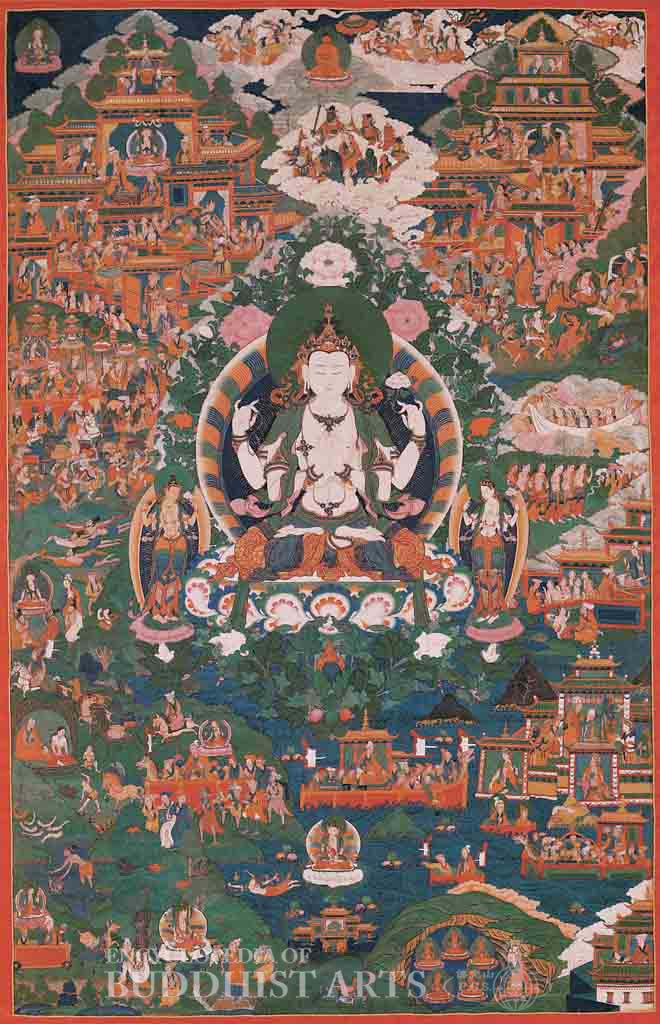
Thimphu Dzong: Biography of Padmasambhava
Ink and color on cotton
Thimphu Dzong: Biography of Padmasambhava
BHUTAN, Thimphu
This is the second in a set of eleven thangkas painted by Gyalse Tenzin Rabgye (reigned 1680–1694), the fourth Druk Desi, or administrative ruler, of Bhutan and a great admirer of Padmasambhava. The majority of the thangkas in the set have an image of Padmasambhava in the center, surrounded by scenes from his legendary life. Padmasambhava is sometimes said to be a manifestation of Avalokitesvara Bodhisattva, so in this painting, Avalokitesvara is the central figure.
The white Bodhisattva sits in lotus position on a lotus throne that rises from a pond. Wearing a pointed golden crown, earrings, and ornaments, Avalokitesvara gazes solemnly at the viewer. Two hands are joined in front of the chest, appearing to hold a wish-fulfilling jewel. The two raised hands carry prayer beads and a lotus. Golden lines of light radiate from the body and fill the aureole. Two smaller images of Four-Armed Avalokitesvara stand on lotus pedestals beside the central figure.
Scenes from the early life of Padmasambhava cover the rest of the thangka. They begin in the water below the central figure and move in a clockwise direction. The first scene shows the benevolent blind Buddhist King Indrabodhi sailing on a boat with a horse’s head on the prow. When his country was beset with famine and pestilence, the king took the suggestion of a sage and ventured forth in a boat in search of treasure. Moved by his sincerity, a naga king gave him a wish-fulfilling jewel, and Indrabodhi regained sight in his left eye. On the journey home, Indrabodhi witnessed Padmasambhava’s birth from a lotus flower and instantly his vision was fully restored. In the painting, Padmasambhava, in the form of Avalokitesvara, is depicted sitting on a lotus in the water. The seven-colored mandorla surrounding him represents his birth. On the lower left, Padmasambhava flies through the air with his arms extended. In the upper corners, there are illustrations of King Indrabodhi and Padmasambhava’s return to the palace, Padmasambhava being adopted by the king and queen, the king’s enshrinement of the jewel he received from the naga king, Padmasambhava’s selection of a wife, and Padmasambhava witnessing the predatory nature of the world, which inspires him to seek enlightenment. In the center of the upper register, Padmasambhava, accompanied by heavenly beings, leaves the palace on a horse borne by clouds, mirroring Prince Siddhartha’s Great Departure. The red Amitabha Buddha sits above this scene. Vajrasattva is depicted in the upper left corner.
For more details, go to the Encyclopedia of Buddhist Arts: Painting P-Z, page 900.
Cite this article:
author = Hsingyun and Youheng and Youlu and Wilson, Graham and Manho and Mankuang and Huntington, Susan,
booktitle = {Encyclopedia of Buddhist Arts: Painting P-Z},
pages = 900,
title = {{Thimphu Dzong: Biography of Padmasambhava}},
volume = 16,
year = {2016}}