

Tashichho Dzong (aerial view)
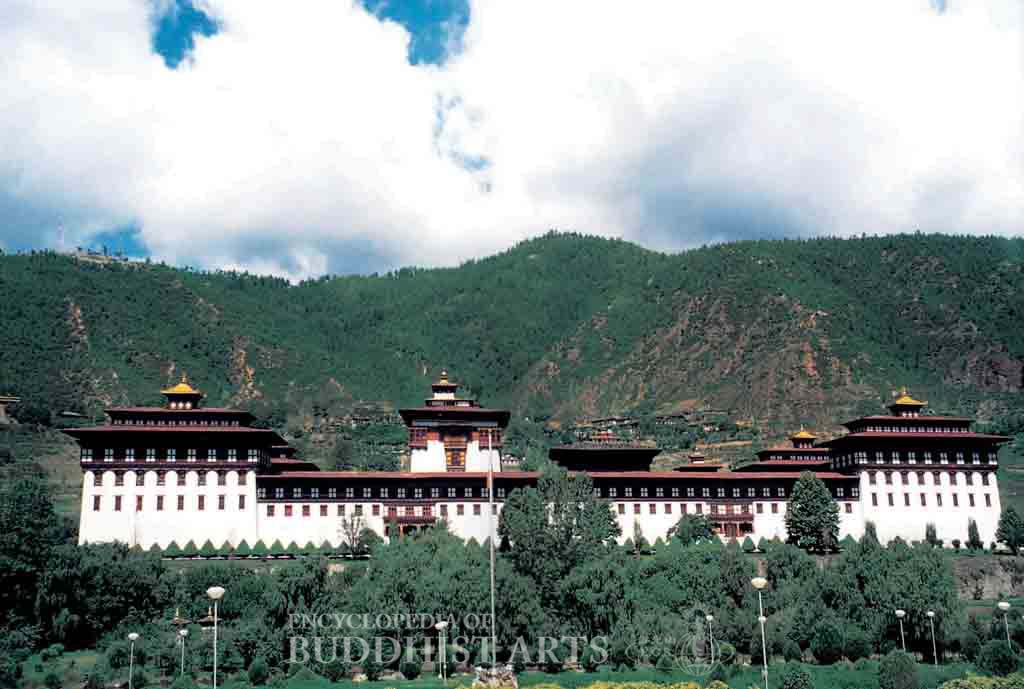
Tashichho Dzong
Tashichho Dzong
BHUTAN, Thimphu
Tashichho Dzong means Fortress of Glorious Religion and it is also called Thimphu Dzong. It is one of the biggest monasteries in the country. In 1641 it was taken over by Shabdrung Ngawang Namgyal (reigned 1616–1651), the first leader who established the dual system of government, which integrated the political and religious affairs of the country. Its name was changed to Tashichho Dzong and monastics and government officials started to live there. In 1961 it was renovated and enlarged by Jigme Dorji Wangchuck (reigned 1952–1972), the third king of Bhutan. Tashichho Dzong is now the seat of Bhutan’s government and religious center of the country. The King, the National Master, and the government ministers live and have their offices there. In the middle of summer each year, the National Master, along with 2,000 monks, reside there and dedicate themselves to spiritual cultivation.
Dzong means a traditional defensive rectangular fortress. Its basic structure consists of several buildings made of brick, stone blocks, and struts forming thick, solid walls. There are several courtyards within. The structure at the center is the highest building. The Tashichho Dzong is a typical example of Bhutanese architecture: the lower walls are white and the upper walls are plain red brick; the brown wooden roofs are decorated with complicated and delicate wood carvings and paintings. The buildings are colorful and magnificent in scale. There are many such Dzongs throughout the valleys of Bhutan.
For more details, go to the Encyclopedia of Buddhist Arts: Architecture T-Z, page 1092.
Cite this article:
author = Hsingyun and Youheng and Johnson, Peter and Mankuang and Lancaster, Lewis,
booktitle = {Encyclopedia of Buddhist Arts: Architecture T-Z},
pages = 1092,
title = {{Tashichho Dzong}},
volume = 4,
year = {2016}}