
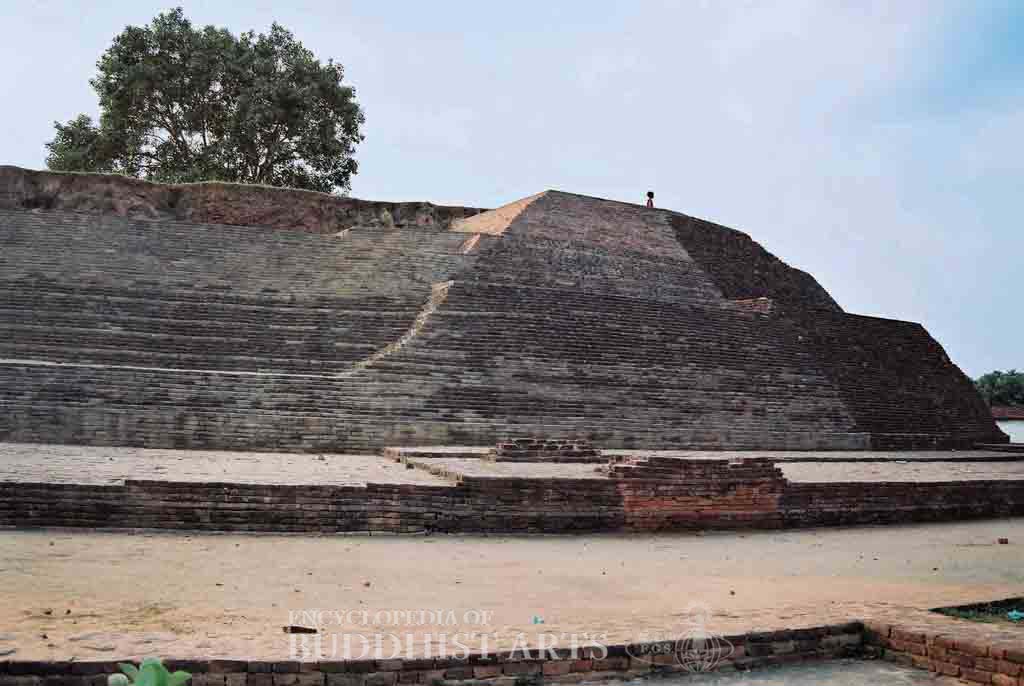
Sujata Stupa
Sujata Stupa
INDIA, Bihar, Bodhgaya
This stupa is set to mark the home of Sujata, the shepherdess who offered a bowl of milk rice to Prince Siddhartha after he had decided to abandon asceticism. Traditionally known as Sujata Kuti, Sujatagarh, and Senanigama, the place is known today as Bakraur. It is situated in the Gaya district on the bank of the Niranjana River, approximately 1 km northeast of Bodhgaya. The exact construction date of the stupa is unknown. According to artifacts found at the site, its earliest occupation dates back to the 2nd century BCE. Excavation has revealed that the stupa was constructed in three phases, with the last phase occurring between the 8th and 10th centuries during the Pala period. Over time the stupa was severely damaged by the villagers removing bricks for building materials. The stupa was discovered and identified by British archaeologist Alexander Cunningham in 1861. Subsequent excavations and renovations were performed by the Archaeological Survey of India between 1973 and 1974, and between 2001 and 2006.
Currently the brick stupa rises to 11 m with a diameter of 46 m. It is approximately circular in shape, with multiple tiers that can be accessed by stairs. Originally, in the first phase, the stupa was made of brick and had a diameter of 55 m. The stupa was enclosed by a brick wall to form a circumambulation path 2 m wide. In the second phase, the size of the stupa was increased in both height and diameter. The enlarged stupa covered up the original stupa and its path, and was faced with molded bricks. A circumambulation path 5 m wide and made of lime plaster was also added. In the third phase, the stupa was covered with lime plaster and the diameter was increased to approximately 65.5 m.
During excavations, archaeologists discovered many artifacts at the stupa and nearby. Among them, several plaster, light-weight plaques of the Buddha forming the bhumisparsa (earth-touching) mudra were the most significant. Other artifacts found include coins, a fragment of an earring made of gold, beads made of agate and terracotta. Some of the unearthed artifacts are in the collection of the Archaeological Museum in Bodhgaya.
For more details, go to the Encyclopedia of Buddhist Arts: Architecture M-S, page 1059.
Cite this article:
author = Hsingyun and Youheng and Johnson, Peter and Mankuang and Lancaster, Lewis,
booktitle = {Encyclopedia of Buddhist Arts: Architecture M-S},
pages = 1059,
title = {{Sujata Stupa}},
volume = 3,
year = {2016}}