
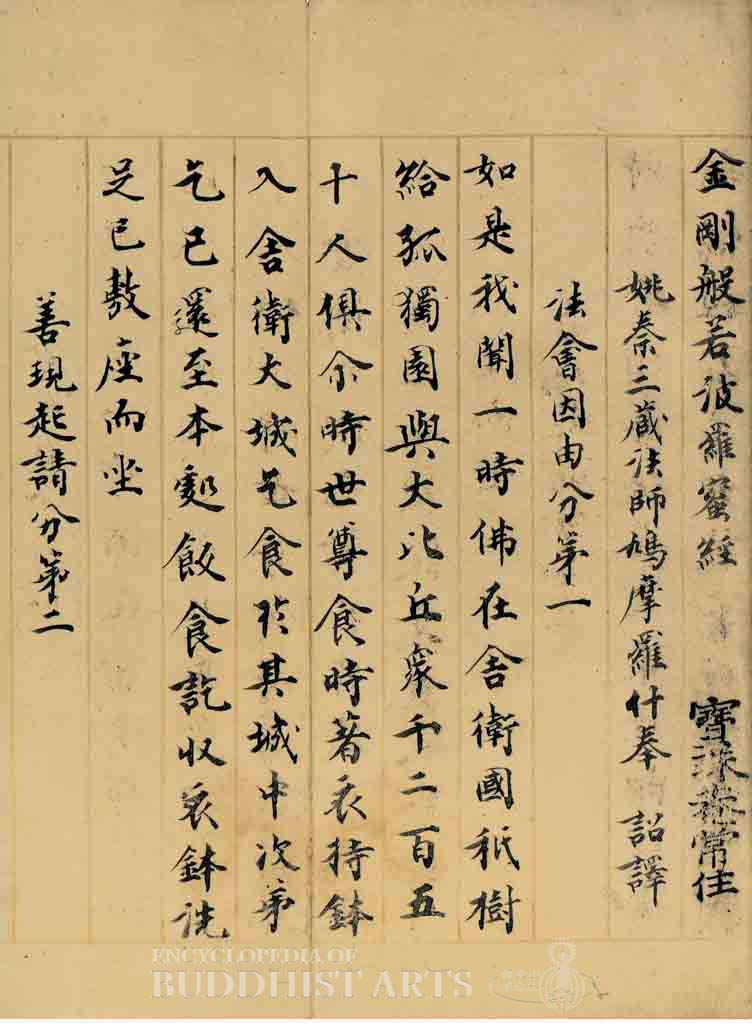
Diamond Sutra (right end section)
Ink on paper
Diamond Sutra
CHINA; Southern Song dynasty
This bound manuscript consists of 37.5 pages, each vertically line in gold and measuring 32.6 cm long by 14 cm high. It was listed as a National Treasure of Japan in 1956.
The regular script style of Zhang Jizhi is readily apparent from the brushwork and formation of characters in this piece. Zhang’s prolific transcripts of Buddhist classics heavily influenced calligraphers in China and Japan, as may be seen here. This work, however, lacks the adeptness and easy flow of Zhang’s stokes, and tends towards more rigidly formed characters and straighter strokes, which may be due to differences in the technique, mastery, and temperament of the calligrapher.
Born in Fuzhou (present day Fuling, Sichuan) during the Southern Song Dynasty (1127–1279), Lanxi Daolong, also known as Rankei Doryo in Japan, was a calligrapher and a monk of the Yangqi branch of Linji school. He traveled to Japan in 1246 and founded the Daikaku branch of the Rinzai school, and was posthumously granted the title of Daikaku Zenji.
For more details, go to the Encyclopedia of Buddhist Arts: Calligraphy, page 52.
Cite this article:
author = Hsingyun and Youheng and Youlu and Pokorski, Stefanie and Mankuang and Edson, Gary,
booktitle = {Encyclopedia of Buddhist Arts: Calligraphy },
pages = 52,
title = {{Diamond Sutra}},
volume = 17,
year = {2016}}