
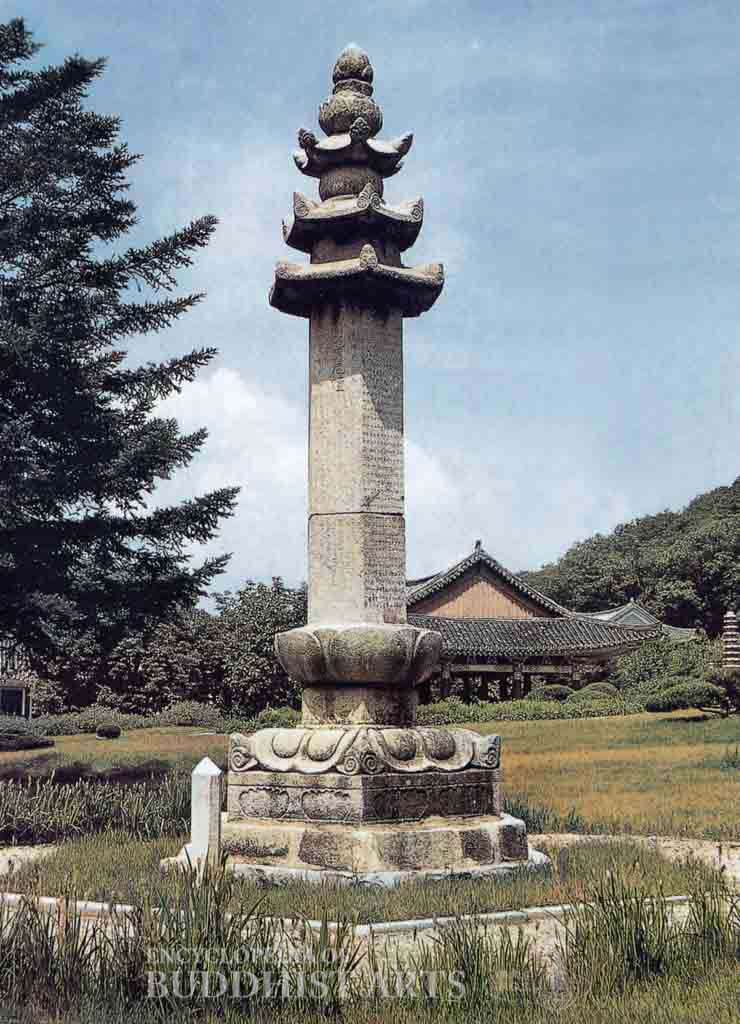
Seongdongri Sutra Pillar
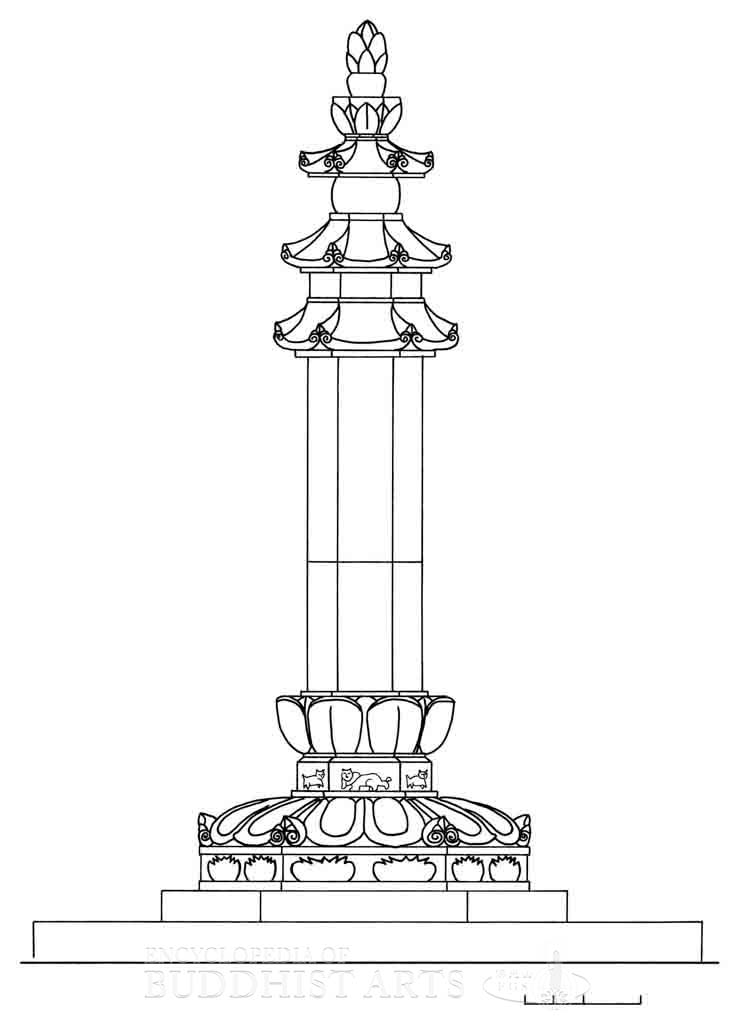
Seongdongri Sutra Pillar (elevation drawing)
Seongdongri Sutra Pillar
NORTH KOREA, North Pyongan, Hyangsan
This sutra pillar was originally situated at Seongdongri village in Pihyeon county. It is currently located at Bohyeonsa (Samantabhadra Temple) on Myohyangsan (Wondrous Fragrance Mountain), in Hyangsan county of the same province. According to the inscriptions found on the pillar, it was erected in 1027 during the Goryeo dynasty, and it is listed as National Treasure No. 59.
The stone pillar consists of a base, body, and spire. The hexagonal base has multiple layers. The bottommost layer consists of an unadorned base, which is followed by a layer decorated with two counter reliefs in the form of floral patterns on each side. Above it there is a layer with pairs of large inverted lotus petals with a floral design in between each pair. The next layer has a carving of a lion on each side. The uppermost layer of the base is in the form of an upright lotus. The body of the pillar is inscribed with the Sitatapatra Dharani Sutra, including its title and content, in 2,388 Sanskrit letters. Above the pillar body there are three hexagonal eaves with floral carvings at their corners. The short pillar between the middle and upper eaves is round rather than hexagonal. The spire consists of an upright lotus followed by a jewel in the shape of a lotus bud. The stone pillar, which is the largest of its kind in North Korea, displays typical features and architectural style of Goryeo dynasty (918–1392) stone structures.
When the stone pillar was relocated, a number of objects, including a small bronze stone pillar and a square bronze mirror, were found underneath its base.
For more details, go to the Encyclopedia of Buddhist Arts: Architecture M-S, page 958.
Cite this article:
author = Hsingyun and Youheng and Johnson, Peter and Mankuang and Lancaster, Lewis,
booktitle = {Encyclopedia of Buddhist Arts: Architecture M-S},
pages = 958,
title = {{Seongdongri Sutra Pillar}},
volume = 3,
year = {2016}}