
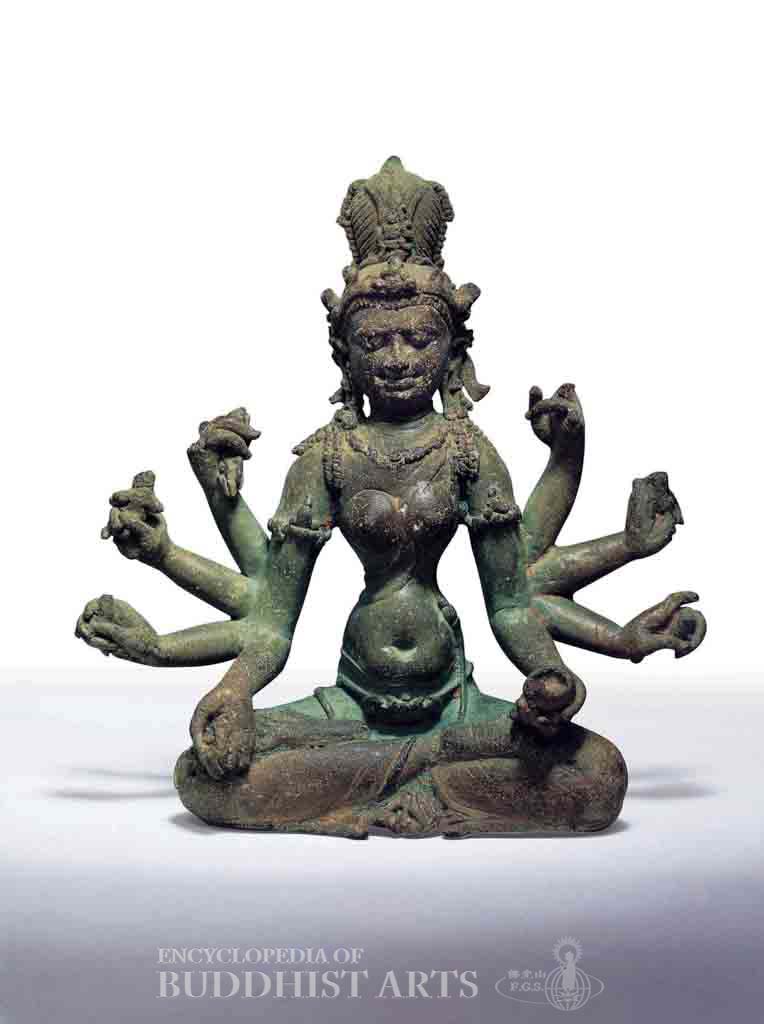
Sumatra: Eight-Armed Avalokitesvara
Copper alloy
Sumatra: Eight-Armed Avalokitesvara
INDONESIA, Sumatra
Sumatra served as a geographical location for naval routes and thus played an important role in the development of art exchanges during the Srivijayan Empire (circa 7th–13th century). Master Yijing of the Chinese Tang dynasty (618–907) traveled twice to Sumatra to study Buddhism between 671 and 695. Sumatra served as the center of Mahayana teachings from the 7th century onward.
This jeweled Bodhisattva has eight arms and wears a tall headdress around a braided topknot, plaits from which scatter over the shoulders. A beaded hairline like those later found in Thai sculpture surrounds the head, and the neck has the three lines of a great person. The figure is unusually disproportionate with an exaggeratedly slim waist. A thin stole winds between the breasts and a long sacred thread runs down the side of the body and crosses over the skirted lap. The Bodhisattva is seated in full lotus position, with eight arms symmetrically splayed about the body. What the hands hold are difficult to identify due to corrosion, but include a vajra at top left and possibly the accompanying ritual bell in the hand opposite.
For more details, go to the Encyclopedia of Buddhist Arts: Sculpture St-Z, page 1176.
Cite this article:
author = Hsingyun and Youheng and Lovelock, Yann and Chou, Yuan and Huntington, Susan and Edson, Gary and Neather, Robert,
booktitle = {Encyclopedia of Buddhist Arts: Sculpture St-Z},
pages = 1176,
title = {{Sumatra: Eight-Armed Avalokitesvara}},
volume = 13,
year = {2016}}