
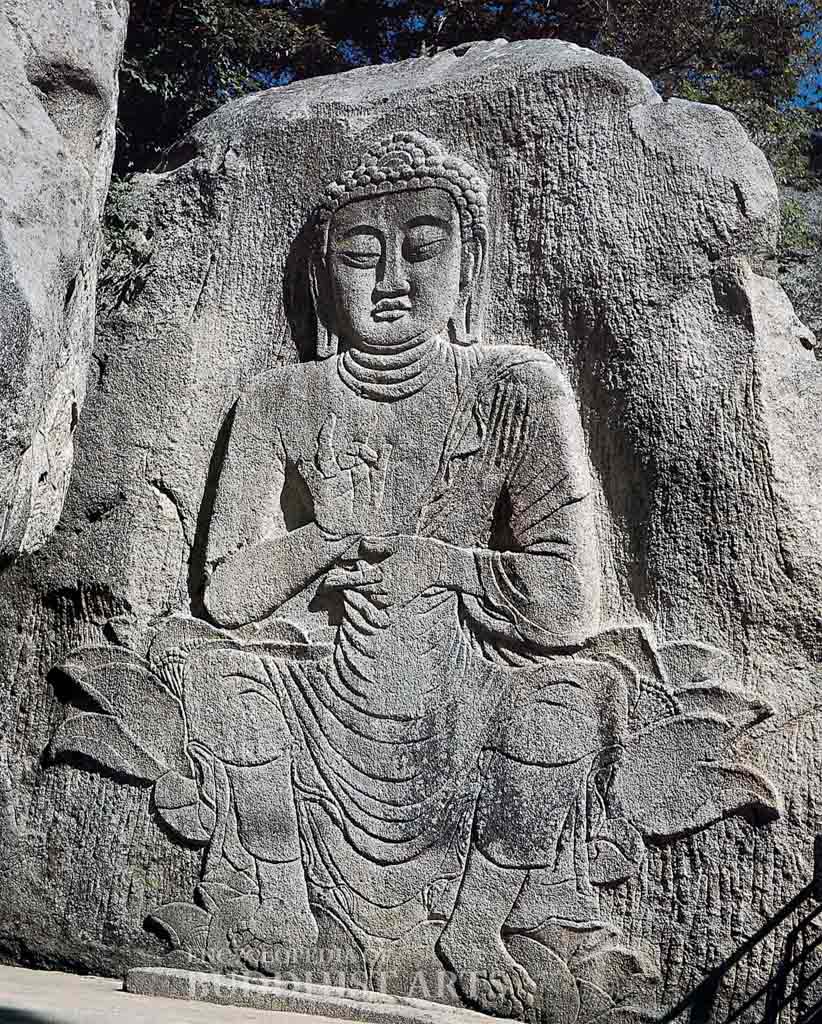
Beopjusa Temple: Seated Buddha
Stone
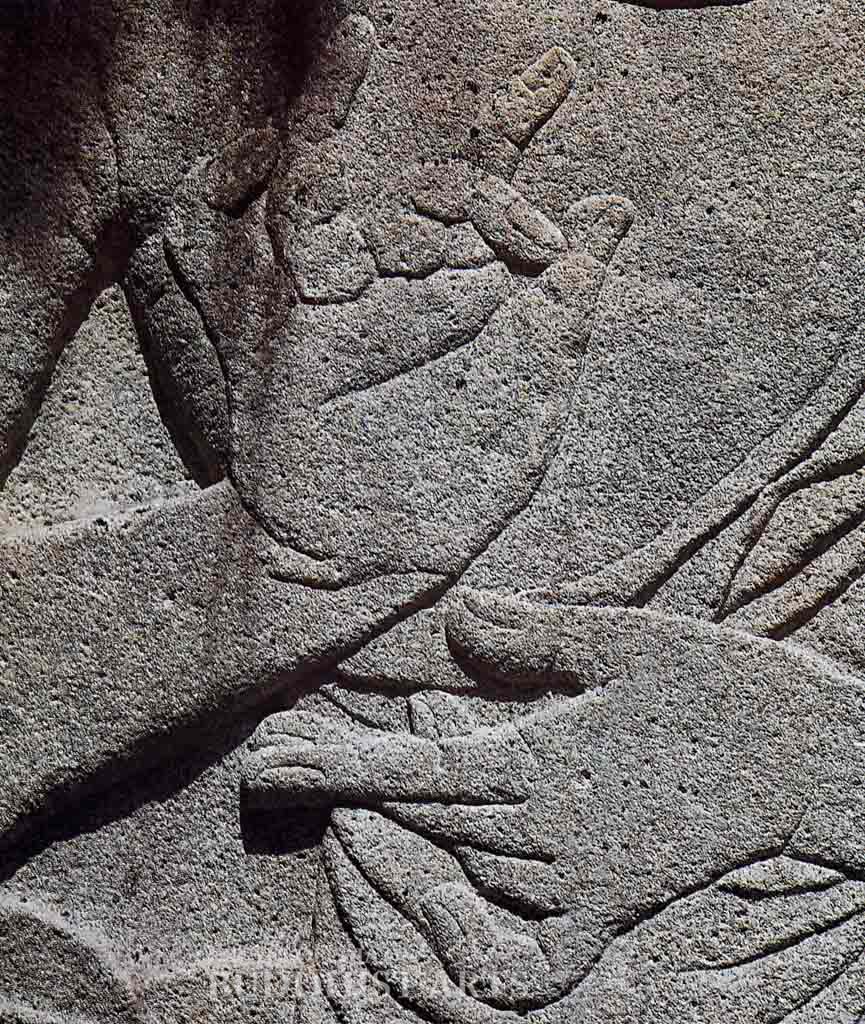
Beopjusa Temple: Seated Buddha - Hands
Beopjusa Temple: Seated Buddha
SOUTH KOREA, North Chungcheong, Boeun; Goryeo dynasty
This bas-relief of a seated Buddha is carved on a high rock to the west of Beopjusa Temple’s Hall of Eight Pictures. It dates from the 11th century and is a representative work of the early Goryeo dynasty (918–1392). The statue was listed as Treasure No. 216 in 1963.
The carving shows marked similarities to the central figure of the Illustration of the Sutra on the Descent of Maitreya by the painter Hoejeon from this period and is therefore presumed to be of Maitreya Buddha. Images of Maitreya seated with legs pendent, though common in China, are rare in Korea. The earliest known image of this kind is the Maitreya Buddha Triad at Samhwaryong from the Silla dynasty (57 BCE–935 CE).
The Buddha is seated on a floating lotus throne with the feet supported on two lotus pedestals. The broad shoulders dwindles to a narrow waist. The right shoulder is bare and the right hand is raised in the vitarka (teaching) mudra.
For more details, go to the Encyclopedia of Buddhist Arts: Caves A-E, page 129.
Cite this article:
author = Hsingyun and Youheng and Johnson, Peter and Mankuang and Huntington, Susan and Edson, Gary and Neather, Robert,
booktitle = {Encyclopedia of Buddhist Arts: Caves A-E},
pages = 129,
title = {{Beopjusa Temple: Seated Buddha}},
volume = 5,
year = {2016}}