
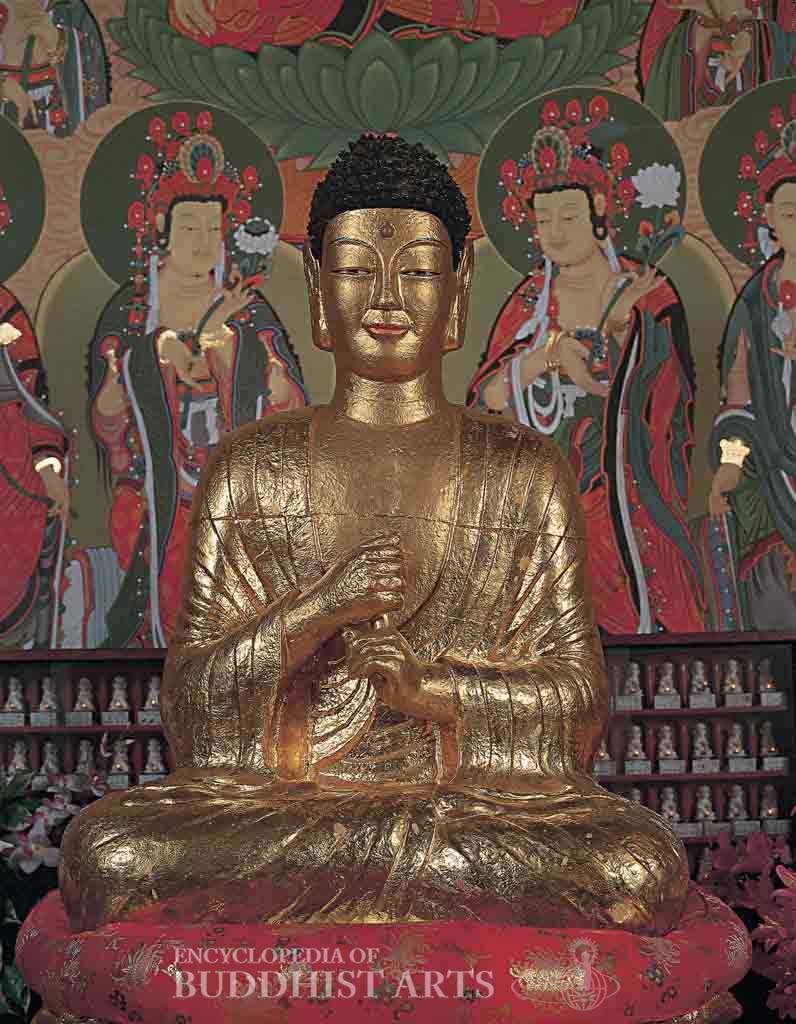
Dopiansa Temple: Vairocana Buddha
Iron
Dopiansa Temple: Vairocana Buddha
SOUTH KOREA, Gangwon, Cheorwon; Unified Silla dynasty
The belief in Vairocana was popular in Korea during the mid-9th century, the time from which the statue dates. A long inscription on the back of the statue states that over 1,500 devotees were involved in its making. The sculpture was listed as National Treasure No. 63 in 1962.
The Buddha sits in full lotus position on a lotus throne with hands forming the bodhyangi (wisdom fist) mudra. The monastic robe covers both the figure’s shoulders, falls over the upper body in parallel folds, and forms circles over the knees. The head section was influenced by the Goryeo dynasty (918–1392) but the style of the body is from Unified Silla (668–935).
For more details, go to the Encyclopedia of Buddhist Arts: Sculpture A-F, page 303.
Cite this article:
Hsingyun, et al. "Dopiansa Temple: Vairocana Buddha." Encyclopedia of Buddhist Arts: Sculpture A-F, vol. 10, 2016, pp. 303.
Hsingyun, Youheng, Yann Lovelock, Yuan Chou, Susan Huntington, Gary Edson, and Robert Neather. 2016. "Dopiansa Temple: Vairocana Buddha" In Encyclopedia of Buddhist Arts: Sculpture A-F, 10:303.
Hsingyun, Youheng, Lovelock, Y., Chou, Y., Huntington, S., Edson, G., & Neather, R.. (2016). Dopiansa Temple: Vairocana Buddha. In Encyclopedia of Buddhist Arts: Sculpture A-F (Vol. 10, pp. 303).
@misc{Hsingyun2016,
author = Hsingyun and Youheng and Lovelock, Yann and Chou, Yuan and Huntington, Susan and Edson, Gary and Neather, Robert,
booktitle = {Encyclopedia of Buddhist Arts: Sculpture A-F},
pages = 303,
title = {{Dopiansa Temple: Vairocana Buddha}},
volume = 10,
year = {2016}}
author = Hsingyun and Youheng and Lovelock, Yann and Chou, Yuan and Huntington, Susan and Edson, Gary and Neather, Robert,
booktitle = {Encyclopedia of Buddhist Arts: Sculpture A-F},
pages = 303,
title = {{Dopiansa Temple: Vairocana Buddha}},
volume = 10,
year = {2016}}