
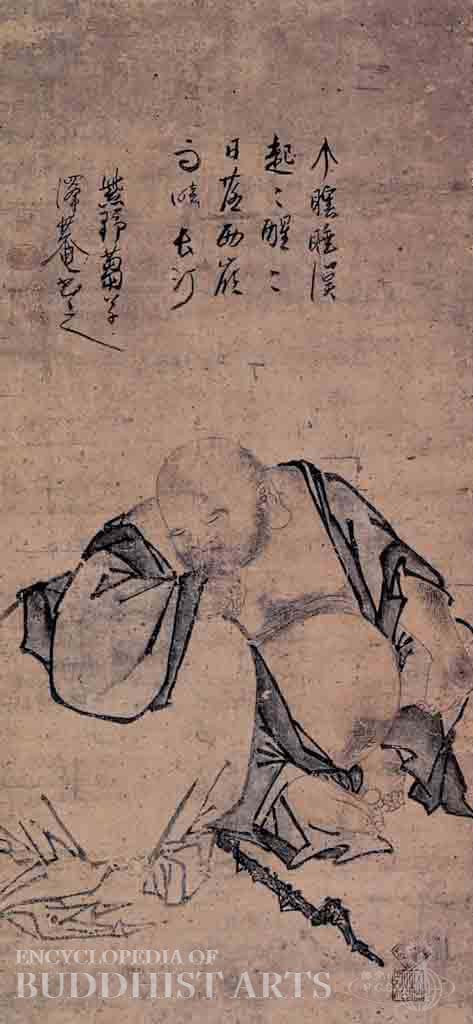
Budai
Ink and color on paper
Budai
JAPAN; Muromachi period
Budai was an eccentric monk thought to have lived in the time of the Five Dynasties (907–960). After he passed away, he came to be venerated as a manifestation of Maitreya Bodhisattva. In Japan, he is recognized as one of the Seven Lucky Gods (Shichi Fukujin), and is said to bestow blessings of treasure and wealth. In the many paintings and sculptures of Budai, he is usually portrayed with a large belly and a cloth sack. This painting, dating from the 15th century, carries the seals of “Tenyu” and “Shokei,” once thought to be two painters with very similar styles but eventually discovered to be the same person, the Japanese artist Shokei. There is an inscription by the Zen master Takuan Soho at the top of the painting. Budai has a short beard, long ears, and a large belly. He leans against his cloth sack, seemingly asleep. His facial features and hair are rendered with fine lines, while the folds of the robe are done with thick, black ink applied with bold brushstrokes. Budai’s facial expression and posture conveys a sense of tranquility and peace.
For more details, go to the Encyclopedia of Buddhist Arts: Painting A-H, page 121.
Cite this article:
author = Hsingyun and Youheng and Youlu and Wilson, Graham and Manho and Mankuang and Huntington, Susan,
booktitle = {Encyclopedia of Buddhist Arts: Painting A-H},
pages = 121,
title = {{Budai}},
volume = 14,
year = {2016}}