
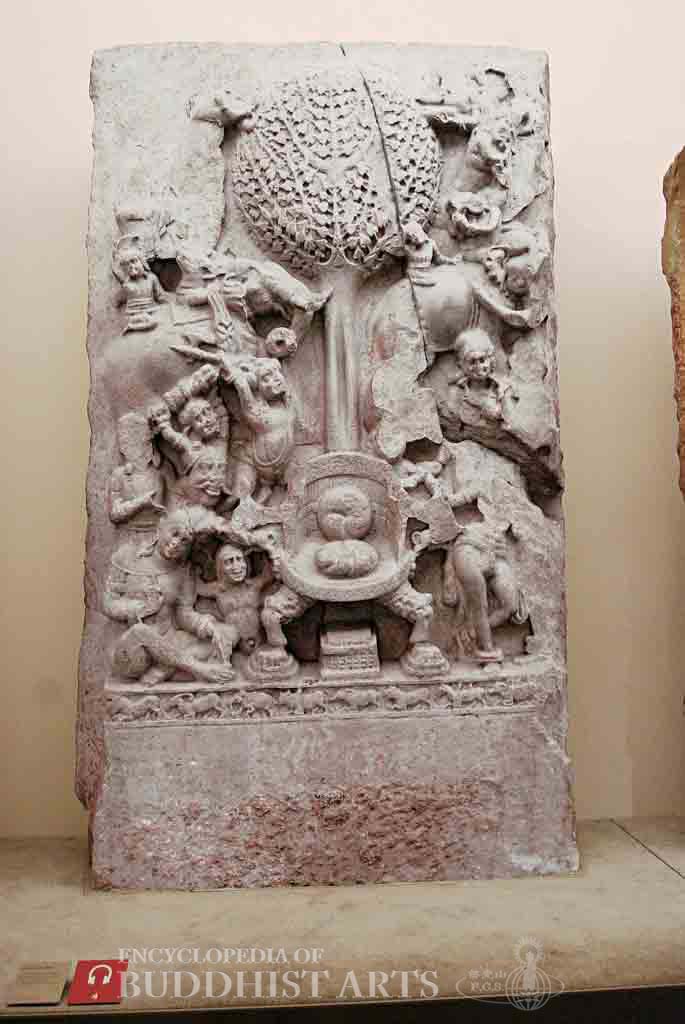
Ghantasala: Life of the Buddha - Defeat of Mara and Enlightenment
Limestone
Ghantasala: Life of the Buddha - Defeat of Mara and Enlightenment
INDIA, Andhra Pradesh, Ghantasala
According to the aniconic theory, the relief depicts Sakyamuni Buddha subduing Mara prior to his enlightenment. The style is believed to have been influenced by the Amaravati style from southern India. The Buddha is represented by an empty throne with the Bodhi tree behind it, as was the custom during the early period of Indian Buddhist art when aniconism was widespread and the Buddha was not represented in human form.
An army of demons are attacking the Buddha on the left side while the upper right side shows the troops withdrawing after their defeat. The damaged relief depicts the daughters of Mara trying in vain to seduce the Buddha. Only the upper torso of one daughter as well as the legs and waist of another remains. The seated figure at the bottom left is the vanquished Mara. Directly beneath this scene is a band of animal carvings.
For more details, go to the Encyclopedia of Buddhist Arts: Sculpture G-M, page 373.
Cite this article:
author = Hsingyun and Youheng and Lovelock, Yann and Chou, Yuan and Huntington, Susan and Edson, Gary and Neather, Robert,
booktitle = {Encyclopedia of Buddhist Arts: Sculpture G-M},
pages = 373,
title = {{Ghantasala: Life of the Buddha - Defeat of Mara and Enlightenment}},
volume = 11,
year = {2016}}