
Swat: Life of the Buddha
Schist
Swat: Life of the Buddha
PAKISTAN, Khyber Pakhtunkhwa, Swat
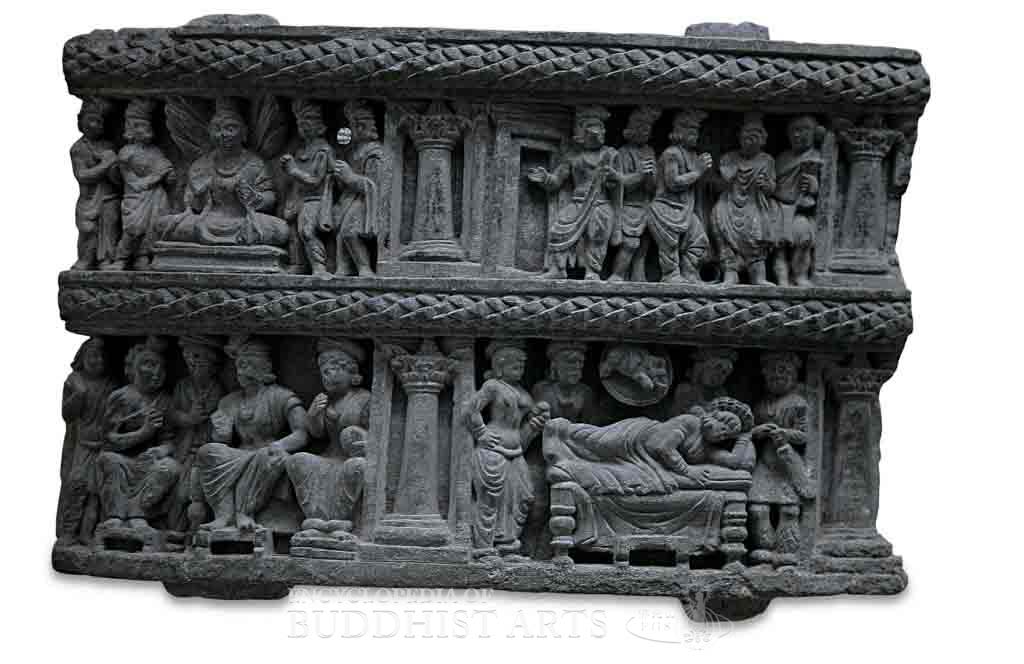
This artwork was unearthed from Swat, which was once part of the greater Gandhara region, and bordered the Greco-Bactrian Kingdom (246–126 BCE). An important trade route from central to western Asia passed through this place. The Greeks heavily influence the sculptures and reliefs found in this region. The important aspect in which they differ; however, is that the narrative order of events proceeds from right to left. This direction is the same in which the local Kharosthi script was written.
Originally part of the decoration of a temple, this carving depicts four scenes from the Life of the Buddha, which are separated by columns in Greek Corinthian style. The right section of the lower register shows Queen Maya’s Dream. She lies on her left side in this relief while the white elephant of her dreams is encased in a nimbus. Her ladies-in-waiting and personal guards stand around the bed. The left section on the same register portrays King Suddhodana asking Asita to interpret Queen Maya’s dream.
The right section on the upper register depicts King Bimbisara of Magadha inviting Sakyamuni to teach following the Buddha’s enlightenment. The figure at the end gestures towards a door, on the other side of which Buddha is seated in full lotus position attended by four turbaned figures. He is most likely teaching the Dharma or is being offered alms by the Four Heavenly Kings.
For more details, go to the Encyclopedia of Buddhist Arts: Sculpture St-Z, page 1179.
Cite this article:
author = Hsingyun and Youheng and Lovelock, Yann and Chou, Yuan and Huntington, Susan and Edson, Gary and Neather, Robert,
booktitle = {Encyclopedia of Buddhist Arts: Sculpture St-Z},
pages = 1179,
title = {{Swat: Life of the Buddha}},
volume = 13,
year = {2016}}