
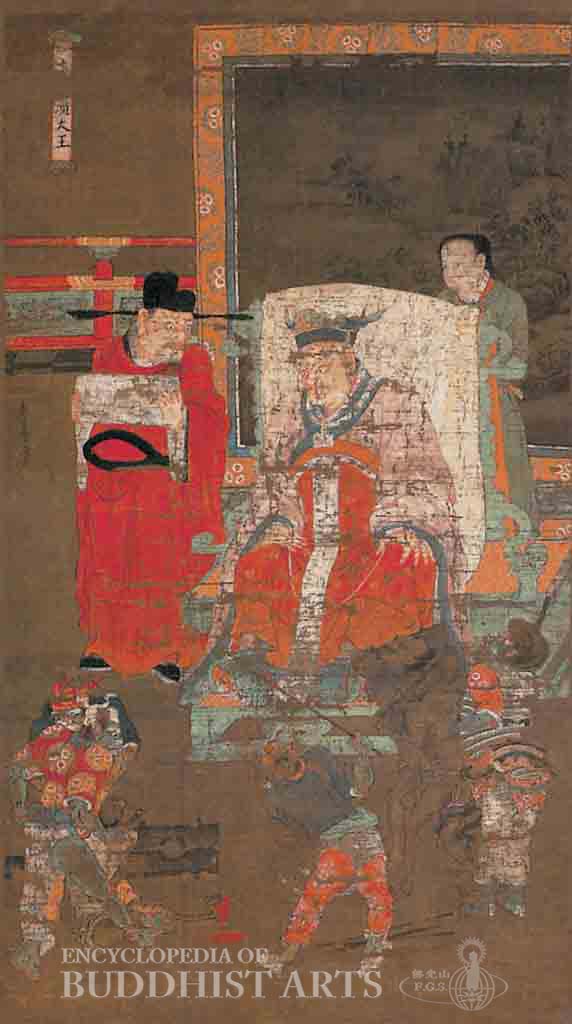
Ten Kings of Hell: King Qinguang
Ink and color on silk
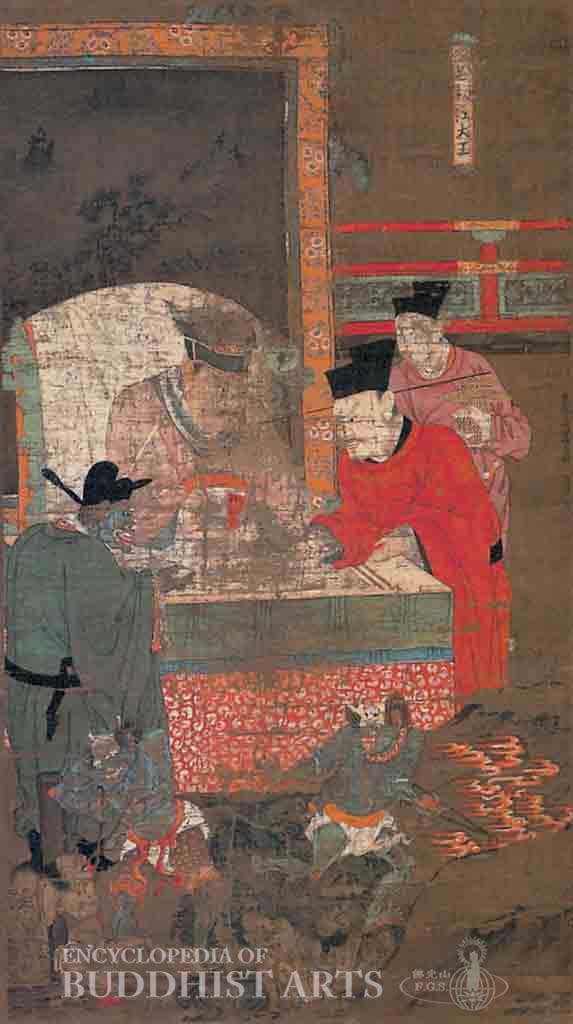
Ten Kings of Hell: King Chujiang
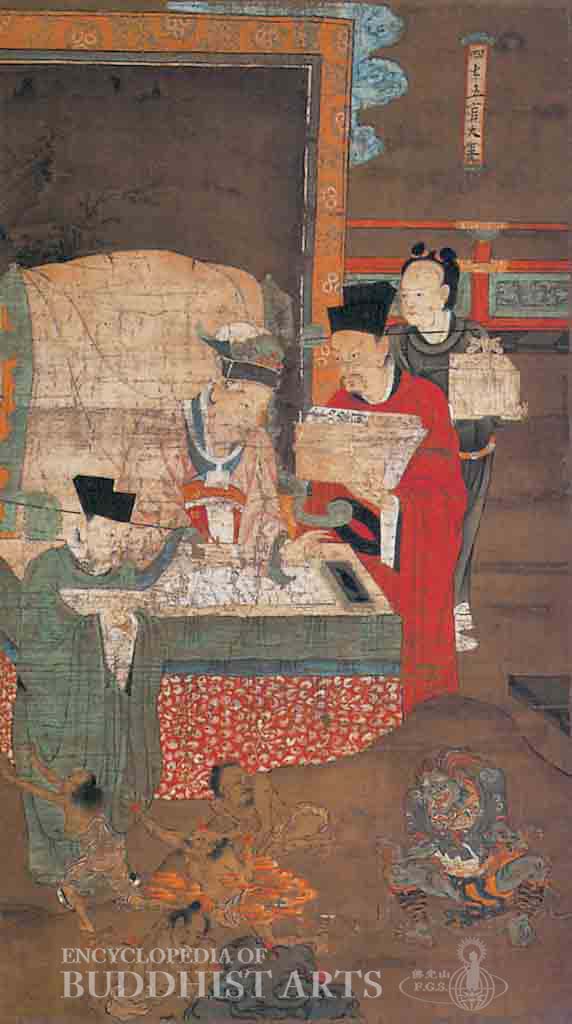
Ten Kings of Hell: King Wuguan
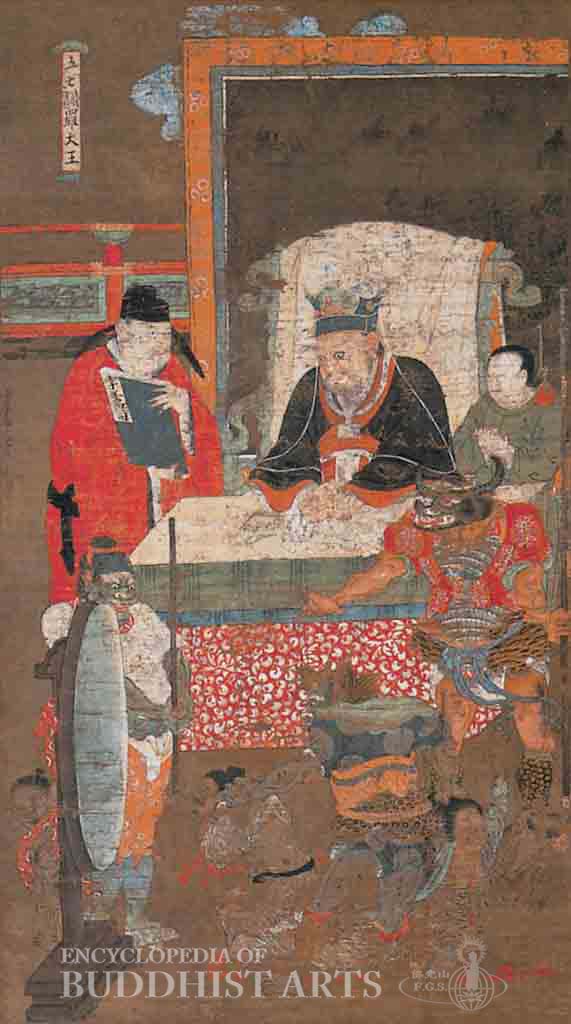
Ten Kings of Hell: King Yama
Ten Kings of Hell
CHINA; Southern Song dynasty
This set of ten paintings is based on the Sutra on the Ten Kings of Hell. According to the sutra, in the first seven days after death, a deceased being will travel to meet the first king, King Qinguang, who decides if they can cross the Naihe River to enter the underworld. During the second week after death, the deceased meets the second king, King Chujiang, and crosses the Naihe River together with an army of other deceased beings, escorted by the ox-headed jailer and hastened by ghost soldiers armed with pitchforks. In the fourth week, the deceased encounters the fourth king, King Wuguan, who carries a scale that weighs misdeeds committed in the previous life. The results are written down by the Recorders of the Good and Evil. In the fifth week, the deceased finally meets the fifth king, King Yama, the ruler of hell. Misdeeds are fully revealed when the deceased looks into the mirror of karmic deeds, and King Yama passes judgment accordingly. The remaining kings act as administrators, presiding over the rebirth of beings in one of the six realms or determining when their sufferings in hell should come to an end.
Each of the ten paintings bears the name of the king of hell it portrays and the signature of the artist, Lu Xinzhong. While the period in which Lu lived is not known for certain, the signature states that he resides in Qingyuan (present day Ningbo, Zhejiang), which was named Mingzhou before 1195 of the Southern Song dynasty (1127–1279). Thus, it can be concluded that the paintings were made no earlier than this date. Many of Lu’s works were later brought to Japan, including this set of paintings, which was listed as an Important Cultural Property in 1977.
The illustrations are richly colored and finely detailed. Each king of hell is portrayed as a stern official, sitting behind a desk and looking down at the small deceased beings below. They are accompanied by finely-dressed attendants and fearsome hell guardians with the heads of animals. The kings in the odd-numbered paintings are turned to the right, while those in the even-numbered paintings are inclined to the left. This suggests that the ten paintings were meant to flank a painting of Ksitigarbha Bodhisattva.
Belief in the Ten Kings of Hell began between the Late Tang period (846–907) and the Five Dynasties (907–960). However, there are many different accounts of the origin of the Ten Kings. Both Chronicle of Sakyamuni Lineage and Chronicle of the Buddha and Patriarchs describe how the Tang dynasty monk Daoming traveled to Hell and encountered the ten kings passing judgments on the karmic deeds of deceased beings. Upon his return, he warned everyone he met about the judgment they would face after death, and Ten Kings of Hell became widely known. According to the Chronicle of Sakyamuni Lineage, the Ten Kings of Hell were first painted by Zhang Guolao of the Tang dynasty. His pictures were subsequently used as models by artists in Dunhuang, Korea, and Japan, many of whose works are preserved today. The oldest known illustration of Ksitigarbha and the Ten Kings of Hell is a silk painting found in Mogao Cave 17 dating from 983 of the Northern Song dynasty. It is currently kept in the Guimet Museum of Asian Art in Paris, France.
For more details, go to the Encyclopedia of Buddhist Arts: Painting P-Z, page 897.
Cite this article:
author = Hsingyun and Youheng and Youlu and Wilson, Graham and Manho and Mankuang and Huntington, Susan,
booktitle = {Encyclopedia of Buddhist Arts: Painting P-Z},
pages = 897,
title = {{Ten Kings of Hell}},
volume = 16,
year = {2016}}