
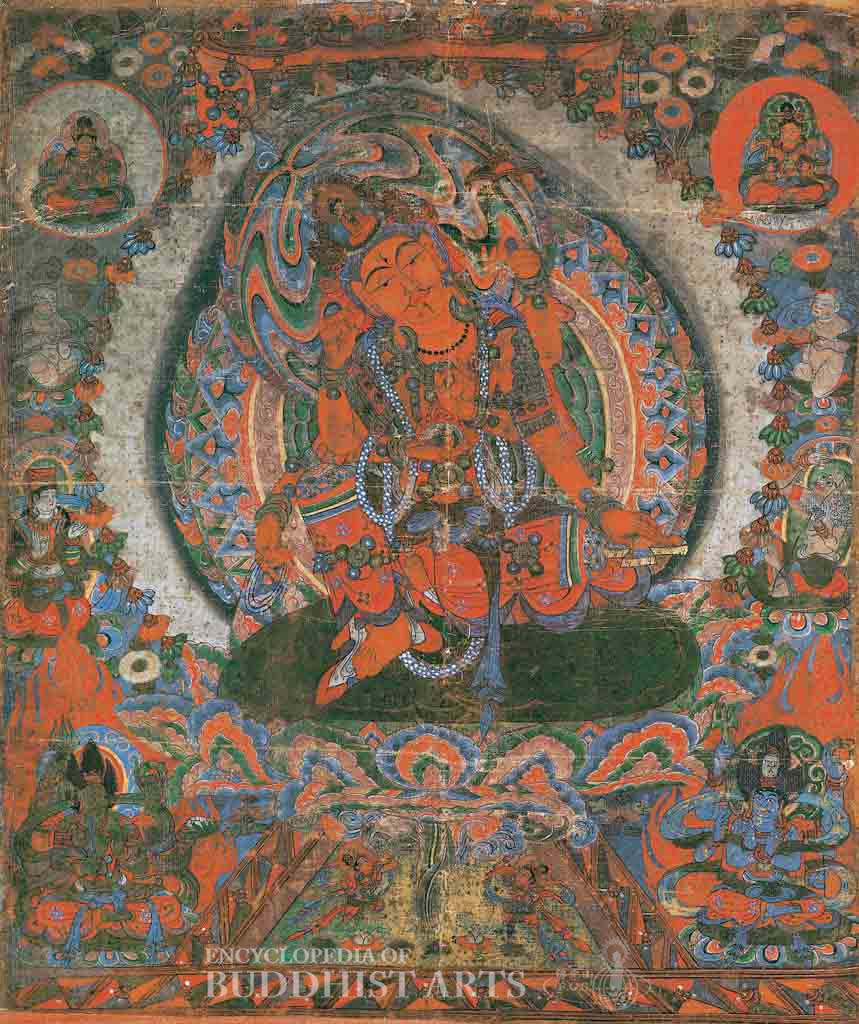
Mogao Cave 17: Cintamanicakra Avalokitesvara
Ink and color on silk
Mogao Cave 17: Cintamanicakra Avalokitesvara
CHINA, Gansu, Dunhuang; Five Dynasties
In this brightly colored painting from Mogao Cave 17, the red Cintamanicakra Avalokitesvara Bodhisattva sits in royal ease posture on a lotus throne. The head, topped with a headdress decorated with a Buddha image, is tilted to one side. There is a third eye between the eyebrows. The body is covered with ornaments. A thin blue stole is draped over the neck and around the arms. The six hands form mudras or hold objects. A cintamani (wish-fulfilling jewel) is held in front of the chest with one of the right hands. Cintamanicakra is usually identified by the emblems of the wish-fulfilling jewel and the cakra (wheel), however, no wheel is visible in this painting.
The nimbus is filled with swirling colors, the aureole is decorated with several layers of intricate patterns, and the white mandorla is bordered with flowers. There are eight figures around the Bodhisattva, one in each corner and four along the sides. Surya and Candra are in the upper corners, contained within large mandorlas. Ucchusma and Kundali, portrayed with multiple arms and patterned nimbuses, sit in the lower corners. Beside the Bodhisattva, two children born from lotuses are painted above Mahadevi and Vasu.
For more details, go to the Encyclopedia of Buddhist Arts: Painting I-O, page 578.
Cite this article:
author = Hsingyun and Youheng and Youlu and Wilson, Graham and Manho and Mankuang and Huntington, Susan,
booktitle = {Encyclopedia of Buddhist Arts: Painting I-O},
pages = 578,
title = {{Mogao Cave 17: Cintamanicakra Avalokitesvara}},
volume = 15,
year = {2016}}