
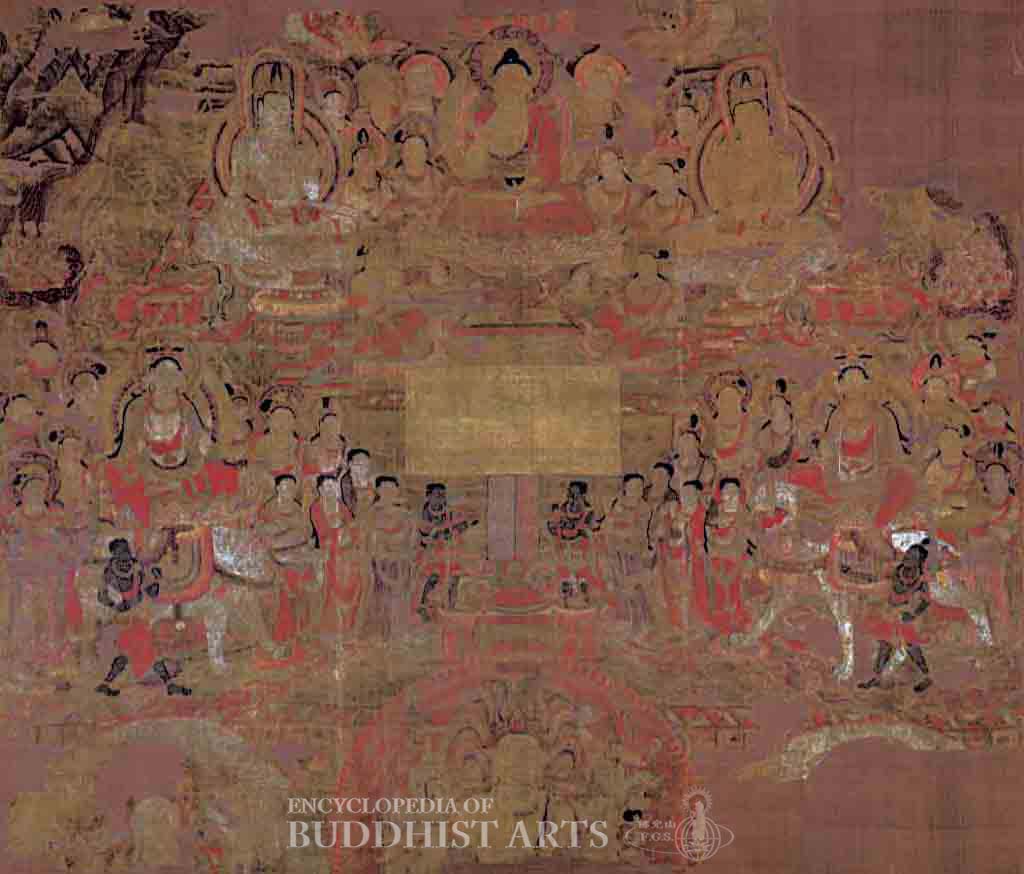
Mogao Cave 17: Medicine Buddha with Manjusri and Samantabhadra Bodhisattvas
Ink and color on silk
Mogao Cave 17: Medicine Buddha with Manjusri and Samantabhadra Bodhisattvas
CHINA, Gansu, Dunhuang; Tang dynasty
This is the only remaining piece of what was once a large silk painting. Although the inscription in the center is almost completely faded, infrared photography has revealed both Chinese and Tibetan writing. The Chinese characters identify the figures and dedicate the painting to the deceased parents of the sponsor. According to the Tibetan inscription, the sponsor was a monk, and the painting dates from 836, during the Tibetan occupation of Dunhuang (781–847).
The Medicine Buddha is in the center of the upper register, accompanied by two Bodhisattvas and a large retinue of attendants. Below, Manjusri and Samantabhadra Bodhisattvas, riding on a lion and an elephant respectively, are depicted in traditional Chinese style, surrounded by attendants. The badly damaged lower register appears to contain images of Thousand-Armed, Thousand-Eyed Avalokitesvara, Cintamanicakra Avalokitesvara, and Amoghapasa Avalokitesvara.
For more details, go to the Encyclopedia of Buddhist Arts: Painting I-O, page 643.
Cite this article:
author = Hsingyun and Youheng and Youlu and Wilson, Graham and Manho and Mankuang and Huntington, Susan,
booktitle = {Encyclopedia of Buddhist Arts: Painting I-O},
pages = 643,
title = {{Mogao Cave 17: Medicine Buddha with Manjusri and Samantabhadra Bodhisattvas}},
volume = 15,
year = {2016}}